GlowGuide GTM Strategy v2
Deep market research, data-refined ICPs, and a complete acquisition-through-activation playbook.
February 2026
The Opportunity
Answering: "Is the market real?"
Executive Summary
The market is real. The product thesis is sound. Three problems stand between ~500 users and a fundable growth trajectory.
The Three Critical Problems
The Timing Mismatch
Women download GlowGuide from a paid ad but don't have a treatment to track right now. The app's core value (VP2: tracking) requires something to track, but paid ads reach people at random moments in their treatment cycle.
The 30% Onboarding Drop-Off
Of users who install, 30% never complete onboarding. The selfie capture, quiz length, and account creation wall each add friction before any value is delivered.
Near-Zero GEM Contribution
Almost no users reach a Glow Evidence Moment -- the point where they track progress 1-2 times post-treatment. Without GEMs, there is no proof the product thesis works, no shareable content for viral loops, and no data for the investor narrative.
The Unified Strategy
The strategy solves all three problems simultaneously by:
- (a) Acquiring users at the moment of treatment via in-clinic B2B2C
- (b) Holding timing-mismatched users via VP1 value and email nurture
- (c) Reducing onboarding to 3 taps before value delivery
- (d) Building an automated milestone-based lifecycle system that shepherds users from install to GEM with minimal friction
Growth Operating Principles
Fix the funnel before filling it
Onboarding and activation must improve before scaling paid acquisition.
Separate the GTM question from the product question
Day 40 diagnostic: if in-clinic users have 3-5x higher GEM rates, it's a GTM problem. If neither cohort has GEMs, it's a product problem.
Treat GEMs as the only metric that matters
Everything upstream feeds into GEM contribution rate. Everything downstream flows from it.
Respect the timing mismatch
VP1 holds users until they have something to track. In-clinic acquires at the moment of treatment.
Don't monetize prematurely
Prove the product thesis with GEMs before introducing subscription or monetization.
Use the brand advantage
GlowGuide's brand feels like a trusted friend, not a corporate app. Founder-led content and community over feature lists.
Think in cohorts, not averages
Every user tagged by acquisition source, VP entry, and persona proxy. All metrics analyzed at cohort level.
The Market
A $25.47B US market growing at 9.86% CAGR with zero direct competitors in post-treatment tracking.
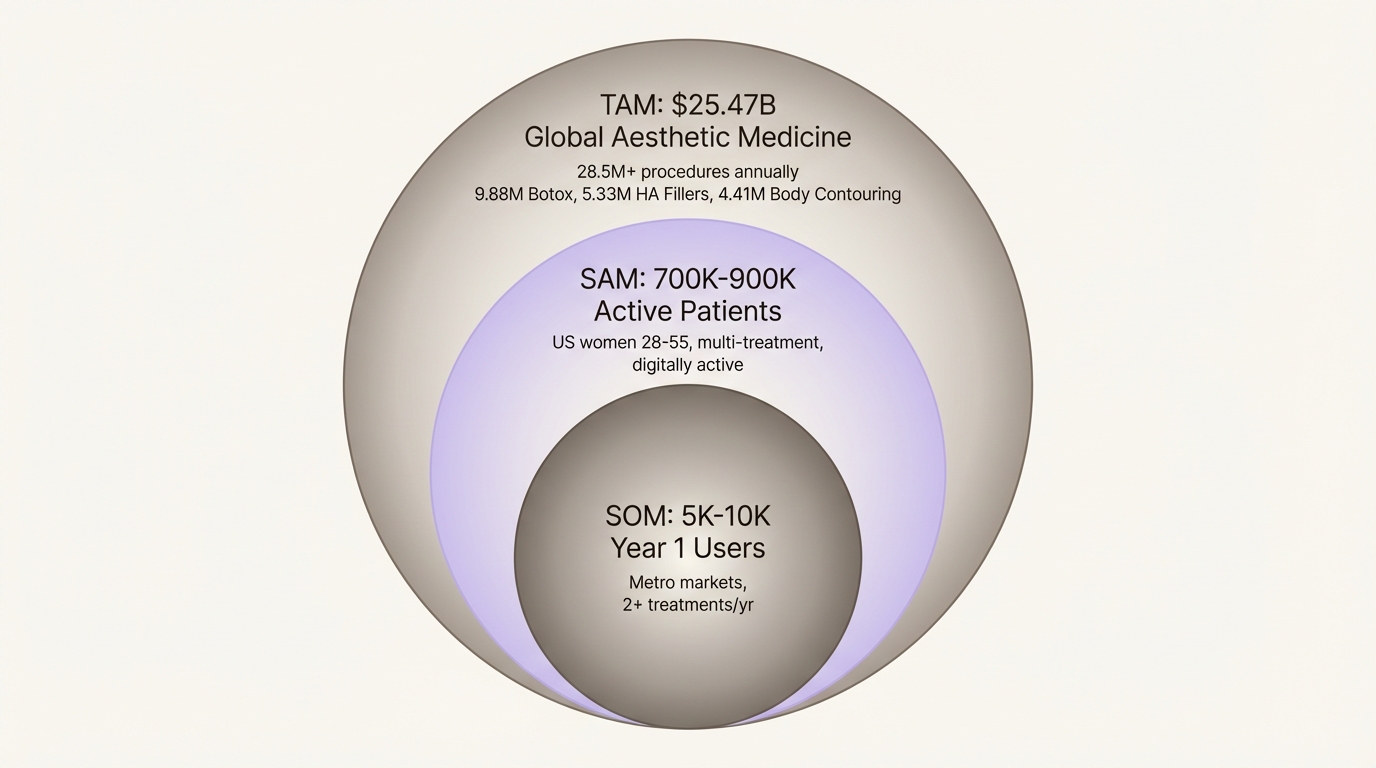
GlowGuide market sizing: from $25.47B total market to ~700K-900K high-fit potential users
Total Addressable Market (TAM)
The US medical aesthetics market was valued at $25.47 billion in 2025, projected to reach $65.24 billion by 2035 at a CAGR of 9.86% (Precedence Research). Non-surgical aesthetics spending reached $17.5 billion in 2024, up from $15.1 billion in 2022 (Guidepoint/Qsight).
TAM: Multiple Sources Triangulated
| Source | US Market Value (2024-2025) | Projected Value | CAGR | Notes |
|---|---|---|---|---|
| Precedence Research | $25.47B (2025) | $65.24B by 2035 | 9.86% | Broadest: devices + injectables + services |
| MarketsandMarkets | $7.62B (2024) | $16.38B by 2030 | 13.6% | Narrower: devices + injectables, excludes service fees |
| IMARC Group | $4.1B (2024) | $8.8B by 2033 | 8.7% | Narrowest: medical aesthetics devices only |
| Custom Market Insights | ~$10B (2024) | ~$20B+ by 2030 | ~12% | Mid-range estimate |
Why the range matters
The $4.1B-$25.47B spread reflects different market definitions. GlowGuide's TAM includes full consumer spend on non-surgical treatments ($25.47B), because the app tracks the entire treatment lifecycle -- not just devices or injectables.
| Metric | Value | Source |
|---|---|---|
| US medical aesthetics market (2025) | $25.47B | Precedence Research |
| US non-surgical procedures market (2024) | $17.5B | Guidepoint/Qsight |
| US facial injectables market (2026 est.) | $7.83B | Fortune Business Insights |
| Global facial injectables market (2024) | $12.53B | Grand View Research |
| Annual US non-surgical procedures (2024) | 28.5M+ | ASPS 2024 Report |
| US women receiving treatments annually | 20M+ | Industry Analysis |
GlowGuide-Specific TAM
20M+ American women receive aesthetic treatments annually. At a digital health app ARPU of $30-100/year, the consumer software TAM is $600M-$2B. This excludes B2B revenue (provider analytics, sponsored listings), which could add $500M+ at scale.
Serviceable Addressable Market (SAM)
GlowGuide's SAM narrows to women aged 30-55, HHI $100K+, in urban/suburban Tier 1-2 US metros, who receive non-surgical treatments and are iOS users.
| Filter | Population | Source |
|---|---|---|
| US women receiving non-surgical treatments | ~17M | ASPS 2024 (85% of 20M+) |
| Aged 30-55 (peak treatment years) | ~8.5M | ASPS: avg Botox patient age 43, peak 35-50 |
| HHI $100K+ in Tier 1-2 metros | ~3.4M | Census ACS, ~40% of age-filtered demo |
| iOS users (affluent skew) | ~2.2M | ~65% iOS share among affluent US women |
| Willing to use a tracking app | ~660K-880K | ~30-40% digital health adoption rate |
Serviceable Obtainable Market (SOM)
| Metric | Target | Basis |
|---|---|---|
| Engaged users (12-month) | 5,000-10,000 | 10-20x current base |
| Revenue (subscription Month 6-7) | $50K-$100K ARR | Mostly affiliate + early subscription |
| SOM as % of SAM | <1% | Massive headroom |
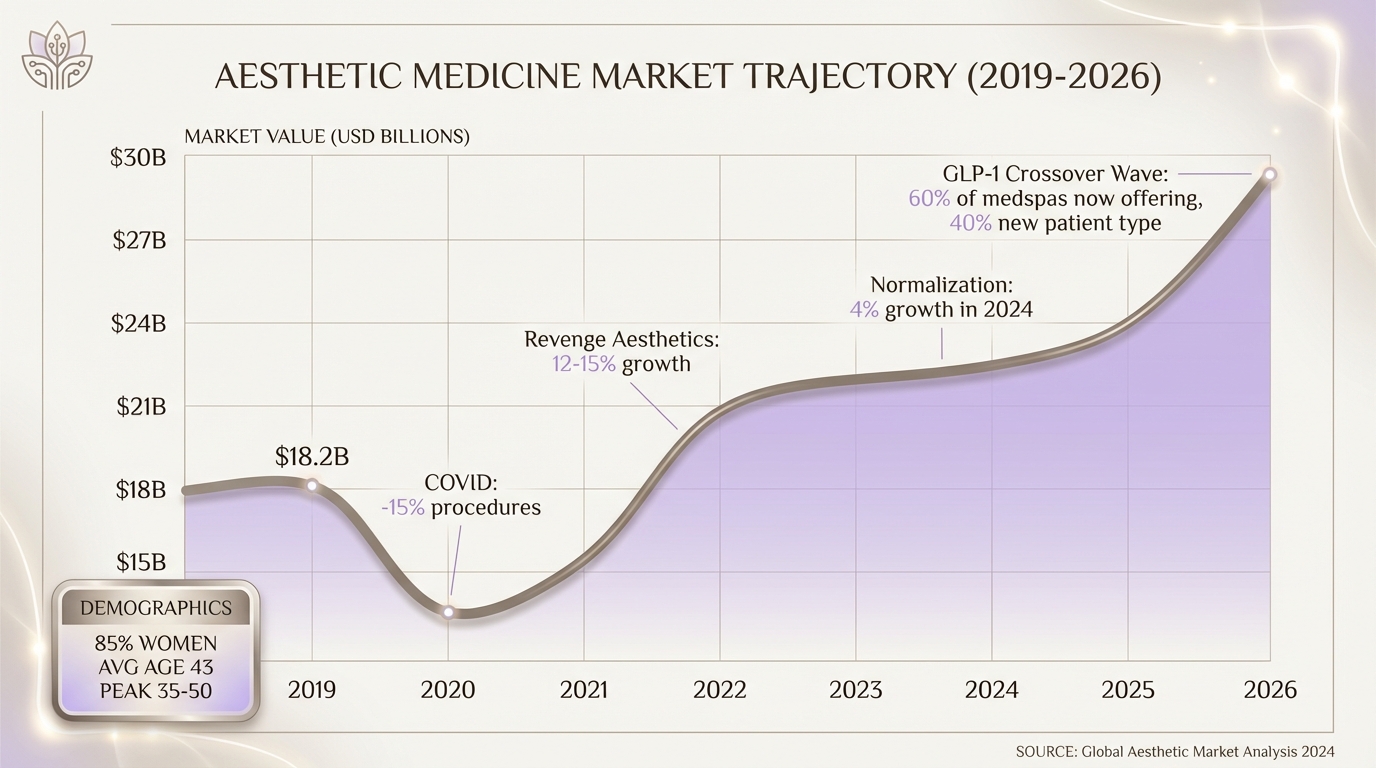
US non-surgical aesthetics market trajectory: from pandemic crash to mature growth
Market Growth Trajectory (2019-2026)
| Year | US Non-Surgical Market | YoY Growth | Key Event |
|---|---|---|---|
| 2019 | ~$12B | Baseline | Pre-pandemic peak |
| 2020 | ~$9B | -25% | COVID shutdown, procedure pause |
| 2021 | ~$13B | +44% | "Zoom boom" -- video call self-awareness drove demand |
| 2022 | ~$15.1B | +16% | Revenge spending + normalization |
| 2023 | ~$16.5B | +9% | Growth decelerating; economic caution |
| 2024 | ~$17.5B | +4-6% | Stabilization; GLP-1 crossover begins |
| 2025 (est.) | ~$18.5B | +4-5% | Mature growth; spending rose 4% through Q3 |
| 2026 (proj.) | ~$19.5-20B | +5-6% | Expected rebound as GLP-1 body contouring accelerates |
Key Takeaway
The market shifted from pandemic-era hypergrowth (44% in 2021) to mature, steady growth (4-6%). Mature markets with predictable spending favor utility tools over hype-driven products.
Procedure Volume Data (2024, ASPS)
| Procedure Category | 2024 Volume | YoY Growth | Share of Non-Surgical |
|---|---|---|---|
| Neuromodulators (Botox, Dysport, Xeomin) | 9,883,711 | +4% | 34.7% |
| HA fillers (Juvederm, Restylane) | 5,331,426 | +1% | 18.7% |
| Non-HA fillers (Sculptra, Radiesse) | 932,861 | +1% | 3.3% |
| Skin resurfacing (all types) | Not specified | +6% | Growing category |
| Total minimally invasive | 28.5M+ | +3% | -- |
Key Market Drivers
Non-Surgical Dominance
Non-surgical procedures now represent 62% of total medical aesthetics treatments worldwide (ISAPS 2024). Lower risk, minimal downtime, and lower cost drive adoption.
Demographic Expansion
Gen Z share grew from 4% to 10% of aesthetic patients (2017-2024). "Prejuvenation" pulls younger demographics in earlier. The 30-54 age group remains ~50% of all procedures.
GLP-1 Crossover
60% of medspas offered GLP-1 treatments by end of 2024. 40% of GLP-1 patients are entirely new to aesthetics. Revenue at GLP-1-offering practices increased 9% vs. 2% decline at non-offering practices.
Med Spa Proliferation & Consolidation
Only 3% of med spas are PE-owned, but consolidation expected to increase ~10% over 4-5 years. MedSpa Partners acquired 40+ clinics backed by $275M from Morgan Stanley PE -- ideal B2B2C partners.
Consumer Sophistication
BCG identified six distinct consumer types (2024). 1 in 3 Americans plan to increase appearance spending in 2025. Women spend an average of $1,064/year on appearance maintenance.
Normalization
Treatment discussion has moved from private to public. 1,158 posts matching "first time botox" in 12 months across just 4 subreddits. Women with HHI $100K+ are 15% more likely to say cosmetic procedures are "normal."
Consumer Demographics
| Demographic | Data | Source |
|---|---|---|
| Gender split | 85% women, 15% men (growing) | ASPS |
| Average Botox patient age | 43 years old | Industry data |
| Peak treatment age range | 35-50 (~50% of procedures) | ASPS |
| Gen Z share (growing) | 10% (up from 4% in 2017) | Guidepoint |
| Average annual spend (regular user) | $3,600-$12,000+ | Industry estimates |
| Average injectable visit cost | $400-$800 | Market data |
| Treatment frequency (Botox) | Every 3-4 months | Standard protocol |
| Treatment frequency (HA filler) | Every 6-12 months | Standard protocol |
Market Headwinds
| Headwind | Severity | Impact on GlowGuide |
|---|---|---|
| Growth deceleration (4% vs. 12-15% pre-2023) | Medium | Slower user pool expansion, but still growing |
| Filler volume softening (+1% vs. neurotoxins +4%) | Low | Botox is primary use case; fillers secondary |
| Beauty tech funding drop (71.6% decline in 2025) | High | Tougher fundraising; must show strong metrics |
| GLP-1 growth deceleration (55% in 2024 vs. 235% in 2023) | Low | Still net positive for new patient acquisition |
| Body contouring decline (~50% below 2019 peak) | Low | GlowGuide focuses on face/neck, not body |
| Provider pricing pressure (56% cite barriers) | Medium | Cost-conscious consumers need ROI tracking more |
| Regulatory uncertainty (FDA & AI) | Low-Medium | Tracking, not diagnosing -- lower risk |
Geographic Concentration
| Tier | Markets | Relevance |
|---|---|---|
| Tier 1 | San Francisco/Bay Area, Los Angeles, San Diego | Current focus. 4 medspa partnerships. Highest target demo density. |
| Tier 2 | Scottsdale/Phoenix, Dallas, Miami, New York, Atlanta | Top medspa-density metros. Phase 2 expansion if in-clinic works. |
| Tier 3 | Nashville, Denver, Austin, Houston, Seattle | High-growth markets with emerging medspa scenes. |
Seasonal Patterns & Timing Windows
| Season | Treatment Pattern | GlowGuide Opportunity |
|---|---|---|
| Jan-Feb | "New Year, New Me" resolutions. Botox bookings spike. | Acquisition: align paid ads with New Year intent |
| Mar-May | Pre-summer prep. Laser, peels, body contouring peak. | Content: "Get ready for summer" treatment guides |
| Jun-Aug | Maintenance mode. Botox rebooking. Less new patients. | Retention: smart reminders, check-ins, rebooking nudges |
| Sep-Oct | Post-summer repair. Fall skin treatments. | Acquisition + re-engagement: "Undo summer damage" |
| Nov-Dec | Holiday events, parties. Gift-giving. | In-clinic activation: holiday event partnerships |
Market Maturity Assessment
| Dimension | Assessment | Evidence |
|---|---|---|
| Market size | Large and growing | $25.47B US market, 9.86% CAGR to 2035 |
| Growth phase | Late growth / early maturation | 4% growth in 2025 vs. 12-15% in 2021-2022 |
| Competition in tracking | Blue ocean | Zero direct competitors |
| Competition in adjacent | Crowded | RealSelf, Alle, Cherry, provider EMRs |
| Consumer awareness | Problem aware, solution unaware | Women struggle but don't know a tool could exist |
| Technology readiness | High | iOS, photo AI, push notifications all mature |
| Category creation required | Yes | Must educate that tracking is a category |
Bottom Line
GlowGuide operates in a large, growing, maturing market with zero direct competition in its niche. The window for category creation is open now -- but a competitor could enter within 12-24 months. Speed matters.
The Competitive Landscape
Zero direct competitors in post-treatment tracking. The biggest threat isn't another app -- it's inertia.
The Zero-Competitor Paradox
There are zero direct competitors in post-treatment aesthetic tracking. This is simultaneously GlowGuide's greatest opportunity and its greatest risk. No existing app offers: structured treatment history across providers, standardized before/after capture with metadata, personalized duration prediction, cross-treatment ROI analysis, or treatment-specific reminders based on personal patterns. This is a genuine blue ocean. But blue oceans require category creation -- consumers are "problem aware, solution unaware."
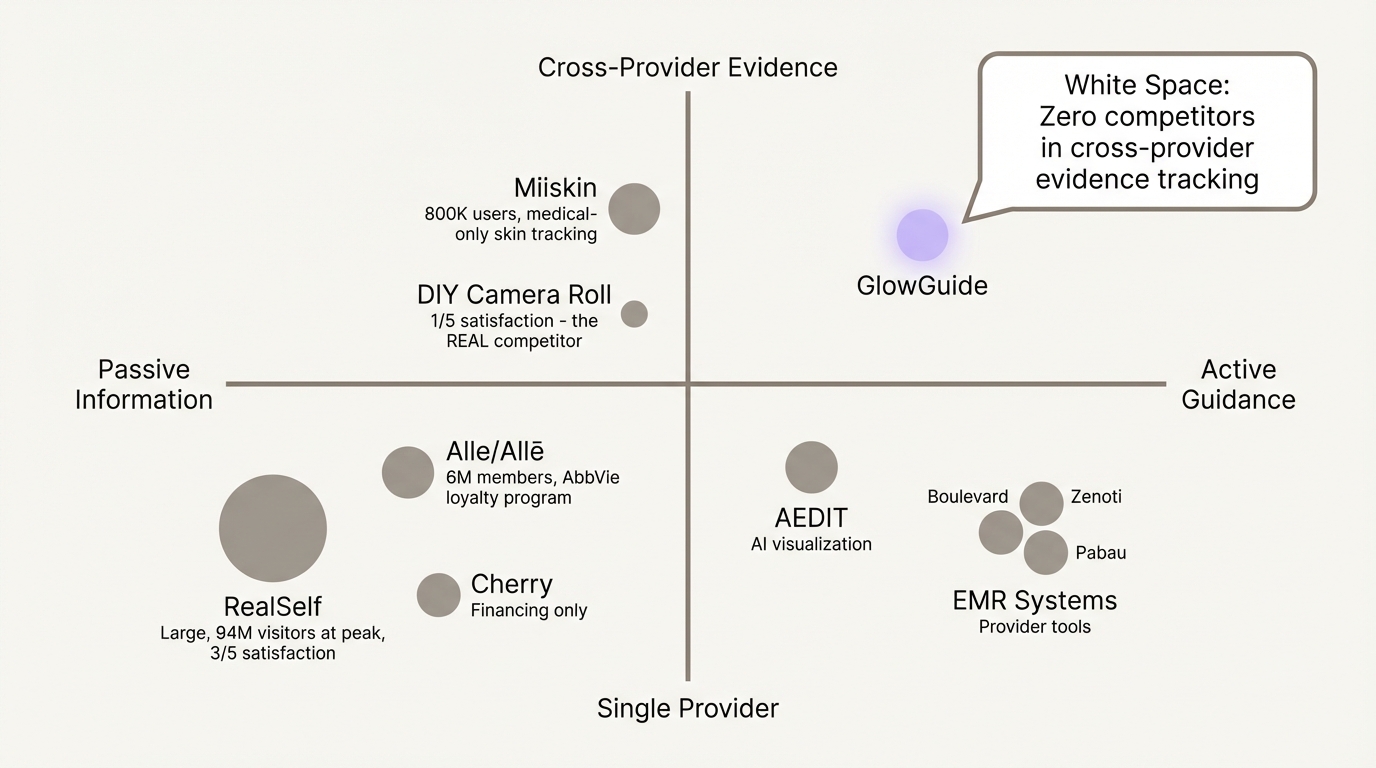
GlowGuide occupies the upper-right quadrant: personal tracking in the post-treatment phase. No existing player occupies this space.
Adjacent / Indirect Competitor Deep-Dives
RealSelf
Pre-Treatment Research Threat: Medium| What they do | Online community for cosmetic treatment research: reviews, before/after photos, provider directory, treatment information. "Yelp + WebMD for cosmetic procedures." |
| Founded / Funding | Founded 2006; $41M raised over 4 rounds, Series C in 2018 ($40M from Elephant). No reported funding since. New female CEO (Minou Clark) hired September 2024. HQ relocated to New York in 2025 with major rebrand. |
| User base | 2M+ reviews, 30K+ registered providers. Historically 94M annual visitors (2017 peak). Recent traffic likely declined. |
| Revenue model | Sponsored provider listings (Yelp-style). Providers pay $300-$1,500/month for premium placement. |
| Strengths | Massive content library (8,000+ before/after images). Brand recognition. SEO dominance on treatment queries. First-mover in aesthetic reviews. |
| Weaknesses | Reviews are provider-incentivized (credibility erosion). Pre-treatment only -- no post-treatment tracking. No mobile-first experience. Stagnant innovation since 2018. 2025 rebrand suggests identity crisis. User satisfaction: 3/5. |
| GlowGuide user gap | Claire wants to track her OWN results, not read reviews. Priya can research but can't get personalized guidance. Megan won't spend hours reading. No personal history, no reminders, no progress photos. |
| Threat assessment | Could add "My Treatment Tracker" but DNA is community/reviews, not health tracking. 2025 rebrand and new CEO suggest focus on revitalizing core business, not new product categories. |
Alle (Allergan Aesthetics)
Loyalty & Rewards Threat: High| What they do | Loyalty rewards program for Allergan products (Botox, Juvederm, CoolSculpting, SkinMedica). Points on treatments, redeemable for savings. Alle Wallet for digital checkout. Recently expanded to 40+ brands beyond Allergan. |
| Parent | Owned by AbbVie (acquired Allergan for $63B in 2020). Effectively unlimited resources. |
| User base | 6M+ members across 19,000 practices. 92% satisfaction rate. Largest aesthetics consumer platform in the US. |
| Revenue model | Drives Allergan product sales. Customer retention tool for a $16B+ aesthetics division. |
| Strengths | Massive user base (6M). Deep provider network (19K). Parent company resources. Brand recognition. Cherry financing integration. |
| Weaknesses | Primarily rewards/loyalty, not tracking. Limited to purchase tracking, not treatment efficacy. No before/after photos, no duration predictions, no cross-provider history. User satisfaction: 2/5. 2025 program restructuring caused provider and patient backlash. |
| GlowGuide user gap | Alle tells Claire she earned 200 points. It doesn't tell her whether her $400 Botox is wearing off faster than average or show a timeline of her history across providers. It's a coupon book, not a health tracker. |
| Threat assessment | Has the user base, provider relationships, and engineering resources to add tracking. However: (1) Alle's DNA is loyalty, not health tracking, (2) cross-provider tracking would be politically difficult (why help track competitor products?), (3) large pharma moves slowly on consumer app innovation. GlowGuide has a 12-18 month head start. |
Cherry
Patient Financing Threat: Low| What they do | Patient financing for aesthetic and dental procedures. Instant approval, soft credit check, payment plans up to $50K. 80%+ approval rate. |
| Founded | 2019. Integrated into Alle ecosystem. |
| Revenue model | Merchant fees on financed transactions. Consumer interest on payment plans. |
| Strengths | Industry-leading 80%+ approval rate. Instant decisions. Integrated with Alle. Removes cost barriers. |
| Weaknesses | Financing only -- no tracking, recommendations, or progress photos. Solves cost barrier, nothing else. |
| Threat assessment | Different problem entirely. Cherry's Alle integration strengthens the Allergan ecosystem overall, raising the constellation threat. |
PatientFi
Patient Financing Threat: Low| What they do | Patient financing with 0% APR promotions. Soft credit check, prequalification in minutes. ~40% approval rate. |
| Ownership | Acquired by Allergan Aesthetics (AbbVie). Now part of Alle ecosystem. |
| Threat assessment | Financing, not tracking. Allergan acquisition consolidates financing but doesn't threaten GlowGuide's core proposition. |
Miiskin
Dermatology Tracking Threat: Low-Medium| What they do | Medical-grade skin tracking focused on mole monitoring and melanoma detection. AI-powered mole mapping, full-body imaging. Also offers teledermatology ($59/first visit). |
| User base | ~800,000 patients use the app for skin monitoring. |
| Strengths | Established skin tracking technology. Face tracking for acne. Medical credibility. 800K users proves demand for skin tracking apps. |
| Weaknesses | Wrong category entirely -- medical dermatology (cancer detection), not cosmetic aesthetics. Clinical UI, not beauty-oriented. No treatment ROI, provider management, or rebooking reminders. |
| GlowGuide user gap | Claire doesn't want to map moles -- she wants to track whether her $600 laser treatment worked. Miiskin's before/after is for medical documentation, not aesthetic progress. |
| Threat assessment | Proves the market for skin tracking apps (800K users), validating GlowGuide's thesis. Could pivot toward cosmetic but medical DNA makes it unlikely. More a market validator than a threat. |
AEDIT
AI Visualization Threat: Low| What they do | AI Plastic Surgeon tool letting patients visualize potential results before committing. Editorial content platform ("The AEDITION"). Provider directory. Founded by Dr. William A. Kennedy III. |
| Revenue model | Provider directory listings. Content/advertising. |
| Strengths | Innovative AI visualization. Strong editorial content. Physician-founded credibility. |
| Weaknesses | Pre-treatment visualization only -- no post-treatment tracking. Focused on surgical more than non-surgical. Small user base. |
| Threat assessment | Different value proposition (visualization vs. tracking). Could evolve into a competitor if they add tracking, but currently focused on pre-decision phase. |
Camera Roll + Notes App + Spreadsheets
THE Real Competitor| What they "do" | How women currently "track" treatments: screenshots, Notes app bullet points, random camera roll photos, Google Docs they started and abandoned, Excel spreadsheets. |
| User satisfaction | 1/5. Chaotic, inconsistent, no metadata, no reminders. |
| Why this is the real competitor | The biggest threat isn't another app -- it's inertia. Women have been managing treatments ad hoc for years. GlowGuide must be dramatically better than DIY, not just incrementally. The bar is low, but the switching cost is also low -- if GlowGuide adds friction, users default back to their camera roll. |
White Space Analysis
| White Space | Opportunity Size | First-Mover Window | GlowGuide Fit |
|---|---|---|---|
| Post-treatment tracking | $600M-$2B (app TAM) | 12-18 months | Core product |
| Cross-provider treatment history | Structural unmet need | 24+ months (needs API integrations) | High-value differentiator |
| Treatment ROI analytics | High ($3,600-$12,000+/yr with no ROI framework) | 18 months | Premium subscription feature |
| Personalized timing predictions | Very high ("#1 question") | 12 months (needs data volume) | Core AI feature |
| Community + data hybrid | Medium | 12 months | Phase 2 expansion |
| Provider-patient data bridge | Large (EMR integration) | 24+ months | Phase 3 platform play |
Competitive Moat Assessment
Current Moats (Weak but Building)
| Moat Type | Strength | Status |
|---|---|---|
| Category creation | Medium | First-mover in post-treatment tracking. Brand can define the category. |
| Brand positioning | Medium | "Glowing forward" is ownable. Sage+Explorer archetype is unique. |
| Founder narrative | Medium | Tara's story is authentic and compelling. Hard to replicate. |
Future Moats (Must Build)
| Moat Type | Strength (if achieved) | Timeline |
|---|---|---|
| Data network effects | Strong | 12-24 months. More users = smarter AI = better outcomes = more users. |
| Longitudinal user data | Very Strong | 6-12 months. Each user's history becomes more valuable over time. Switching costs increase. |
| Provider network | Strong | 12-18 months. In-clinic B2B2C creates a distribution moat. |
| Content/UGC moat | Medium | 12-18 months. User-generated GEMs become a defensible content library. |
Potential Competitive Threats
| Potential Entrant | Likelihood | Timeline | How They'd Enter |
|---|---|---|---|
| Allergan (via Alle) | Medium-High | 12-24 months | Add tracking to 6M-user platform. Leverage provider relationships. Would be Allergan-biased. |
| Apple Health / Google Fit | Low | 24+ months | Expand health tracking into aesthetics. Would be generic, not specialized. |
| A new VC-backed startup | Medium | 6-18 months | Beauty tech startups raised $600M in 2024. Well-funded entrant could target this space. |
| RealSelf | Low-Medium | 18-24 months | Add personal tracking to complement reviews. New CEO may explore expansion. |
| A med spa chain | Low | 24+ months | Build proprietary patient app. Would be single-chain only, not cross-provider. |
| EMR vendors (Boulevard, Zenoti) | Low | 24+ months | Build patient-facing portal. B2B DNA makes consumer UX unlikely to compete. |
Defensive Strategy
- Move fast on category definition. Own "aesthetic treatment tracking" in consumer and press consciousness before a competitor claims it.
- Build data switching costs. Every treatment logged makes GlowGuide more valuable and harder to leave.
- Lock in provider partnerships. In-clinic B2B2C agreements create distribution that's hard to replicate.
- Patent/trademark defensibility. File trademarks for "Aesthetic Intelligence" and "Glow Evidence Moments." Consider provisional patents on prediction algorithms.
The Consumer
Answering: "What does the data actually say?"
Consumer Intelligence
1,530 Reddit posts, 515 comments, and 144 tweets reveal a 6-stage decision journey, a trust hierarchy that puts providers first and influencers last, and pain points GlowGuide was built to solve.
Treatment Cycles & Cost Ranges
| Treatment | Typical Cycle | Duration Variance | Avg. Cost/Session | Annual Spend | Key Pain Point |
|---|---|---|---|---|---|
| Botox / Dysport / Xeomin | 3-4 months | 1-6 months (highly individual) | $300-$600 | $1,200-$2,400 | "Why doesn't mine last as long?" |
| HA Fillers (lips, cheeks, under-eye) | 6-12 months | 4-18 months | $600-$1,200/syringe | $1,200-$3,600 | "How do I know when I need more?" |
| Non-HA Fillers (Sculptra, Radiesse) | 12-24 months | Builds over 2-3 sessions | $800-$1,500/session | $800-$3,000 | "How many sessions until I see results?" |
| Laser (IPL, Fraxel, Clear+Brilliant) | 3-6 sessions + annual | Varies by condition | $200-$2,000/session | $600-$6,000 | "How long between sessions?" |
| Chemical peels | Monthly (superficial), quarterly (medium) | Seasonal adjustment | $100-$500 | $1,200-$3,000 | "Am I doing too many?" |
| Microneedling | Monthly for 3-6 sessions | Varies by depth | $200-$700/session | $1,200-$4,200 (initial) | "When should I see results?" |
| Daxxify (newer neurotoxin) | 4-6 months | Emerging data | $400-$800 | $800-$2,400 | "Is this better than Botox?" |
"Working out daily and using a sauna multiple times per week is increasing your metabolism and causing your body to metabolize the Botox faster."
-- r/30PlusSkinCare comment (38 upvotes)
Critical Insight
Treatment duration variability is the #1 tracking need. Botox can last 1 month or 6 months depending on the individual's metabolism, injection site, unit count, and lifestyle. Women actively seek understanding of WHY their personal results differ from averages.
The 6-Stage Consumer Decision Journey
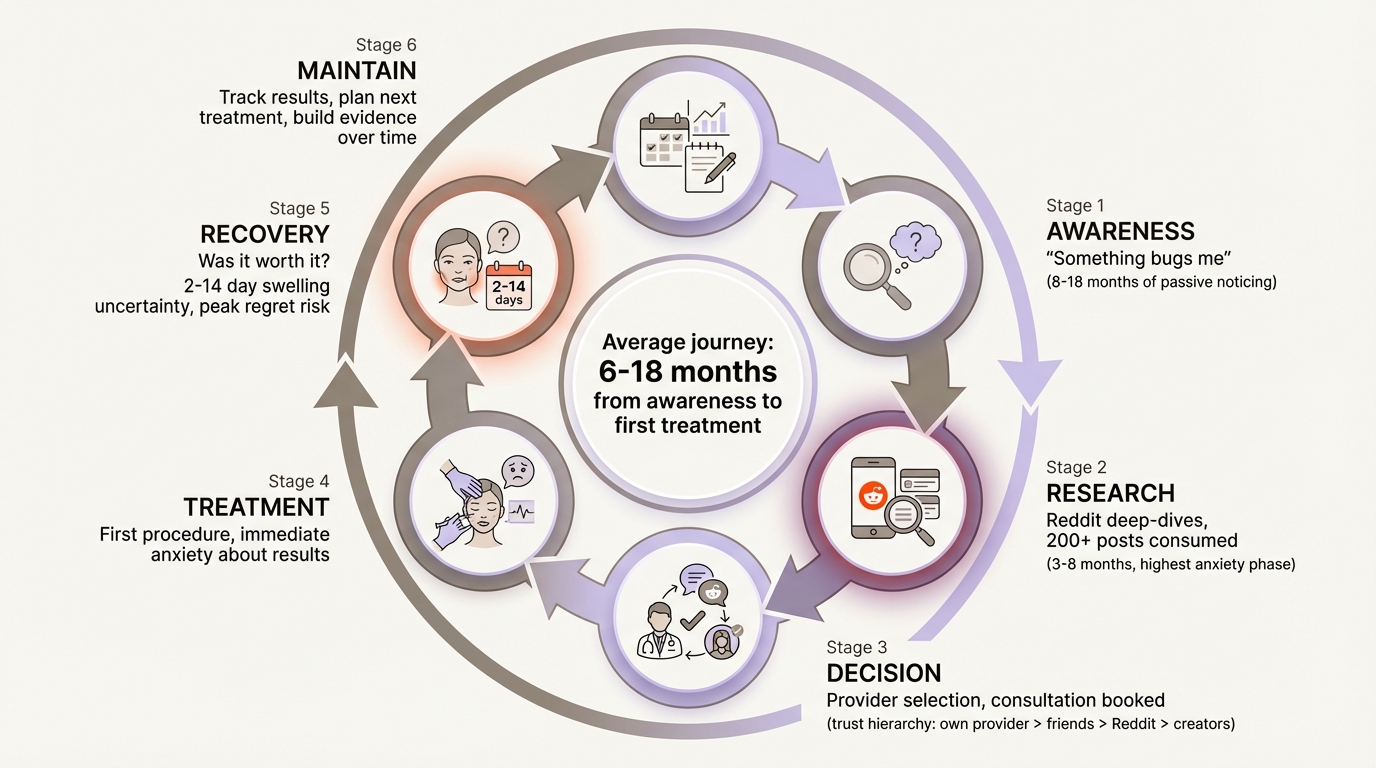
The consumer journey from research through rebooking -- GlowGuide's core zone spans the Assess and Rebook stages
Research (Weeks to Months)
Extensive, multi-platform, often obsessive information gathering. 902 Reddit posts matched "first time botox" in 12 months across just 4 subreddits. Average research phase for first-timers: 3-8 months. Primary channels: Reddit (narrative depth), Instagram (visual results), TikTok (treatment reveals), Google (factual questions), provider consultations.
Decide (Days to Weeks)
Provider selection, appointment booking, pre-treatment anxiety. Provider trust is procedure-specific: "Even if you trust him for Botox and laser, this is a higher-risk area." Recommendations are name-specific -- women share injector names and IG handles. Decision triggers are often emotional + seasonal.
Treat (Day of Procedure)
The highest-intent moment for GlowGuide adoption (in-clinic B2B2C). Users have something to track RIGHT NOW. Baseline photo capture is most natural at this moment.
Assess (Weeks to Months)
Evaluating results, comparing to expectations, documenting progress. Before/after photos taken inconsistently -- wrong lighting, different angles, lost in camera roll. Duration tracking is mental. ROI assessment is intuitive, not data-driven: "I think I look... better?" This is GlowGuide's core zone (VP2).
Rebook (Recurring, 3-12 Months)
Scheduling next appointment, sometimes switching providers or treatments. Forgetting to rebook is universal. Missing maintenance windows costs money -- extra units needed to "catch up." Provider switching is stressful.
Evolve (Ongoing)
Over 12-24 months, women expand their treatment portfolio. Priya becomes Claire as she adds treatments and builds history. The persona evolution happens naturally as data accumulates.
Pain Points Ranked by Severity
| Rank | Pain Point | Severity | Frequency in Data | Primary Persona |
|---|---|---|---|---|
| 1 | Treatment timing confusion ("When should I rebook?") | Critical | 50+ direct posts + pervasive in comments | Megan, Claire |
| 2 | First-timer anxiety ("What if I overdo it?") | Critical | 902 posts on "first time botox" alone | Priya |
| 3 | ROI uncertainty ("Was it worth the money?") | High | 55+ posts on cost/value analysis | Claire |
| 4 | Provider trust & switching | High | Persistent across all treatment threads | All |
| 5 | Duration unpredictability ("Why doesn't mine last?") | High | Common in comments, high engagement | Claire, Megan |
| 6 | Before/after documentation (inconsistent photos) | High | 41 direct posts + massive engagement on B/A | Claire |
| 7 | "Too much" fear (overdone anxiety) | High | 126 posts on "too much filler" + 25 on "overdid it" | Priya |
| 8 | Information overload (conflicting advice) | Medium-High | Implicit in research-phase posts | Priya |
| 9 | Social comparison pressure | Medium | Concentrated in Twitter data | Priya |
| 10 | Bad outcome regret | Medium | 18 posts on "botox regret" + horror stories | All (fear-based) |
Trust Hierarchy
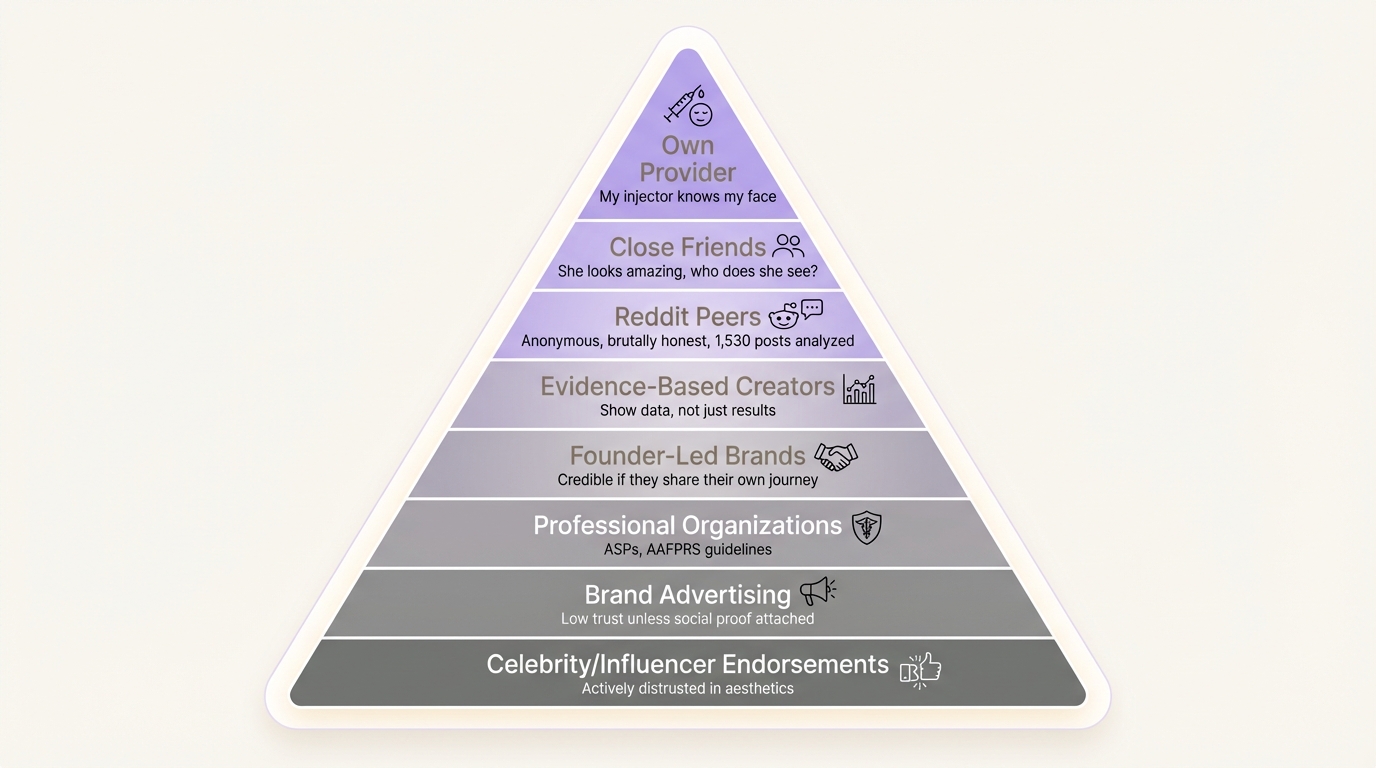
Consumer trust in aesthetic information: providers at the top, influencers at the bottom
Own Provider / Injector
Highest trust. Personal relationship is paramount. "Dr. Kim handles everything."
Friends Who've Had the Same Treatment
"My friend Sarah who's been getting Botox for years."
Anonymous Peers with Detailed Experiences (Reddit)
"I trust strangers who have nothing to sell me."
Evidence-Based Content Creators
Dermatologists and surgeons who educate, not sell.
Founder-Led Brands with Authentic Stories
"If the New York Times wrote about it."
Professional Organizations (ASPS, AAD)
Trusted but not consumer-facing.
Brand Advertising
Low trust. "Everyone is selling something."
Influencer Endorsements
Lowest trust. "I don't trust influencers at all."
GlowGuide Implication
The app must position at levels 2-5, NOT level 7. Brand advertising will not build trust in this market. Founder content (Tara), peer evidence (GEMs), and editorial credibility are the trust mechanisms.
Emotional Drivers
| Driver | Intensity | Evidence |
|---|---|---|
| Desire for control | Very High | "I'm my own medical records department, scheduling assistant, research analyst, and photo archivist." |
| Investment protection | High | "Spent 30k+ On Lasers/Skincare" (1,692 upvotes). Women want evidence their money is well spent. |
| Social belonging | High | Treatment discussion is a bonding mechanism. "What did you do?" conversations strengthen friendships. |
| Identity / self-narrative | High | "I've been on a skincare journey since I was 26-27." Treatments are part of identity story. |
| Subtle enhancement desire | High | "I want to look like myself but more rested -- not like I 'got something done.'" |
| Seasonal/event motivation | Medium | Weddings, holidays, summer, professional milestones trigger decisions. |
Emotional Barriers
| Barrier | Intensity | Evidence |
|---|---|---|
| Fear of looking "overdone" | Very High | 126 posts on "too much filler." #1 emotional barrier for first-timers. |
| Cost guilt | High | "Sometimes I feel guilty about spending $400 on Botox." Framing as "investment" alleviates guilt. |
| Information overwhelm | High | "Every Reddit thread says something different." More research = more confusion. |
| Judgment anxiety | Medium | "Being judged by coworkers, family, or partner for 'caring about vanity.'" |
| Provider trust deficit | Medium | "She told me 6 months or 12 on skin quality and I thought was being scammed." |
| Irreversibility fear | Medium | "Botox lasts 3-4 months means 3-4 months of regretting it." Fillers worse (6-12 months). |
Verbatim Consumer Quotes
On Tracking & Memory
"I want to keep track of it somewhere and I thought maybe this was the place to do that! I just haven't been feeling great lately and my age is showing."
-- r/30PlusSkinCare (27 upvotes)
"I took so many notes and tried different products until the point I am today in which I feel I have a solid base."
-- r/SkincareAddiction
"I've been getting Botox/dysport for about 2.5 years. This past November I switched medspas since the injector I was seeing at the previous moved."
-- r/PlasticSurgery
"How often do you get Botox?"
-- r/30PlusSkinCare (60+ upvotes, 20+ comments)
"I usually let my forehead almost completely wear off before I get more."
-- r/30PlusSkinCare
On Cost & ROI
"Spent 30k+ On Lasers/Skincare - Here are My Hacks and Takeaways"
-- r/30PlusSkinCare (1,692 upvotes, 115 comments)
"I'm between injectors, I go to one medspa for my filler and another one for Botox."
-- r/30PlusSkinCare comment
"Rhinoplasty in Korea: $2-3K vs $10K+ in the US -- what would stop you from flying out?"
-- r/PlasticSurgery (32 upvotes, 43 comments)
"I spent 6 months researching surgeons in Turkey before my rhinoplasty."
-- r/cosmeticsurgery
"Consider it the best money I ever spent treatment wise. I needed 2 sessions to treat all of my spider veins."
-- Reddit comment
On First-Timer Fear
"I've always been a little intimidated about seeing a dermatologist. Part of it was the cost, part of it was just not knowing what to expect."
-- r/SkincareAddiction
"I would always tell the nurses to be extra conservative with the amount injected, because I didn't want to look too frozen."
-- r/30PlusSkinCare comment
"Try it and if you don't like it don't do it again."
-- Reddit comment (how experienced users reassure newcomers)
"My new dermatologist said my skincare routine is crap."
-- r/SkincareAddiction (807 upvotes)
"What do you consider to be 'normal' signs of aging for an almost 31 year-old?"
-- r/30PlusSkinCare (169 upvotes, 115 comments)
On Provider Trust
"Make sure your specific provider has done temple filler on lots of patients before. Even if you trust him for Botox and laser, this is a higher-risk area."
-- r/PlasticSurgery comment
"She had a baby and is only in the city once a week now, and mainly operates out of the Hinsdale location. I just started going elsewhere for Botox, but will definitely go to Hinsdale to get quality filler."
-- r/PlasticSurgery comment
"Would a Botox injector be offended if you didn't go to your 2 week follow up appointment?"
-- r/30PlusSkinCare
"I went to somebody recently... she told me 6 months or 12 on skin quality and I thought was being scammed."
-- Reddit comment
"The injector is Ashley Lasco and her IG is @injectionsbyashleylouise."
-- Reddit comment (word-of-mouth via IG handles)
On Duration & Maintenance
"Botox never lasts long on me... how about you?"
-- r/30PlusSkinCare (post title)
"I stopped Botox because it was only lasting a month."
-- r/30PlusSkinCare comment
"I was shocked how much longer mine lasted when I started taking zinc."
-- r/30PlusSkinCare comment
"It depends on the location! Like my neck wears off really fast but I feel like my forehead is slower."
-- r/30PlusSkinCare comment
On Before/After & Evidence
"I want to share with you my acne scar treatment experience which continues this year."
-- r/30PlusSkinCare (255 upvotes, 146 comments)
"I wanted to share this because for the longest time I thought my problem was that I just hadn't found the right product."
-- r/SkincareAddiction
"The first time I did 1ml chin filler it didn't last at all, but I went back two times after, about six months apart, to get the look I wanted."
-- Reddit comment
On Social/Emotional Dynamics
"Being on instagram again for the past year really got me f***ed up. Like I'm actually considering lip filler. Sometimes I feel like I'm the only woman my age with my natural lips and I used to like them but now I think they are inherently not good enough."
-- Twitter (@disco_martini)
"I've been on a skincare journey since I was 26-27. I'm a sensitive person who grew up in an environment that didn't allow for that, and it shows on my face now."
-- r/30PlusSkinCare (169 upvotes)
"Hi, I turned 40 in March and have been through 9 months of crazy stress, which took a toll on my body and skin... I want a serious glow up."
-- r/30PlusSkinCare (66 upvotes)
"May this be proof I just lost weight and actually have LESS lip filler and wear LESS makeup than I used to."
-- Twitter (136 likes)
On Bad Outcomes & Regret
"Profiles Beverly Hills Ruined My Face - Two Years Later and I'm Still Waiting... I paid $16,000 USD."
-- r/PlasticSurgery (217 upvotes, 40 comments)
"I went against recommendations and got under eye filler, could use some support."
-- r/PlasticSurgery (1,481 upvotes)
"Masseter Botox fail - update"
-- r/30PlusSkinCare (1,091 upvotes)
"Be careful not to overdo it though, as I feel like I kind of did."
-- r/PlasticSurgery comment
Spending Patterns by Demographic Segment
| Segment | Annual Spend | Treatment Mix | Price Sensitivity | Provider Loyalty |
|---|---|---|---|---|
| Claire (35-50, HHI $150K+) | $8,000-$12,000+ | Multi-treatment: Botox + filler + laser + skincare | Low -- values results over cost | Moderate -- will switch for better outcomes |
| Priya (28-40, HHI $80-150K) | $0 to $1,200-$3,000 (first year) | Single treatment: Botox or laser | High -- every dollar scrutinized | High -- first provider becomes default |
| Megan (32-48, HHI $120K+) | $1,200-$3,600 | Single treatment: Botox only | Medium -- trusts provider pricing | Very High -- "Dr. Kim handles everything" |
The Cross-Provider Problem
"I'm between injectors, I go to one medspa for my filler and another one for Botox."
-- Reddit comment
Women routinely use 2-3 providers for different treatments. No single provider has the complete picture. This is the core structural problem GlowGuide solves -- a unified treatment history across all providers.
Social Listening Deep Dive
1,530 Reddit posts, 515 comments, and 144 tweets analyzed. Reddit is the primary source for deep consumer psychology; Twitter is surface-level commentary.
Collection Summary
Reddit Data (12-Month Lookback)
| Search | Subreddits | Posts Found | Relevant (filtered) | Key Signal |
|---|---|---|---|---|
| 1: Tracking pain points | PlasticSurgery, 30PlusSkinCare, SkincareAddiction, cosmeticsurgery | 100 | 55 (55%) | Direct product-market fit: women describing the exact problem GlowGuide solves |
| 2: Decision & anxiety | Same 4 subs | 1,158 | ~700 (est.) | Priya persona: first-timer fear, regret, "did I overdo it" |
| 3: Results & money | Same 4 subs | 72 | 52 (72%) | Claire/Megan persona: ROI tracking, provider switching, frequency |
Twitter/X Data (7-Day Lookback)
| Search | Raw Tweets | Quality (filtered) | Key Signal |
|---|---|---|---|
| 1: Treatment journeys | 100 | 28 (2+ likes) | Casual treatment sharing, social comparison loops |
| 2: Pain points & regret | 100 | 29 aesthetic-relevant | "Too much filler" as cultural commentary (71% non-cosmetic noise) |
| 3: Transparency movement | 88 | 16 (3+ likes) | "Normalize botox/fillers" returned 0 exact matches -- movement not active on X |
Platform Insight
Reddit contains dramatically richer narrative data for aesthetic treatments. Twitter is mostly surface-level commentary and celebrity gossip. For deep consumer psychology, Reddit is the primary source.
Top 10 Pain Points (Ranked by Frequency)
Treatment Timing Confusion
Very High frequency: 37 posts matching "botox schedule", 13 matching "how often botox." Women actively struggle to track timing and describe anxiety about being "overdue" or retreated too early.
ROI Uncertainty ("Was it worth the money?")
High frequency: 40 posts matching "is botox worth it", 15 matching "aesthetic budget." Cost-consciousness is universal -- women want evidence that treatments deliver value.
First-Timer Anxiety
Very High frequency: 902 posts matching "first time botox", 47 matching "nervous about fillers." Fear of looking "frozen" or "overdone" is the #1 barrier.
Provider Trust & Switching
High frequency: pervasive across threads. Finding and trusting a provider is a major pain point. Women describe losing their trusted injector as genuinely stressful.
Duration Unpredictability
High frequency in comments. Botox varies wildly (1-5+ months). Major frustration source creating repeat "is this normal?" questions.
Before/After Documentation Desire
High: 41 posts matching "before after." Before/after posts are the highest-engagement content type across all subreddits.
"Too Much" Fear / Overdone Anxiety
High: 126 posts matching "too much filler", 25 matching "overdid it." Both pre-treatment barrier and post-treatment regret trigger.
Social Comparison & Instagram Pressure
Moderate, concentrated in Twitter. Social media creates a comparison loop driving treatment consideration -- but also anxiety about beauty standards.
Skincare Journey as Identity
Moderate, concentrated in r/30PlusSkinCare. Women frame aesthetic care as a "journey" with narrative arcs -- the emotional foundation for GEMs.
Regret & Bad Outcomes
Moderate: 18 posts matching "botox regret." When treatments go wrong, the emotional impact is severe. Creates cautionary content and a need for evidence-based tracking.
Verbatim Language Library (40 Quotes)
Category A: Treatment Tracking & Memory (GlowGuide Core Use Case)
"I want to keep track of it somewhere and I thought maybe this was the place to do that!"
-- r/30PlusSkinCare
"I took so many notes and tried different products until the point I am today in which I feel I have a solid base."
-- r/SkincareAddiction
"I've been getting Botox/dysport for about 2.5 years. This past November I switched medspas since the injector I was seeing at the previous moved."
-- r/PlasticSurgery
"How often do you get Botox?"
-- r/30PlusSkinCare (60+ upvotes, 20+ comments)
"I usually let my forehead almost completely wear off before I get more."
-- r/30PlusSkinCare
Category B: Cost & ROI Anxiety (Claire Persona)
"Spent 30k+ On Lasers/Skincare - Here are My Hacks and Takeaways"
-- r/30PlusSkinCare (1,692 upvotes)
"I'm between injectors, I go to one medspa for my filler and another one for Botox."
-- Reddit comment
"Rhinoplasty in Korea: $2-3K vs $10K+ in the US -- what would stop you from flying out?"
-- r/PlasticSurgery (32 upvotes, 43 comments)
"I spent 6 months researching surgeons in Turkey before my rhinoplasty."
-- r/cosmeticsurgery
"Consider it the best money I ever spent treatment wise. I needed 2 sessions to treat all of my spider veins."
-- Reddit comment
Category C: First-Timer Fear & Research (Priya Persona)
"I've always been a little intimidated about seeing a dermatologist. Part of it was the cost, part of it was just not knowing what to expect."
-- r/SkincareAddiction
"I would always tell the nurses to be extra conservative with the amount injected, because I didn't want to look too frozen."
-- Reddit comment
"Try it and if you don't like it don't do it again."
-- Reddit comment (how experienced users reassure newbies)
"My new dermatologist said my skincare routine is crap."
-- r/SkincareAddiction (807 upvotes)
"What do you consider to be 'normal' signs of aging for an almost 31 year-old?"
-- r/30PlusSkinCare (169 upvotes, 115 comments)
Category D: Provider Trust & Relationships (All Personas)
"Make sure your specific provider has done temple filler on lots of patients before. Even if you trust him for Botox and laser, this is a higher-risk area."
-- Reddit comment
"She had a baby and is only in the city once a week now... I just started going elsewhere for Botox, but will definitely go to Hinsdale to get quality filler."
-- Reddit comment
"Would a Botox injector be offended if you didn't go to your 2 week follow up appointment?"
-- r/30PlusSkinCare
"I went to somebody recently myself... she told me 6 months or 12 on skin quality and I thought was being scammed."
-- Reddit comment
"The injector is Ashley Lasco and her IG is @injectionsbyashleylouise."
-- Reddit comment (word of mouth via IG handles)
Category E: Treatment Duration & Maintenance (Megan Persona)
"Botox never lasts long on me... how about you?"
-- r/30PlusSkinCare
"Working out daily and using a sauna multiple times per week is increasing your metabolism and causing your body to metabolize the Botox faster."
-- Reddit comment (38 upvotes)
"I stopped Botox because it was only lasting a month."
-- Reddit comment
"I was shocked how much longer mine lasted when I started taking zinc."
-- Reddit comment
"It depends on the location! Like my neck wears off really fast but I feel like my forehead is slower."
-- Reddit comment
Category F: Before/After & Evidence (GEM Behavior)
"I want to share with you my acne scar treatment experience which continues this year."
-- r/30PlusSkinCare (255 upvotes, 146 comments)
"I wanted to share this because for the longest time I thought my problem was that I just hadn't found the right product."
-- r/SkincareAddiction
"The first time I did 1ml chin filler it didn't last at all, but I went back two times after, about six months apart, to get the look I wanted."
-- Reddit comment
"A lot of people saying she got filler or surgery I just think she stopped using the thick lashes."
-- Twitter (public debate about what's "real")
"May this be proof I just lost weight and actually have LESS lip filler and wear LESS makeup than I used to."
-- Twitter (136 likes)
Category G: Social/Emotional Dynamics
"Being on instagram again for the past year really got me f***ed up. Like I'm actually considering lip filler."
-- Twitter (@disco_martini)
"Sometimes I feel like I'm the only woman my age with my natural lips and I used to like them but now I think they are inherently not good enough."
-- Twitter (@disco_martini)
"98% of women are 'mid' or 'ugly' unless they've had nose jobs, lip filler, etc."
-- Twitter (53 likes -- cultural commentary on beauty standards)
"Just got some lip filler AMA."
-- Twitter (casualization of treatment discussion)
"Can you tell I got Botox? -- coworker who looks like she's on the Polar Express now."
-- Twitter (12 likes -- humor about overdoing it)
Category H: Bad Outcomes & Regret
"Profiles Beverly Hills Ruined My Face - Two Years Later."
-- r/PlasticSurgery (217 upvotes)
"I went against recommendations and got under eye filler, could use some support."
-- r/PlasticSurgery (1,481 upvotes)
"Masseter Botox fail - update"
-- r/30PlusSkinCare (1,091 upvotes)
"Be careful not to overdo it though, as I feel like I kind of did."
-- Reddit comment
"Her injector needs to lose their license."
-- Twitter
Unmet Needs (Things People Want But Can't Find)
A treatment timeline/history tracker
Multiple Reddit users literally describe wanting this. One created a post series specifically to "keep track" of treatments publicly because no private tool existed.
Personalized duration predictions
"How often should I get Botox?" is one of the most asked questions. No tool tells users "based on YOUR history, your next appointment should be around X date."
Cost-per-result analysis
Women spend $400-$16,000+ on treatments but have no way to compare ROI across providers, procedures, or time periods.
Provider comparison data
"Should I switch injectors?" has no good answer. Women rely on IG follows and word-of-mouth. No structured way to compare based on personal outcomes.
Before/after with context
Reddit posts get massive engagement when they include treatment details. Existing photo storage doesn't capture this metadata.
Treatment-specific communities
Women want to connect with others who have the SAME treatment type, timeline, and skin concerns. General beauty forums are too broad.
Emotional Spectrum
| Emotion | Intensity | Where It Shows | Hook Implications |
|---|---|---|---|
| Anxiety | Very High | First-timer posts, "am I overdoing it" | Lead with reassurance, not features |
| Desire for control | High | Treatment tracking, B/A documentation | "Take control of your aesthetic journey" |
| Cost guilt | High | Budget posts, "was it worth it" | Frame as investment protection |
| Pride in results | High | Before/after posts (highest engagement) | GEMs tap into this directly |
| Trust anxiety | High | Provider switching, bad outcomes | Social proof from community > brand claims |
| Social comparison | Moderate | Instagram pressure tweets | Enable confidence, don't fuel comparison |
| Empowerment | Moderate | "Glow up" narratives, sharing routines | Support the journey narrative |
Key Language Patterns for Ad Copy
Words Women USE (verbatim)
- "journey" (not "routine" or "regimen")
- "glow up" (aspirational transformation)
- "worth it" (value/ROI framing)
- "how often" (frequency uncertainty)
- "first time" (entry point anxiety)
- "too much" (overdone fear)
- "can't remember" (tracking need)
- "wear off" / "wore off" (duration frustration)
- "switched" / "switching" (provider trust)
- "keep track" (direct product signal)
- "conservative" (desire for subtlety)
- "natural" (aesthetic goal)
Words Women DON'T Use
- "aesthetic intelligence" (proprietary -- absent in data)
- "evidence moment" (not natural phrasing)
- "optimize" (too clinical)
- "protocol" (too medical)
- "regimen" (prefer "routine" or "journey")
- "log" or "document" (too formal)
- "ROI" (say "worth it" instead)
- "duration" (say "how long it lasts")
What the Research Changed
10 net-new findings from 1,530 Reddit posts, 8,400 comments, 144 tweets, and ASPS 2024 data -- cross-referenced against the kickoff call, all-hands deck, and product strategy docs.
What's Just Confirmation (Already Known)
The research validates but doesn't add to: "Women 30-50 with money" as the ICP. The timing mismatch. VP1 vs VP2 tension. In-clinic B2B2C value. The 30% onboarding drop-off. The 90% non-return rate. These are confirmed but not new. Here's what IS new:
10 Genuinely Non-Obvious Findings
1. The biggest emotional driver isn't "tracking" -- it's EVIDENCE
The company frames VP2 as "Is It Worth It?" = tracking treatments. But the social data reveals something different. Women don't want to "track" their Botox. They want proof it worked. The most resonant verbatim: "I've spent so much money and I honestly can't tell you what actually made a difference."
The reframe from "tracking app" to "evidence system" is a meaningful strategic shift. "Track your treatments" is a feature. "Know if it worked" is an emotional outcome. The positioning doc captures this as the Narrative Kernel: "We exist so women can finally know -- not guess, not hope, not wonder -- whether it's actually working."
2. The #1 tracking need isn't treatment history -- it's duration prediction
The company's mental model is: tracking = recording what you got and when. But the most frequent pain in the data is: "Why does my Botox only last 6 weeks when my friend's lasts 4 months?"
Duration varies wildly based on metabolism, exercise habits (sauna, weight training), injection site, unit count, and even zinc supplementation. Women obsess over this variability. This is PERSONAL data that no provider has because they only see one patient at a time.
GlowGuide is the only product that could say: "Based on YOUR history, your Botox typically wears off at week 11." That's a different product promise than "log your treatments."
3. Cost transparency is the highest-engagement content type -- by a mile
The post "Spent $30K+ on Lasers/Skincare - Here are My Hacks and Takeaways" got 1,692 upvotes and 115 comments -- the single highest-engagement post in the entire dataset. Not a before/after. Not a treatment reveal. A cost breakdown.
Women are starved for cost transparency. How much does this ACTUALLY cost per month of results? What's the real total across providers? Nobody aggregates this for them.
4. GLP-1 crossover is creating a massive new Priya cohort -- and nobody has mentioned it
40% of GLP-1 patients at med spas are entirely new to aesthetics (ASPS 2024). These are women who lost weight on Ozempic/Mounjaro and are now exploring body contouring, skin tightening, and facial treatments for the first time. They exhibit classic Priya behaviors: research-heavy, anxious about overcorrection, seeking conservative first experiences.
This is a near-term cultural moment. It's a new acquisition angle not discussed in ANY of the kickoff materials.
5. Provider trust is PROCEDURE-SPECIFIC, not blanket
The company knows women use multiple providers. But the data reveals: "Even if you trust him for Botox and laser, this is a higher-risk area." Trust doesn't transfer between procedure types. A woman's Botox injector is NOT automatically trusted for filler.
GlowGuide's cross-provider history isn't just organizational convenience -- it's solving a structural trust fragmentation that women actively feel but can't articulate as a product need.
6. Reddit is being used as a LITERAL treatment journal -- users know it's a bad solution
Multiple users are posting treatment logs on Reddit specifically to track their progress. One explicitly said: "I want to keep track of it somewhere and I thought maybe this was the place to do that!" She's using a public forum as a private tracking tool because nothing else exists.
This isn't just "pain point validated." This is users building public workarounds for a product that doesn't exist.
7. The "transparency movement" doesn't exist on Twitter
The brand positioning leans into a cultural narrative of "normalizing" aesthetic treatments. The Twitter search for "normalize botox" / "normalize fillers" / "aesthetic transparency" returned zero exact matches. The movement isn't as organized or vocal as the brand assumes. Women ARE discussing treatments openly on Reddit -- but anonymously, and as individuals, not as a cultural movement.
8. Megan (Guided Minimalist) is weakly validated in digital channels
The company treats the 3 personas as roughly equal in priority. The data says otherwise:
- Priya: 902 posts matching "first time botox" -- massive digital footprint
- Claire: Highest engagement on cost/ROI posts -- very visible online
- Megan: "PARTIALLY VALIDATED" -- barely shows up in social data
Megan doesn't research online. She doesn't post. She does what her provider says. She is ONLY reachable through in-clinic B2B2C. Spending paid ad dollars targeting Megan is likely wasted.
9. GlowGuide's proprietary language is invisible to consumers
"Aesthetic Intelligence," "GEMs," "Glow Evidence Moments" -- none appear in any consumer conversation across 1,530 Reddit posts and 144 tweets. The words women actually use: "journey" (not "routine"), "worth it" (not "ROI"), "wear off" (not "duration"), "keep track" (not "log").
Also absent: "optimize," "protocol," "regimen." Women say "routine" and "journey."
10. VP1/VP2 isn't a split test -- it's a funnel architecture question
The company is treating VP1 vs VP2 as an A/B test to find the "winner." But the data suggests they're not competing -- they're sequential. VP1 captures a MUCH larger audience (Priya = 40% of SAM, 902 "first time" posts) but converts to VP2 after first treatment. VP2 captures smaller but higher-intent audience (Claire = 25% of SAM).
The answer isn't "which VP wins" -- it's "VP1 is the top of funnel, VP2 is the moat, and the bridge between them is the highest-leverage moment in the entire user journey."
The observation that "tracking engagement is really low" may not be a product problem -- it may be that VP1-acquired users haven't had their first treatment yet, so there's nothing to track. The engagement will come later, as a lagging metric.
Bottom Line: 6 Strategic Shifts
- Reframe from "tracking" to "evidence/knowing" -- changes all consumer-facing copy
- Duration prediction as hero feature, not timeline view -- changes product positioning
- Cost transparency as highest-engagement hook -- changes creative priority
- GLP-1 crossover as near-term acquisition angle -- new creative concept
- Megan is digitally unreachable -- reallocate paid budget away from her
- VP1 and VP2 are sequential, not competing -- stop split-testing them as equals
The strongest single insight: Women don't want to track treatments. They want to KNOW if they worked. That's the gap between what the company says and what the market feels.
The Personas & Positioning
Answering: "Are these personas real? How should we position?"
The Three Women
Three data-refined personas grounded in 1,530 Reddit posts, 515 comments, 144 tweets, ASPS 2024 procedure data, BCG consumer segmentation, and growth analysis. Each includes all 16 discovery dimensions.
Personas refined from Story System archetypes with market data
Original v1 personas were narrative-driven archetypes. v2 adds: behavioral segmentation data, treatment cycle mapping, psychographic depth ranked by hierarchy, trust sources ranked, seasonal patterns, dormancy risks, and full 16-dimension structured discovery Q&As. Megan's digital invisibility confirmed — she doesn't exist in social data, validating in-clinic-only acquisition.
Persona Priority & Channel Mapping
| Persona | % of TAM | Acquisition Channel | VP Entry | Time to First Value | Retention Mechanism |
|---|---|---|---|---|---|
| Priya (Thoughtful Explorer) | 40% | Meta/TikTok Ads (VP1), Organic Social, Founder Content | VP1 | Fast (5 min — personalized recs) | VP1→VP2 bridge after first treatment |
| Megan (Guided Minimalist) | 35% | In-Clinic B2B2C (provider referral), Email nurture | Provider recommendation | Fast (if onboarding is 1-tap) | Smart reminders, passive logging |
| Claire (Curated Connoisseur) | 25% | Meta Ads (VP2), Google Search, Reddit-informed creative | VP2 | Slow (days-weeks — needs treatment data) | Portfolio tracking, ROI analytics |
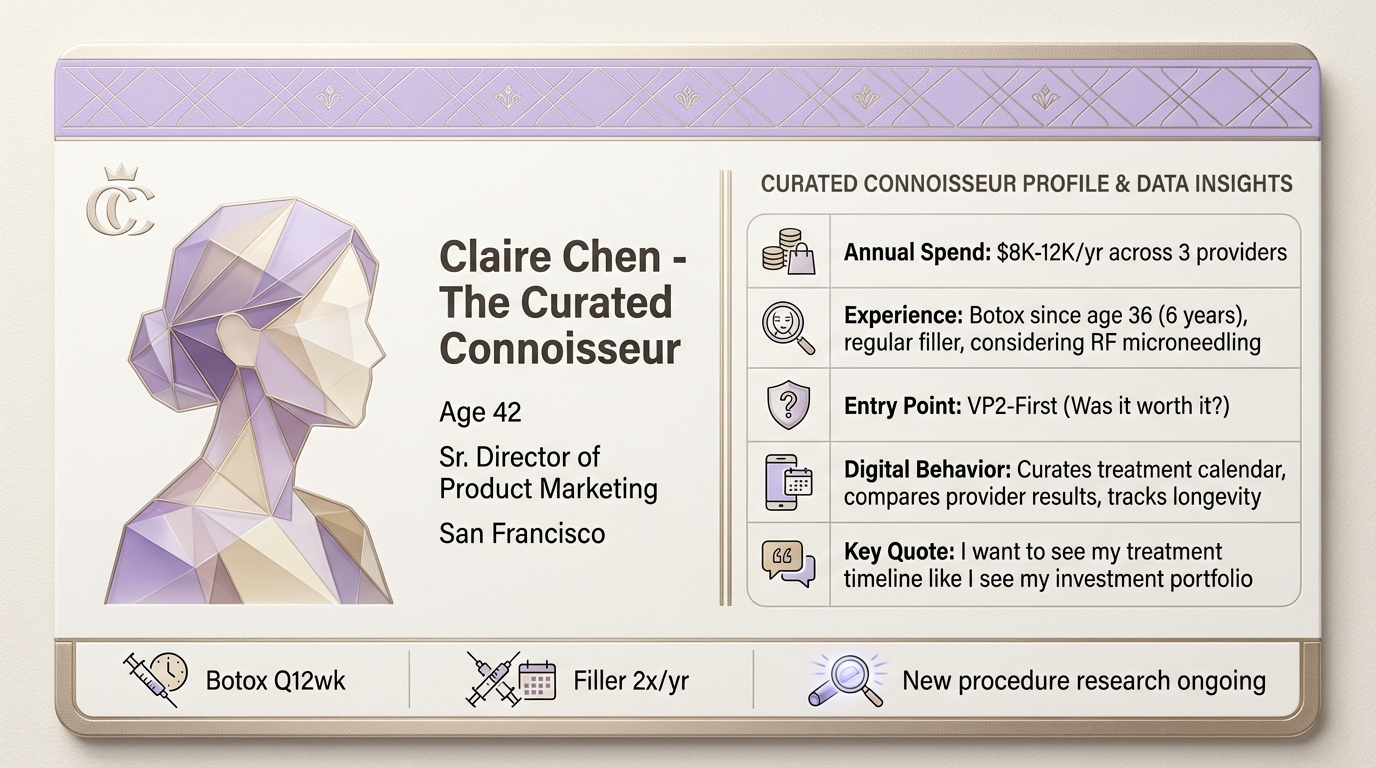
Claire Nakamura — The Curated Connoisseur: Data-driven professional, $6-12K/yr spend, VP2-first entry
Claire Nakamura
The Curated Connoisseur
Snapshot
Claire is a 42-year-old Senior Director of Product Marketing at a Series C SaaS company in San Francisco. She's been getting Botox since 36, added lip filler at 38, started laser treatments at 40, and now spends $8,000-$12,000/year across three different providers. She approaches her aesthetic routine the way she approaches her investment portfolio — with research, tracking, and a desire for evidence that her money is well spent.
Market Validation
The post "Spent 30k+ On Lasers/Skincare - Here are My Hacks and Takeaways" (1,692 upvotes, 115 comments on r/30PlusSkinCare) is the single highest-engagement post in our dataset. Claire's need for cost-transparency and evidence-based treatment evaluation is the most engaged topic in the aesthetic community.
Daily Reality
- Manages a $2M annual marketing budget professionally but tracks her $1K/month aesthetic spend in her Notes app
- Has photos from treatments scattered across 3 providers' systems, her Camera Roll (23,000 photos), and a Google Doc she started and abandoned
- Checks r/30PlusSkinCare during her morning coffee
- Gets a text from her Botox provider saying "it's been 4 months!" but can't remember if it was 3.5 or 4.5 months since her last visit
- Opens Alle app to check points balance but finds it useless for anything beyond Allergan products
- Spends 20 minutes trying to find her "before" photo from her last laser session
Core Fears (Ranked)
- Cumulative treatment over years doing something to her face she can't see — "like a frog in boiling water"
- Been overspending on treatments that aren't doing much, can't prove it either way
- Current provider is mediocre but she has nothing to compare against
- Friends getting better results for less money
Deep Motivations (Ranked)
- Evidence that her investment is paying off — proof, not hope
- Organizational control — the "portfolio view" of aesthetic investments
- Being the authoritative friend who gives treatment advice backed by DATA
- Identity: someone who makes smart, intentional beauty decisions
Identity Narrative
Claire's aesthetic journey is an extension of her professional identity — analytical, optimized, evidence-based. "I'm not anti-aging, I'm pro-evidence." She wants to be the woman who "does her skincare the way she does her investments." The Oura Ring is her reference product.
Critical Pain Points
- No unified treatment history across 3 providers (Botox at one medspa, filler at another, laser at a derm office)
- Can't answer "is my $400 Botox wearing off faster than average?" — no baseline comparison
- Before/after photos in different lighting, angles, times of day — useless for real comparison
- Forgot to rebook Botox twice last year → deeper lines → more units
- Can't articulate a clear "treatment plan" when friends ask
- Pays out of pocket for everything but has no documentation
Treatment Cycle Mapping
| Phase | When | Reachability | GlowGuide Engagement Window |
|---|---|---|---|
| Pre-appointment research | 1-2 weeks before | HIGH | Surface treatment history, remind of last duration |
| Post-treatment tracking | 0-14 days after | HIGHEST | Structured photo capture, milestone tracking |
| Maintenance period | 4-8 weeks post | LOW | Passive logging; progress insights |
| Wearing-off awareness | 2-4 weeks before next | HIGH | Duration prediction alert |
| Rebooking decision | 1-2 weeks before rebook | MODERATE | ROI comparison, provider history |
Trust Hierarchy (Ranked)
- Board-certified dermatologists and plastic surgeons
- Her own provider/injector (relationship trust)
- Data and evidence (numbers, timelines, measurable outcomes)
- Peer women at her professional/income level
- Publications she respects (NYT, not influencers)
- Premium design signals
16-Dimension Structured Discovery Q&A
1. Pain Points
"I spend more time trying to remember when I last got Botox than actually researching new treatments. My provider texts me but I honestly don't trust their timeline — they want me to come back sooner."
"How long my last treatment actually lasted versus what they said it would. I feel like I'm always guessing."
"Last month. I was trying to show my new injector my 'history' and all I had was vague memories and inconsistent photos. I felt unprepared for someone who spends this much."
2. Frustrations
"I expect them to have my full treatment history, but they only know what they've done — not what other providers have done. I'm the only person who has the full picture, and I don't have a good system."
"Comparing results over time. I have 6 years of treatments but zero way to see if I'm trending in the right direction."
3. Fears/Uncertainties
"That I've been overdoing it gradually and can't see it because the change is so slow. Like frog in boiling water."
"Getting too much filler and looking puffy. But honestly, the more likely bad outcome is just wasting $600 on something that doesn't do much."
4. Trust Builders
"If it was recommended by my dermatologist. Or if the New York Times wrote about it. I trust institutions and experts, not influencers."
"Oura Ring. Clean design, data-driven, didn't try to sell me supplements. Just showed me my data and let me draw conclusions."
5. Annoyances/Trust Busters
"Fake before/afters. If I catch one manipulated photo, I assume everything is manipulated."
"'Anti-aging' fearmongering. I'm not anti-aging. I'm pro-evidence. There's a difference."
6. What They Care About
"My actual cost per month of visible improvement. Like, ROI by treatment type."
"A dashboard. My treatments, my spend, my results, my schedule. Like Mint.com but for my face."
7. Job Description
"I'm my own medical records department, scheduling assistant, research analyst, and photo archivist. And I'm failing at all of them."
8. Skills
"Research. I can deep-dive a Reddit thread like nobody's business. I also trust my visual judgment — I know when something looks right."
9. Background
"A friend got Botox at 34 and I couldn't stop staring at how rested she looked. I booked an appointment the next week."
10. Career Trajectory
"Started with just Botox. Then filler. Then laser. Now I'm managing a mini treatment portfolio and realizing I need better systems."
11. Jobs to Be Done
"Usually checking when my next appointment should be, or trying to find a before photo. Both take way too long."
12. Work Products/Deliverables
"Inconsistent photos, forgotten appointment dates, and a vague sense of whether things are working. Not exactly a KPI dashboard."
13. Job Expectations
"Knowing exactly what I've done, when I need to go back, and having visual proof that it's working. Basically, feeling as organized about my face as I am about my job."
14. Metrics/KPIs
"I can't, honestly. I know I look better than I did 5 years ago, but I couldn't tell you which treatments contributed most."
15. Ways to Be Promoted/Fired
"Having a treatment plan I could actually explain to someone. Not just random appointments."
"Finding out I've been overspending on treatments that weren't doing anything, and a simple photo comparison could have told me that months ago."
16. Who They Work With
"My injector (70%), my friend Amy who researches everything (20%), and Reddit (10%). I don't trust influencers at all."
GlowGuide Company Fit
GlowGuide is the "portfolio view" Claire has been assembling manually. Structured photo capture solves her biggest frustration. Treatment timelines with personal duration data answer her most pressing question. The cross-provider treatment history is something NO existing app offers. Claire would upgrade to premium immediately for treatment ROI analytics.
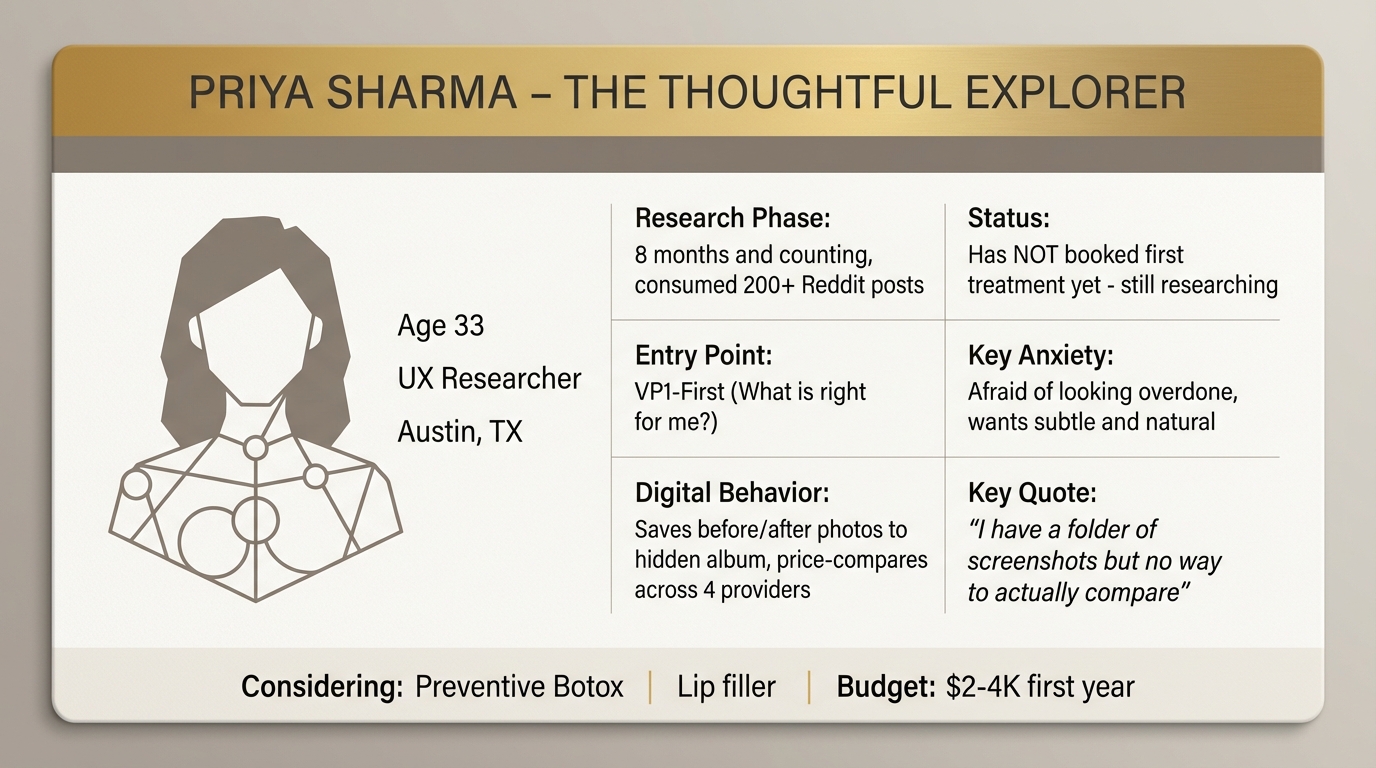
Priya Anand — The Thoughtful Explorer: Research-driven first-timer, VP1-first entry, 40% of TAM
Priya Anand
The Thoughtful Explorer
Snapshot
Priya is a 33-year-old UX researcher at a healthtech startup in Austin. She's been researching Botox for 8 months, has read 200+ Reddit posts, watched 50+ TikTok videos, and asked three friends who've had it. She still hasn't booked an appointment. She's not opposed to treatments — she's opposed to making an uninformed decision. Her browser has 14 open tabs about "first time Botox" and she just created a private Pinterest board called "Skin Research."
Daily Reality
- Scrolls r/PlasticSurgery and r/30PlusSkinCare during lunch, reading first-time Botox posts
- Takes screenshots of before/after posts but can't find them when needed
- Has a Notes document titled "Botox Research" with 47 bullet points of conflicting information
- Asks her friend Sarah (who's had Botox for 3 years) the same questions she's already Googled
- Watches TikTok treatment reveals at night, oscillating between amazement and fear
- Has been DM'd by two med spas from Instagram ads but felt too pressured to respond
- Briefly considered booking during a Black Friday medspa deal but talked herself out of it
Core Fears (Ranked)
- Looking "frozen" or "overdone" — the uncanny valley of aesthetic treatments
- Having a bad reaction and not being able to undo it (3-4 months of regretting)
- Being judged by coworkers, family, or partner for "caring about vanity"
- Making a decision she can't take back with a provider she doesn't fully trust
- Spending $400+ on something that "doesn't even do anything" and feeling foolish
Deep Motivations
- Wants to feel confident in appearance without feeling shallow about caring
- Desires the "refreshed" look she sees in friends
- Values information-as-armor: if she knows everything, the decision feels safe
- Wants someone/something to say: "based on what you want, here's exactly what makes sense"
Critical Pain Points
- Information overload: 200+ posts, 50+ TikToks, 14 open tabs — MORE confused than when she started
- Conflicting advice: one source says 20 units, another says 40
- No personalized guidance — all information is generic
- Provider selection paralysis
- Social anxiety about the first appointment
- Fear of the "slippery slope"
- No one to validate her decision who isn't also selling her something
16-Dimension Structured Discovery Q&A
1. Pain Points
"Not knowing what questions to ask. I don't even know what I don't know. And every source has different information."
"I keep finding one more thing to research. And then I see a horror story post and convince myself to wait another month."
2. Frustrations
"It's either from providers trying to sell me something, or from random people on Reddit where I don't know their context. There's no unbiased, personalized source."
"Saving screenshots and posts across 5 different apps and then never being able to find the one I need when I need it."
3. Fears/Uncertainties
"Looking different in a way that people notice. I want to look like myself but more rested — not like I 'got something done.'"
"I would spiral. I've already catastrophized every possible outcome. Heavy eyelids, frozen forehead, asymmetry — I've Googled all of them."
4. Trust Builders
"If real women shared their actual experiences with photos taken in normal lighting, not filtered. With specific details — how many units, what brand, how long it lasted, what they didn't like."
"If someone who understood my specific face and concerns said 'here's what I'd recommend, here's what to expect at each stage, and here's what the first appointment is actually like.' Basically, a preview of the experience."
5. Annoyances/Trust Busters
"If it asks me to create an account or enter personal info before I can see any value. I need to browse first."
6. What They Care About
"That the person understands I'm nervous and doesn't make me feel silly for being cautious. And that I know what to expect for the next 2 weeks."
7. Job Description
"Full-time detective. I cross-reference Reddit threads, filter by people with similar skin to mine, check comment sections for corrections, and build mental models of what seems safe."
8. Skills
"I'm a UX researcher professionally, so I know how to synthesize qualitative data. I just can't synthesize it for myself because I'm emotionally invested."
9. Background
"My friend got Botox and looked incredible — not different, just refreshed. And she said it was no big deal. I've been researching ever since."
10. Career Trajectory
"I think once I get over the first one, I'll be a regular. It's the first step that's terrifying."
11. Jobs to Be Done
"Walk me through everything. What happens at the consultation. How to describe what I want. What it feels like. What I'll look like at Day 1, Day 7, Day 14. What goes wrong and how it's fixed."
12. Work Products/Deliverables
"A clear record of what I got (units, placement), what to expect for recovery, when to check if it's working, and when I should consider going back."
13. Job Expectations
"If my partner says 'you look well-rested' and doesn't know why. That's the dream outcome."
14. Metrics/KPIs
"If I feel more confident and don't regret it after 2 weeks. If I look at my before photo and feel glad I did it."
15. Ways to Be Promoted/Fired
"Having a plan. Knowing what I'm doing and why, not just following trends. Being able to explain my reasoning to myself."
16. Who They Work With
"My friend Sarah who's been getting Botox for years. My Google search results. And honestly, Reddit. I trust strangers who have nothing to sell me."
GlowGuide Company Fit
GlowGuide is the "knowledgeable friend" Priya has been searching for on Reddit. VP1 is perfectly aligned — personalized recommendations WITHOUT pushing to book. The brand voice (warm, honest, "even when the answer is 'we don't know yet'") is exactly the tone that earns Priya's trust. She'll download for recommendations and stay because, when she finally books, she'll want to track whether it worked.
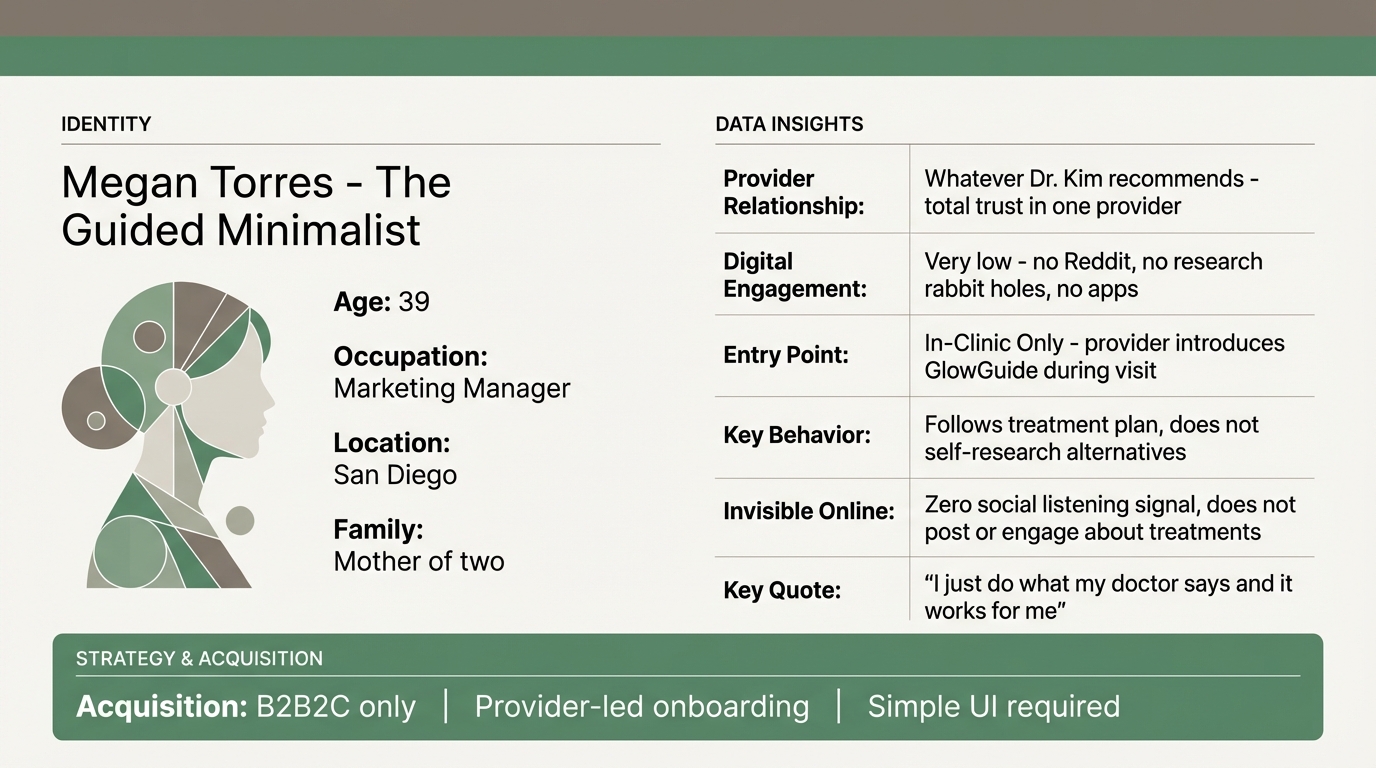
Megan Torres — The Guided Minimalist: Provider-led, low-digital, in-clinic acquisition only
Megan Torres
The Guided Minimalist
Snapshot
Megan is a 39-year-old marketing manager and mother of two in San Diego. She started getting Botox 18 months ago because her dermatologist suggested it during a routine skin check. She's been back three times, always to the same provider, always getting "whatever Dr. Kim recommends." She doesn't research treatments, compare providers, or think deeply about her routine. Her problem isn't decision-making — it's maintenance. She forgets to rebook, can't remember when she last went, and has no idea if she should be doing anything between appointments.
Megan is digitally invisible
Social listening confirmed Megan doesn't exist in online data. Zero Reddit/Twitter posts match her profile. This validates: she can ONLY be reached through in-clinic B2B2C channels. Digital ads will never reach her. Provider recommendation is THE acquisition channel.
Daily Reality
- Gets a calendar reminder from her medspa 3 months after last appointment but often reschedules
- Doesn't take before/after photos because "it's just Botox, not a big deal"
- Opens Instagram occasionally but doesn't act on aesthetic content
- Asks her dermatologist "what should I do?" and follows instructions without research
- Has no idea how many units she gets, what brand, or cost per unit
Core Fears (Ranked)
- Being lazy about something she should be paying more attention to
- Overpaying because she never shops around
- Realizing in 5 years she should have been doing something differently
- Missing maintenance windows → more units → higher cost
- Being upsold on treatments she doesn't need
Deep Motivations
- Aesthetic care as automated and effortless as grocery delivery
- Looking "put together" without it being a project or identity
- Reassurance: doing enough (not too much, not too little)
- Simple, clear guidance: "Here's what to do next" with no decision required
Critical Pain Points
- Forgets to rebook: "I know I'm overdue but I keep putting it off"
- No awareness of treatment history: can't answer "when did you last get Botox?" with certainty
- Doesn't know what questions to ask beyond "the usual"
- Overwhelmed by skincare information landscape → opts out entirely
- Would benefit from tracking but would never set it up herself
16-Dimension Structured Discovery Q&A
1. Pain Points
"Remembering to go back. I'm supposed to go every 3-4 months and I always end up going at 5 or 6 because I forget until I notice my lines coming back."
"Honestly? I don't even know what I should wish I had. I just want someone to tell me 'time to go back' and 'here's what to get.'"
2. Frustrations
"That it's one more thing to manage. I already have the kids' dentist, my annual physical, their school stuff. Botox falls to the bottom."
3. Fears/Uncertainties
"That I should be doing more — like filler or laser or whatever — but I don't know if I actually need it or if my provider is just upselling."
"If they stopped working or if it became too complicated. Right now it's easy because Dr. Kim handles everything."
4. Trust Builders
"If my dermatologist handed it to me and said 'this will help you keep track.' That's literally the only way."
5. Annoyances/Trust Busters
"If it sent me more than one notification a week. Or if it made me feel like I was doing something wrong."
6. What They Care About
"That it's easy. I don't want a project. I just want to look good without thinking about it too much."
7. Job Description
"Passenger. Dr. Kim drives. I just show up when she tells me to."
8. Skills
"Good taste and a good provider. I don't need to be an expert because I trust mine."
9. Background
"Dr. Kim mentioned it during a mole check. She said 'have you thought about a little Botox for those elevens?' I said sure. That was it."
10. Career Trajectory
"Whatever Dr. Kim suggests next. Probably some kind of laser thing eventually."
11. Jobs to Be Done
"An app that knows what I get, when I got it, and tells me when to go back. That's it. I don't need anything else."
12. Work Products/Deliverables
"Reminders. And maybe being able to tell a new provider what I've been getting if I ever switch."
13. Job Expectations
"Looking like I take care of myself without it being a whole thing."
14. Metrics/KPIs
"If my husband says I look nice. Or if I look in the mirror and feel good. I don't need data."
15. Ways to Be Promoted/Fired
"If it just happened automatically. Like, I get a reminder, I go, I'm done. No research, no decisions."
16. Who They Work With
"Dr. Kim, 95%. My sister occasionally mentions something. That's it."
GlowGuide Company Fit
GlowGuide solves Megan's core problem (maintenance and memory) through smart reminders and effortless logging. The key: ZERO-FRICTION onboarding. She needs the app to be introduced by her provider (in-clinic B2B2C), set up with one tap, and then quietly remind her when it's time. If the app requires her to take a baseline photo or configure settings on Day 1, she'll delete it.
Key Strategic Implications
Persona-Driven Strategy Summary
- Priya is the largest addressable segment (40%) but has the longest decision cycle. Content marketing and trust-building are necessary before conversion.
- Claire is the highest-value per user (25%) but the smallest. She'll pay for premium, create GEMs, and evangelize — requires product depth.
- Megan is easiest to acquire via in-clinic (35%) and most likely to retain long-term via reminders, but current 30% onboarding drop-off rate suggests zero-friction isn't working.
- The VP1→VP2 bridge is persona-dependent: Priya enters VP1, guided to VP2 after first treatment. Claire enters VP2 directly. Megan bypasses both VPs and enters via provider.
- Treatment cycles create natural re-engagement windows: Botox (3-4 months), filler (6-12 months), laser (monthly). Each persona has different cycle patterns driving reminder cadence.
Brand Story & Voice
Brand archetype, tone, value proposition definitions, persona hooks, and brand guardrails — from the GlowGuide Story System.
"We exist to end the guesswork in skincare and aesthetic treatments for discerning women who invest in looking their best, so they can make confident decisions backed by real evidence."
GlowGuide Core Story
Brand Archetype: The Sage + The Explorer
We show up as the knowledgeable, trusted friend in the group chat who actually did the research for you. We guide through clarity and evidence, not hype or fear. The Explorer dimension captures the forward-looking, curiosity-driven energy: skincare is a journey of discovery, not a problem to fix.
Tone & Voice
| We Are... | We Are Not... |
|---|---|
| Warm, conversational, like a smart friend who's been through it | Corporate, clinical, or preachy |
| Clear, direct, and honest — even when the answer is "we don't know yet" | Jargon-heavy, condescending, or oversimplified |
| Forward-looking and empowering ("glowing forward") | Fear-based, anti-aging, or rooted in self-doubt |
| Data-informed but human — evidence with personality | Cold, transactional, or robotically technical |
| Witty, self-aware, pop-culture-literate | Try-hard, snarky, or dismissive |
| Inclusive of all skin types, tones, and starting points | Exclusionary, aspirational in an unattainable way, or one-size-fits-all |
Value Propositions
VP1: "What's Right for Me?"
Value Proposition: Cut through the noise to find the treatments, products, and providers that actually match your skin, goals, and budget.
Problem: You're overwhelmed by medspa treatments, conflicting recommendations, and an internet full of sponsored opinions. Everyone is selling something.
Solution: Personalized onboarding, curated recommendations powered by Aesthetic Intelligence, side-by-side comparisons, and a treatment library with honest expectation-setting.
Benefit: Clarity and confidence in every decision. Less time researching, more time acting.
VP2: "Is It Worth It?"
Value Proposition: Finally know if your treatments and products are actually working with private progress tracking that turns hope into evidence.
Problem: Spending hundreds (or thousands) on treatments but you honestly can't tell what made a difference. Your "before" photos are in different lighting.
Solution: Structured photo tracking, treatment timelines with expected milestones, regimen logging, smart reminders, and guided check-ins.
Benefit: Real evidence of what's working. Confidence to rebook, switch, or stop. Your Glow Evidence Moments (GEMs).
VP1 Hooks by Persona
| Persona | Hook 1 (Pain Spotlight) | Hook 2 (Credibility) | Hook 3 (Obstacle Flip) |
|---|---|---|---|
| Claire | "You've tried everything. But do you know what actually worked?" | "Built with plastic surgeons and dermatologists — not influencers." | "Your provider can only recommend what they offer. GlowGuide shows you everything." |
| Priya | "Every month you spend researching is a month your skin isn't improving." | "First-timers: stop Googling. Start planning." | "Imagine walking into your first consultation knowing exactly what to ask." |
| Megan | "Your personalized treatment plan in 5 minutes. No Reddit required." | "Think of GlowGuide as a financial advisor for your face." | "You don't need to become a skincare expert. You need a smarter system." |
VP2 Hooks by Persona
| Persona | Hook 1 (Pain Spotlight) | Hook 2 (Credibility) | Hook 3 (Aspirational) |
|---|---|---|---|
| Claire | "You spent $1,200 on that laser. Can you prove it worked?" | "Track every treatment, product, and result in one private timeline." | "Finally have the receipts when friends ask 'what did you do?'" |
| Priya | "Afraid of picking wrong? Track from day one so you'll know for sure." | "Skin treatments work on 3-6 month timelines. Don't wait to find out it didn't work." | "Starting your first treatment? Capture your baseline now — future you will thank you." |
| Megan | "Snap. Compare. Know. Progress tracking that takes 30 seconds." | "Your treatments deserve the same tracking as your investments." | "Stop guessing if it worked. Start seeing the proof." |
Proprietary Terms
Aesthetic Intelligence
GlowGuide's proprietary physician-informed AI that combines expert insight, real-world data, and personal progress tracking to deliver evidence-backed skincare guidance.
GEMs (Glow Evidence Moments)
The core engagement metric. A GEM is when a user tracks their progress 1-2 times post-treatment or over 1-2 months of product use, creating real evidence of results.
Brand Guardrails
Do
- Forward, not anti. Say "glowing forward" not "anti-aging." Celebrate the journey, not the problem.
- Undetectable is the goal. Appeal to the woman who wants subtle, natural results.
- Evidence over hype. Don't make promises you can't track. Tie claims to something measurable.
- Your knowledgeable friend. Warm, honest, sometimes funny, always useful.
- Empowerment and curiosity. The energy is discovery and confidence.
Don't
- No fear-based marketing. Never rooted in self-doubt, insecurity, or "you need to fix this."
- No beauty app cliches. Not another skincare app telling you to buy retinol.
- No influencer brand energy. Premium evidence, not a life hack.
- No dramatic transformation language. "Results" not "transformation."
- No prescriptive "should." "Might want to" or "consider" instead.
Channel Roles
| Channel | Role |
|---|---|
| Instagram / TikTok | Primary organic + paid. Treatment education, decision content, tracking stories, founder voice. |
| Founder thought leadership (Tara's POV on building in beauty + tech). | |
| Substack ("Pretty Smart") | Long-form founder content. Personal treatment stories, industry critique, product transparency. |
| GlowGuide Magazine (blog) | SEO + education. Treatment guides, budgeting, ingredient deep-dives. |
| Lead magnet (education-first) → app download conversion. Re-engagement. | |
| In-Clinic (B2B2C) | QR codes, table tents, staff scripts at partner medspas. Hyperlocal: Bay Area, LA, San Diego. |
| C2C (Word of Mouth) | Before/after sharing, friend invites framed by VP1 or VP2. |
Positioning & Messaging
Narrative kernel, reframe ladder, StoryBrand framework, VP bridge, taglines, and complete language guide — built from social listening data and brand strategy.
Narrative Kernel
"If GlowGuide disappeared tomorrow, what would our best users miss most?"
Not the features. Not the photo capture. Not the treatment library. They would miss:
- Knowing. Knowing when to go back. Knowing if it worked. Knowing what they spent and whether it mattered.
- The end of guessing. No more "I think I look better?" No more mental math on when Botox wore off.
- Feeling in control of something that used to be vague.
"We exist so women who invest in their appearance can finally know — not guess, not hope, not wonder — whether it's actually working."
The Narrative Kernel
Kernel Test Across Personas
Claire: "I finally have the receipts." (Knowing = evidence of ROI)
Priya: "I finally know what to do." (Knowing = clarity that enables action)
Megan: "I finally don't have to remember." (Knowing = automated memory)
The kernel holds across all three. "Knowing" is the universal emotional outcome.
Reframe Ladder
GlowGuide's category risk: if positioned as a "tracking app," the default comparison is the camera roll (free). The reframe moves the conversation to a problem only GlowGuide solves.
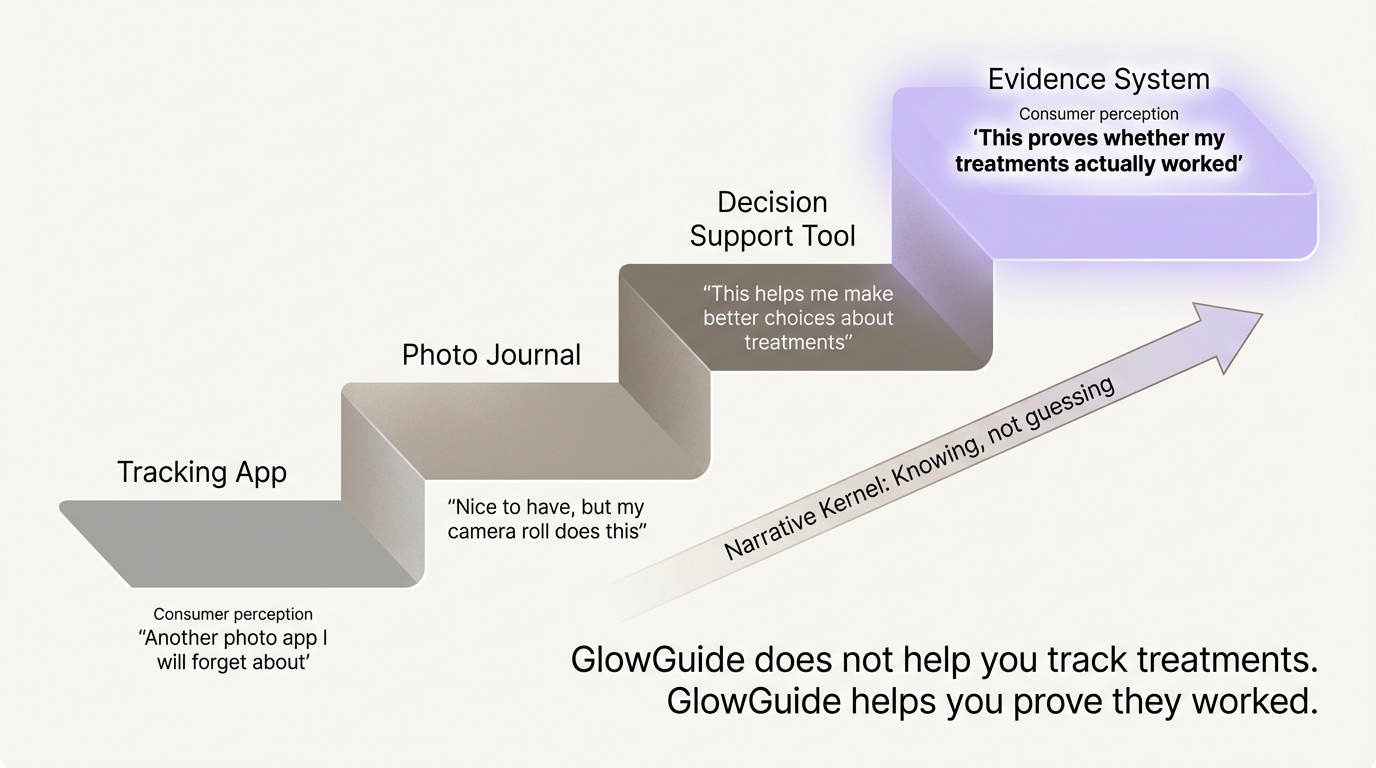
From "tracking app" to "evidence system" — 4 steps of progressive reframing
The Obvious Problem
"Women need better tools to manage their skincare and aesthetic treatments."
The Deeper Problem
The problem isn't management. It's evidence. Women spend $3,600-$12,000+/year on treatments and have zero proof of what worked. They make $400-$1,200 decisions on memory and hope.
Why Existing "Solutions" Fail
Camera roll: Different lighting, angles, times of day — evidence of nothing. Provider systems: Only see what THEY did. Reddit: Other people's evidence, not yours. Memory: Gradual change is invisible.
The New Problem Only GlowGuide Solves
"You're making expensive decisions about your face with no personal evidence." GlowGuide doesn't help you track treatments. GlowGuide helps you prove they worked.
B.A.D. to B.E.S.T. Messaging Transformation
Claire: The Curated Connoisseur
B.A.D. (Current Risk)
"Track your treatments and products in one intelligent system with AI-powered recommendations."
- Boastful: "AI-powered" is a feature claim, not a benefit
- Abstract: "intelligent system" means nothing to a consumer
- Dry: sounds like SaaS, not personal
B.E.S.T. Transformation
Benefit-led: "See exactly which treatments are delivering results — and which aren't worth rebooking."
Empathetic: "You've spent $8K this year. You deserve to know if it worked."
Story-driven: "She spent $30K on treatments over five years. When her friend asked 'what made the biggest difference,' she couldn't answer. Now she can."
Transformational: "From guessing if your Botox is 'still working' to knowing exactly when it wears off."
Final line: "Your treatments cost thousands. Your evidence shouldn't live in your camera roll."
Priya: The Thoughtful Explorer
B.A.D. (Current Risk)
"Personalized treatment recommendations based on your goals, skin type, and budget."
- Boastful: "personalized" is overused, meaningless in beauty
- Abstract: "based on your goals" — every app says this
- Dry: reads like an app store description
B.E.S.T. Transformation
Benefit-led: "Stop researching. Start knowing what's right for your specific face, budget, and comfort level."
Empathetic: "You've been thinking about Botox for months. Every thread says something different. That's not your fault — it's a broken system."
Story-driven: "She had 14 open tabs, 200 Reddit posts saved, and a Notes document with 47 bullet points. She still couldn't decide. Then she answered 5 questions and got a plan."
Transformational: "From 'I'm still researching' to 'I know exactly what I'm doing, why I'm doing it, and what to expect.'"
Final line: "You don't need more opinions. You need a plan."
Megan: The Guided Minimalist
B.A.D. (Current Risk)
"Smart reminders and treatment logging with automated aftercare tracking."
- Boastful: "smart" and "automated" are tech-speak Megan ignores
- Abstract: "treatment logging" sounds like homework
- Dry: productivity app, not helpful nudge
B.E.S.T. Transformation
Benefit-led: "Never forget to rebook. Never wonder when you last went."
Empathetic: "You have the kids' dentist, your annual physical, school stuff, and work. Botox keeps falling to the bottom. We get it."
Story-driven: "She was supposed to go back at 3 months. She went at 6. Her lines were deeper and she needed more units. One reminder would have saved her $200."
Transformational: "From 'I keep meaning to go back' to 'it's handled.'"
Final line: "Your Botox appointment should be as automatic as your grocery delivery."
The VP1 → VP2 Bridge
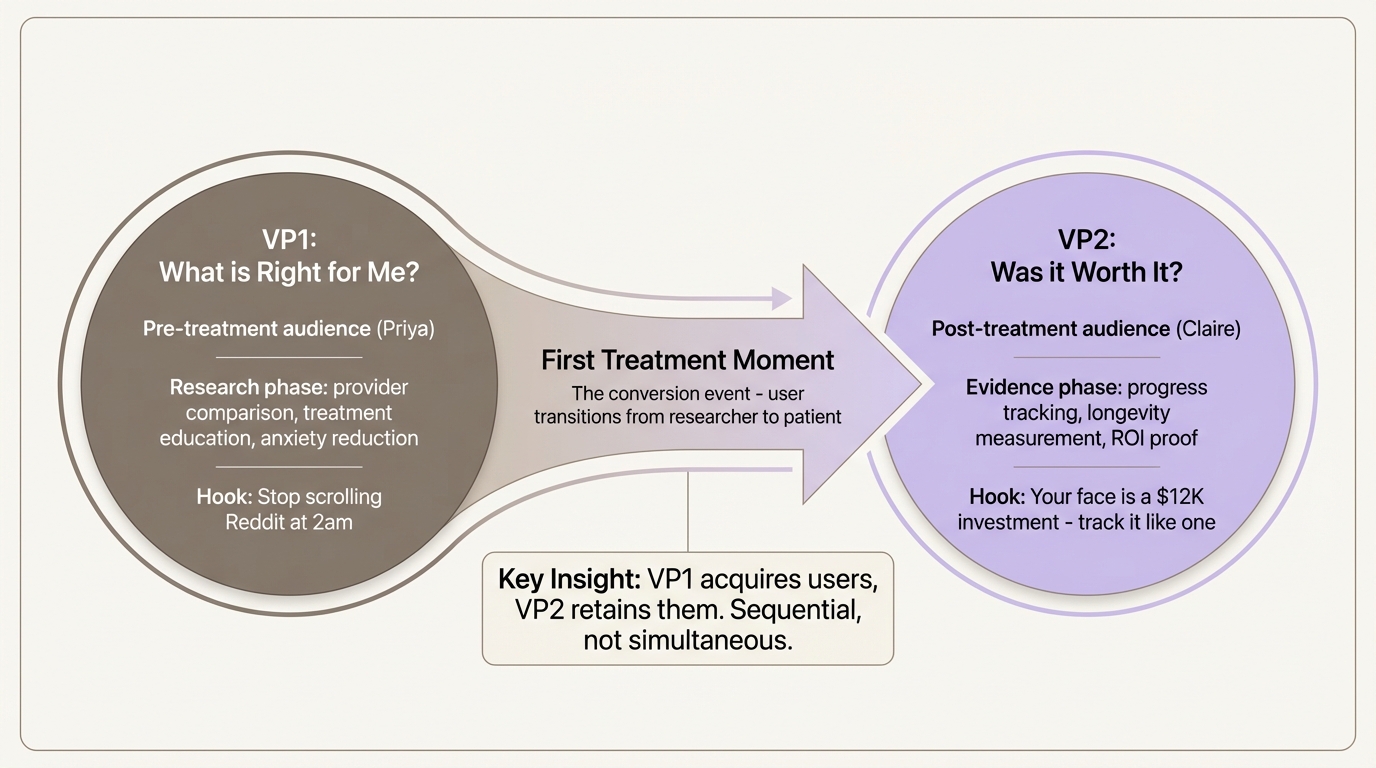
VP1 ("What's Right?") → First Treatment → VP2 ("Was It Worth It?") — the highest-leverage lifecycle moment
The bridge is the highest-leverage moment in GlowGuide's user lifecycle. It converts a "researcher" into a "tracker" — transforming a VP1 user who might churn into a VP2 user who builds longitudinal data.
Bridge Messaging Sequence
| Timing | Message |
|---|---|
| Pre-appointment (1-3 days) | "Your appointment is coming up. Take 60 seconds to capture your 'before' — you'll want this later." |
| Day of treatment | "You just had [treatment]. Welcome to your tracking journey. Here's what to look for this week." |
| Day 3 | "How are you feeling about your [treatment]? Quick check-in (30 seconds)." |
| Day 7 | "One week in. Time for your first comparison photo. Same angle, same lighting." |
| Day 14 | "Two weeks — this is when [treatment] typically peaks. How do you look compared to Day 1?" |
| Day 30 | "Your first Glow Evidence Moment. Here's your before and after. This is what $[amount] bought you." |
Bridge by Persona
- Priya: The bridge IS the conversion moment. "You did it. You got your first Botox. Now let's make sure it was worth it."
- Claire: Already in VP2 but bridge deepens engagement. "You logged your Botox. Now let's compare it to last time."
- Megan: Doesn't experience the bridge as messaging. Provider sets up app, reminders just work. VP2 accrues passively.
Category Creation Language
Do Say
- "Your aesthetic evidence system"
- "The proof behind your glow"
- "Your beauty decisions, backed by your own data"
Don't Say
- "Treatment tracking app" (invites camera roll comparison)
- "Beauty app" (commodity category)
- "AI skincare tool" (overpromises)
- "Aesthetic management platform" (clinical B2B)
Tagline Candidates
"Know your glow."
Universal — Primary recommendation
Short, warm, ties to Narrative Kernel. Double meaning: know what's working + know your beauty.
"Stop guessing with your face."
Claire/Priya — Best for paid ads
"The proof behind your glow."
Claire — Best for brand/PR contexts
"Your treatments, tracked. Your results, proven."
Claire/Megan — Best for App Store
"Glow forward."
Universal — Brand building & community
"Every treatment tells a story. Start reading yours."
Priya — Narrative-driven, journey-oriented
"Because 'I think it worked' isn't good enough."
Claire — Best for VP2 ad creative
Positioning Statements
Universal (Brand-Level)
GlowGuide is the first evidence system for women who invest in aesthetic treatments — turning scattered photos, forgotten appointments, and hopeful guesses into clear proof of what works.
Claire variant: "For women who spend thousands on treatments and want to know exactly what's delivering results, GlowGuide is the portfolio view of your aesthetic investments that no provider, app, or camera roll can give you."
Priya variant: "For women researching their first treatment and drowning in conflicting advice, GlowGuide is the trusted guide that cuts through the noise with personalized, honest recommendations so you can stop researching and start deciding."
Megan variant: "For busy women who get treatments but forget to go back, GlowGuide is the smart reminder that knows your treatment history and tells you exactly when it's time."
Competitive Positioning
GlowGuide does not compete head-to-head with any existing product. It contrasts against the fragmented tools women currently cobble together.
| "Solution" | What It Gives You | What It Can't Give You | GlowGuide's Contrast |
|---|---|---|---|
| RealSelf | Other people's reviews | YOUR personal evidence | "Their stories vs. your evidence" |
| Alle | Loyalty points on Allergan products | Cross-brand, cross-provider tracking | "Points vs. proof" |
| Camera Roll | Random photos | Structured, comparable evidence | "Photos vs. evidence" |
| Community opinions | Personalized, data-backed recs | "Opinions vs. your data" | |
| Provider records | What ONE provider did | Cross-provider, patient-controlled history | "Their records vs. your complete picture" |
| Nothing (memory) | Vague impressions | Anything measurable | "I think vs. I know" |
Language Guide
Words to Use (from social listening)
| Word/Phrase | Why It Works | Source |
|---|---|---|
| "journey" | How women naturally describe their aesthetic experience | Dominant framing across 200+ posts |
| "glow up" | Aspirational transformation language. Positive, forward-looking. | Common in both Reddit and Twitter |
| "worth it" | The ROI question in consumer language. Universal. | 40 posts matching "is botox worth it" |
| "keep track" | How women describe the tracking need. Not "log" or "monitor." | "I want to keep track of it somewhere" (27 upvotes) |
| "wore off" / "wearing off" | How women describe treatment duration ending. Natural. | Dominant phrasing for treatment fading |
| "conservative" | Signals safety and subtlety. Priya's #1 trust word. | "I would always tell the nurses to be extra conservative" |
| "natural" | The aesthetic goal across all personas. | Dominant desired outcome descriptor |
| "evidence" / "proof" | Claire's language for what she wants. Data-adjacent but warmer. | Story System: "evidence over hype" |
| "refreshed" / "rested" | Ideal outcome. Not "younger." | Priya: "you look well-rested and doesn't know why" |
| "smart" | Positions the decision as intelligent, not vain. | "the smart friend in the group chat" |
Words to Avoid
| Word/Phrase | Why It Fails | Use Instead |
|---|---|---|
| "anti-aging" | Fear-based, backward-looking. Violates guardrails. | "glowing forward" or nothing |
| "optimize" | Too clinical, too tech. Sounds like SaaS. | "get the most out of" or "see what's working" |
| "protocol" | Medical jargon. Intimidating for Priya. | "routine" or "plan" |
| "regimen" | Stiff, clinical. Women say "routine." | "routine" or "journey" |
| "aesthetic intelligence" (in ads) | Proprietary term meaningless to consumers. | Reserve for PR, investor, in-app only |
| "AI-powered" | Overused, meaningless in consumer context. | "personalized" or "built with dermatologists" |
| "transform" | Implies dramatic change. Conflicts with "undetectable." | "results" or "progress" or "difference" |
| "patients" | Clinical framing. | "women" or "you" |
| "should" | Prescriptive and judgmental. | "might want to" or "consider" |
| "hack" / "tricks" | Cheapens the brand. | "insights" or "what we've learned" |
Messaging Hierarchy by Persona
Claire: The Curated Connoisseur
Primary: "Finally see if your treatments are actually working."
Supporting: (1) Track every treatment across every provider in one private timeline. (2) Compare before/after with structured photos. (3) Know YOUR personal treatment duration. (4) See cost per result, not just cost per visit.
Proof: No existing app offers cross-provider history. Structured photo capture. Personal duration tracking. Physician-informed methodology.
Priya: The Thoughtful Explorer
Primary: "Cut through the noise. Find what's right for you."
Supporting: (1) Personalized recs based on goals, concerns, budget — not provider inventory. (2) Honest expectation-setting for every treatment. (3) First-timer's guide. (4) Capture baseline from Day 1.
Proof: 902 women posted about first-time Botox on Reddit. Treatment library with real timelines. 5 minutes to first recommendation.
Megan: The Guided Minimalist
Primary: "We'll remind you. You just show up."
Supporting: (1) Smart reminders based on YOUR history and timing. (2) One-tap treatment logging: 30 seconds. (3) Full history in one place. (4) No research required.
Proof: Missing rebooking by 2 months = extra units + higher cost. Provider-endorsed. 30-second onboarding. Max 2 notifications/month.
The Funnel & Channels
Answering: "How do we reach and move them?"
Full Funnel Architecture
Per-persona journey maps from ad impression through GEM creation and retention — with specific tactics, hooks, lifecycle emails, and metrics at every stage
The six-stage consumer decision journey: Awareness → Research → Decision → Treatment → Recovery → Maintain
The Three Problems This Funnel Solves
The Timing Mismatch
Women download GlowGuide from a paid ad but don't have a treatment to track right now. Result: 90% never log in a second time. The app's core value (VP2: tracking) requires something to track, but paid ads reach people at random moments in their treatment cycle.
The 30% Onboarding Drop-Off
Of users who install, 30% never complete onboarding. The selfie capture, quiz length, and account creation wall each add friction before any value is delivered. Every user who doesn't onboard is invisible to the entire lifecycle system.
Near-Zero GEM Contribution
Almost no users reach a Glow Evidence Moment — the point where they track progress 1-2 times post-treatment. Without GEMs, there is no proof that the product thesis works, no shareable content for viral loops, and no data for the investor narrative.
The Unified Solution
The strategy solves all three simultaneously by (a) acquiring users at the moment of treatment via in-clinic B2B2C, (b) holding timing-mismatched users via VP1 value and email nurture, (c) reducing onboarding to 3 taps before value delivery, and (d) building an automated milestone-based lifecycle system that shepherds users from install to GEM with minimal friction.
North Star Metric: GEM Contribution Rate — the percentage of onboarded users who track progress at least once post-treatment.
Growth Operating Principles
Claire Nakamura — The Curated Connoisseur
Claire 25% of SAM ~175K-225K users
Claire is a data-driven professional (38-50) spending $6,000-$12,000+/year across 2-4 providers. She enters through VP2 and becomes the highest-value user — premium subscriber, GEM creator, and word-of-mouth evangelist.
| Stage | Messaging | Channel | Tactic | Lifecycle Email | Success Metric | Failure Recovery |
|---|---|---|---|---|---|---|
| Ad Impression | Hook 1 "The $8K Guessing Game": "You spent $8,000 on treatments this year. Can you name the one that actually made a difference?" | Meta Ads (VP2 creative), Ad Concept 8 "The Treatment Portfolio" | PAS hook format. Advantage+ Sales campaign, hyperlocal Bay Area/LA/SD. Whitelisted from Tara's account for Concept 2 "Tara's $2K Confession." | — | CTR 1.5%+ (Month 1), 2%+ (Month 3) | Rotate creative weekly. Kill below 1.5% CTR. Replace with Hook 22 "Hidden Unit Price" or Hook 5 "Provider Gap." |
| Click | App Store: "Your treatments, tracked. Your results, proven." Description leads with VP2: "Finally know if your treatments are actually working." | App Store (optimized listing) | App Store screenshots mirror the ad creative (portfolio view, treatment timeline). No disconnect between ad promise and store page. | — | Click-to-Install 15%+ (Month 1), 20%+ (Month 3) | A/B test App Store screenshots: treatment portfolio vs. before/after comparison as hero image. |
| Signup / Install | First screen: "Finally see if your treatments are actually working." Social proof: "Joined by 500+ women tracking their aesthetic journey." | In-app (Territory Framework: Filter stage) | Deliver the outcome statement in 3 seconds. Premium design signals quality. | Flow 1 E1: Welcome email (immediate) — "Your treatment evidence system is ready." | Install-to-Onboarding-Start 90%+ | If she doesn't start onboarding within 4h, push notification: "Your personalized plan is ready." |
| Onboarding | VP2 path: "What treatment did you just have?" + date picker + "Here's what to expect at Day 1, 7, 14, 30." | In-app (Territory Framework: Commit stage) | Value-first onboarding: show personalized treatment timeline BEFORE account creation. 3-Tap Test: Open > Select treatment > See timeline. | — | Onboarding completion 85%+ (Day 30), 90%+ (Day 90) | Stall recovery: Flow 2 E1 if she pauses (Trigger T1 at 48h). "Finish setup in 2 minutes." |
| Baseline Photo | "Take 60 seconds to capture your 'before' — you'll want this later." | In-app prompt + Push (Day 1 if skipped) | Photo capture is optional but prompted. Pre-fill treatment type, date, provider from onboarding. On-screen guides reduce bad-photo friction. | Flow 2 E2 "Treatment Log Nudge" (+48h if no baseline) | Baseline capture rate 50%+ of onboarders within 14 days | "You don't need a perfect photo. A quick selfie works." |
| First Treatment Log | "Your treatment timeline is live. Here's what to watch for this week." | In-app + Email (Flow 2 triggered) | 1-tap treatment logging with pre-populated fields. Show the timeline immediately — the populated dashboard IS the reward. | Lifecycle Flow 2 E2: "Your Botox typically peaks at Day 7-14. Here's what to look for." | 40%+ of users with baseline also log a treatment within 30 days | "Treatment coming up? We'll help you track results." (Email, 7d after baseline with no log) |
| First GEM | "Two weeks — this is when Botox typically peaks. How do you look compared to Day 1?" Then: "Your first Glow Evidence Moment. Here's what $504 bought you." | Push notification + In-app comparison overlay | Reduce GEM creation from 6 steps to 2: (1) Tap push notification to open camera with before photo pre-loaded, (2) Take photo, see instant comparison. Celebration screen. | Trigger T3: GEM Celebration email. "You just created your first Glow Evidence Moment!" | GEM contribution rate 5% (Day 30), 10-15% (Day 90) | If no GEM by Day 21: "Your [treatment] results should be settling in. Time to check in?" |
| D7 Return | Feature discovery: "You've logged 1 treatment with 1 provider. As you add more, you'll see your complete treatment story." | In-app + Email (Flow 2 E3 "Feature Discovery") | Show what the populated dashboard WILL look like with sample data. Tease cross-provider view. | Flow 2 E3: "Here's a feature you haven't tried yet." | D7 retention 15%+ (Day 30), 20%+ (Day 90) | "How are your results looking? Quick 2-question check-in." |
| Retention Loop | "Based on your history, your Botox typically wears off around now. Your last session lasted 14 weeks." + "Your treatment portfolio: 3 providers, 4 treatment types." | Push notification (treatment reminder) + In-app portfolio view | Smart reminders via Trigger T2. Dormancy management: Max 1 notification/month during maintenance cruise. ROI comparison surfaces at rebooking decision point. | Trigger T2: Treatment Reminder. Seasonal: "Spring treatment season" re-engagement. | D30 retention 15-20%. Cost per GEM-contributing user <$50. | Win-back at 30+ days dormant: "Spring treatment season is here. Your tracking is waiting for you." |
Claire's VP Bridge
Claire enters at VP2 and stays there. She uses VP1 as a secondary tool when evaluating whether to ADD a new treatment (e.g., "Should I try Sculptra?"). Her bridge is VP2-to-VP1, the reverse of Priya — she goes from tracking to exploring, not the other way around.
Priya Anand — The Thoughtful Explorer
Priya 40% of SAM ~280K-360K users
Priya is a research-oriented professional (28-38) who has been considering her first treatment for 3-12 months. She enters through VP1 and converts to VP2 after her first treatment. Largest segment by volume.
| Stage | Messaging | Channel | Tactic | Lifecycle Email | Success Metric | Failure Recovery |
|---|---|---|---|---|---|---|
| Ad Impression | "You've been researching Botox for 6 months. You have 14 open tabs, 47 bullet points in Notes, and you're MORE confused than when you started." | TikTok Ads (VP1 creative) + Meta Ads. Ad Concept 3 "14 Open Tabs" | Persona callout hook. UGC-style, iPhone-shot. First 3 seconds must hook. Also test Hook 7 "The Overthinker" on TikTok. | — | CTR 0.8%+ (TikTok), 1.5%+ (Meta). Hook rate (3s view) 30%+ on TikTok. | Rotate to Hook 10 "The Almost-Ready First-Timer" or Hook 12 "Stop Researching." Test Concept 9 "First Time? Start Here." |
| Click | App Store: "Your personalized treatment plan in 5 minutes." / "Cut through the noise. Find what's right for you." | App Store | Screenshots show the onboarding quiz (simple, warm) and the recommendation output. No intimidating tracking screens. | — | Click-to-Install 15%+ | A/B test "personalized plan" vs. "first-timer guide" as hero screenshot. |
| Signup / Install | First screen: "Your personalized treatment plan in 5 minutes. No Reddit required." Category anchor: "The knowledgeable friend in the group chat." | In-app (Filter stage) | Immediate VP1 value signal. No tracking screens visible yet. The app presents as a recommendation engine, not a tracker. | Flow 1 E1 / Post-install: Flow 2 E1 "First Steps" (immediate). | Install-to-Onboarding-Start 90%+ | Push at 4h: "Your personalized plan is ready — see what we recommended." |
| Onboarding | VP1 path: value FIRST, then ask for account creation. "Based on your answers, here's what we recommend..." shows treatment name, expected timeline, cost range. | In-app (Commit stage) | Show personalized recommendation BEFORE account creation. Valid defaults: pre-select most common treatment (Botox). Time to first value: ~2 minutes. | — | Onboarding completion 85%+. Time to first value <3 minutes. | Stall recovery at 48h: "Finish setup in 2 minutes. Your plan is waiting." Reduce quiz if drop-off is at question screen. |
| VP1 Value (Pre-Treatment) | "You don't need more opinions. You need a plan." Treatment library with honest expectation-setting. | In-app + Email nurture + Substack "Pretty Smart" | VP1 delivers immediate TTFV without requiring a treatment. Email lead magnet: "The Smart Woman's Guide to Your First Injectable." 6-email nurture holds Priya for weeks-months. This is how VP1 solves the timing mismatch. | Lead magnet nurture E1-E6 (30-day sequence). E3: "3 questions to ask at your first consultation." E5: VP2 bridge. | Lead-to-download conversion rate. Email open rate 35%+. | "We found a treatment that matches your goals" (Push, D7). Content nudge: link to relevant Substack post. |
| Treatment Booked | THE BRIDGE MOMENT: "You did it. You booked your first Botox. Now let's make sure it was worth it." Pre-appointment: "Take 60 seconds to capture your 'before' — you'll want this later." | Push notification + In-app prompt | This is the highest-leverage conversion moment in the entire funnel. Priya transitions from VP1 (researcher) to VP2 (tracker). Baseline photo capture creates the foundation for her first GEM. | Bridge email: "Your appointment is coming up. Capture your baseline now — future you will thank you." | VP1-to-VP2 bridge rate: establish baseline (Day 30), 20%+ (Day 90). Baseline photo capture: 60%+. | "Don't worry about the perfect photo. A quick selfie is all you need." |
| First Treatment | "You just had Botox. Welcome to your tracking journey. Here's what to expect this week." | In-app + Push + Email | In-app treatment logging: pre-populated "Botox." Date defaulted to today. 1-tap log. Show personalized treatment timeline: Day 0, 1-3, 7, 14, 30. | Bridge email: "Your treatment timeline is live. Here's what to watch for." | Treatment logged within 24h of appointment: 50%+ | "How did it go? Quick log takes 30 seconds." (Push, evening of treatment day) |
| Check-ins & GEM | Day 3: "Quick check-in (30 seconds)." Day 7: "Same angle, same lighting." Day 14: "This is when Botox typically peaks." Day 30: "Your first Glow Evidence Moment." | Milestone-based push notifications (from treatment log, not install) | Progressive check-ins at treatment-appropriate intervals. Each notification opens camera with comparison overlay pre-loaded. GEM celebration at Day 30 includes shareable format + friend invite. | Trigger T3: GEM Celebration. "You just created your first Glow Evidence Moment!" | GEM contribution rate. Priya's first GEM is the most emotionally powerful moment in the funnel. | If stalled at Day 14: "Your Botox results should be settling in. Time to check in?" One recovery attempt, then quiet. |
| Retention Loop | "Your Botox lasted 14 weeks last time. How does this round compare?" Treatment comparison over time becomes the retention hook. | Smart reminders (Trigger T2) + In-app longitudinal comparison | Data accumulates passively. Switching costs increase with each logged treatment. Persona evolution: Priya → Claire as she builds a treatment portfolio over 2-3 years. | Trigger T2: Treatment reminder. Seasonal: "Spring treatment season" (March-May). | D30 retention 15-20%. Rebooking on time. | 30-day win-back: "Your last Botox was [X] months ago. Ready to track your next round?" |
Priya's VP Bridge — The Highest-Leverage Moment in the Funnel
VP1 captures Priya during her 3-12 month research phase. Immediate TTFV (~2 minutes to first recommendation). VP1 holds her via email nurture and treatment library until she books. The bridge fires when she books: "Capture your baseline now — future you will thank you." VP2 activates after her first treatment. She is now a tracker. The bridge timing is persona-specific: Priya bridges at first treatment (could be months post-download).
Megan Torres — The Guided Minimalist
Megan 35% of SAM ~245K-315K users
Megan is a busy professional mother (34-48) who gets Botox 2-4 times per year but has zero engagement with the aesthetic information landscape. She is acquired almost exclusively through in-clinic provider referral and retained through smart reminders. Zero-friction is non-negotiable.
| Stage | Messaging | Channel | Tactic | Lifecycle Email | Success Metric | Failure Recovery |
|---|---|---|---|---|---|---|
| Ad Impression | Table tent: "Get the most from today's treatment. Scan to track your results." + "Your provider recommends GlowGuide." | In-Clinic B2B2C: QR code table tent (waiting room + treatment room + checkout). Take-home card. Staff script. | In-clinic acquisition solves ALL three problems simultaneously: (1) She has something to track RIGHT NOW, (2) Provider endorsement bypasses trust barrier, (3) Staff can assist with 30-second setup. | — | Installs per activation day: 15-30. In-clinic install rate: 10-15% of patients. | Staff script Version B: "We use GlowGuide to help our patients get the most from their treatments." If table tents don't convert, add checkout handoff card. |
| Click / Install | App Store for Megan: "We'll remind you when it's time to go back." Radically simple messaging. | QR code → App Store (unique UTM per clinic location) | Unique UTM-tagged QR codes per clinic. Attribution tracked via aggregate installs per clinic code. | — | QR-to-Install 40%+ (high intent, in context). | If QR doesn't scan: checkout staff hands take-home card with printed URL shortlink. |
| Onboarding | "You're all set. We'll remind you when it's time for your next treatment." Peak moment: resolution, not more work. | In-app (Provider-assisted setup) | 30-second onboarding: staff selects treatment type, enters units, taps "Done." Photo captured by staff (consistent lighting). Megan does almost nothing. Zero-education onboarding. | — | Onboarding completion 90%+ (in-clinic cohort). Time to setup: <60 seconds. | If staff doesn't help: simplified self-service path. "What treatment did you just have?" (one tap: Botox) + "When?" (today) + Done. |
| Baseline Photo | "Your baseline is set. We'll check in at Day 7." | In-clinic (staff-assisted capture) | Structured photo capture in clinic = consistent lighting, consistent angle. Dramatically better than at-home selfie. In-clinic photos are highest-quality GEM inputs. | — | Baseline capture rate 80%+ for in-clinic cohort (vs. 50% for paid social) | Push at 4h post-appointment: "Quick selfie before you forget? It takes 10 seconds." |
| Treatment Log | "Your Botox is logged. We've got it from here." | In-app (pre-populated at setup) | The treatment log IS the onboarding for Megan. No separate step. | In-clinic lifecycle E1 (same day): "You just had Botox at [clinic name]. Here's how to get the most from it." | Treatment logged: 90%+ for in-clinic cohort | Not applicable — treatment is logged during setup. |
| First GEM | "Time to check in. Quick photo?" Then: "Here's your before and after. Looking good." | Push notification (Day 14 milestone trigger) | 2-step GEM creation: (1) Tap notification, (2) Take photo. Before photo pre-loaded. Celebration is brief and warm — Megan doesn't want a party, she wants confirmation. | Trigger T3: GEM Celebration (simplified). "Your first check-in is done. We'll remind you when it's time to rebook." | GEM contribution rate 20%+ for in-clinic cohort (Day 60 diagnostic benchmark) | ONE gentle push at Day 21. "Your Botox results should be settling in. Quick check-in?" If no response: quiet period. Do not nag Megan. |
| D7 Return | "How's your recovery going? Quick 2-question check-in." | Push (Day 7) | Megan is dormant 80% of the time. The 20% reachability windows must deliver enough value to prevent uninstall. Do NOT pursue aggressive engagement during maintenance cruise. | Flow 2 E2: "Your recovery is on track." (Only if push disabled) | D7 retention is less important for Megan than rebooking-window retention. | No aggressive recovery for Megan. She'll engage at rebooking. Patience. |
| Retention Loop | "Your Botox typically lasts 3.5 months for you. Next appointment window: this week." | Smart reminder (Trigger T2, personal cycle offset) | The smart reminder IS the product for Megan. One well-timed reminder saves her $140-$280 in extra units from over-lapse. Treatment history accumulates passively over 6-12 months. | Trigger T2: "Your [treatment] typically lasts [X months]. Your next window is coming up." | Rebooking within personal cycle window: 70%+. Megan retained at 6 months: 50%+. | ONE follow-up at +1 week: "Want us to remind you again next week?" Then quiet. Respect the "no." |
Megan's VP Bridge
Megan doesn't experience a conscious VP bridge. She enters through her provider (neither VP), receives utility value (reminders), and VP2 value accrues passively over 6-12 months as her treatment history builds. When she eventually switches providers, her GlowGuide history becomes indispensable: "I can tell my new provider exactly what I've been getting." That's when she discovers VP2's full value — built without her doing anything.
The Timing Mismatch Solution
The timing mismatch is GlowGuide's structural challenge: VP2 (tracking) requires a recent or upcoming treatment, but most users arrive between treatments with nothing to track. Three solutions, each mapped to the personas most affected.
In-Clinic Acquisition (Acquire at Moment of Treatment)
User downloads in the medspa waiting room or treatment room. She just had (or is about to have) a treatment. She has something to track RIGHT NOW. Applies to: Megan (primary), Claire (secondary). QR code table tents, take-home cards, staff scripts at 4 partner medspas.
VP1-to-VP2 Bridge (Hold with Recommendations Until Treatment Happens)
User downloads for VP1 ("What's Right for Me?"). She gets a personalized recommendation in 2 minutes. She explores the treatment library, saves a plan. Weeks or months later, she books her first treatment. The bridge fires: "Capture your baseline now." Applies to: Priya (primary), Claire (secondary).
Email Nurture (Lifecycle Holds Users Until Ready)
User installs, completes VP1 onboarding, gets a recommendation, but doesn't have a treatment to track. Lifecycle Flow 2 and the email lead magnet nurture sequence keep her connected. Seasonal triggers re-engage. Applies to: All personas, especially Priya and dormant Claire.
Detecting User State
| Signal | State | Action |
|---|---|---|
| Acquired via in-clinic QR code | Has treatment now | VP2 path: log treatment, capture baseline, begin milestone sequence |
| Onboarding answer: "Have you had treatments before? No" | Pre-first-treatment | VP1 path: recommendations, treatment library, email nurture until booking |
| Onboarding answer: "Yes, I have treatments" + no treatment logged within 7 days | Between treatments | Hybrid: show VP1 value + estimate rebooking window from onboarding answers + set Trigger T2 |
| Treatment logged during onboarding | Just had treatment | VP2 path: immediate timeline, milestone check-ins, GEM sequence |
The VP1-to-VP2 Bridge
VP1 ("What's Right?") → First Treatment → VP2 ("Worth It?") bridge flow
This is the most important conversion moment in GlowGuide's user lifecycle. It transforms a "researcher" (who might churn after getting a recommendation) into a "tracker" (who builds longitudinal data and becomes a retained user with increasing switching costs).
VP1 TTFV
~2 minutes (answer 3 questions, see personalized recommendation). Fast, satisfying, but doesn't require the app long-term.
VP2 TTFV
Days to weeks (capture baseline, wait for treatment results, do check-ins, see comparison). Slow, but this is the real moat — data that compounds over time.
Bridge Trigger Points
| Trigger | When It Fires | Messaging Shift |
|---|---|---|
| Treatment booked (manual input or calendar) | 1-3 days before appointment | "Your appointment is coming up. Take 60 seconds to capture your 'before' — you'll want this later." |
| Treatment logged (first) | Day of treatment | "You just had [treatment]. Welcome to your tracking journey. Here's what to expect this week." |
| First check-in completed | Day 3-7 post-treatment | "How are you feeling? Quick check-in." This establishes the tracking habit. |
| First GEM created | Day 14-30 post-treatment | "Your first Glow Evidence Moment. This is what $[amount] bought you." The emotional payoff. |
Per-Persona Bridge Timing
| Persona | Bridge Trigger | Typical Timing | Bridge Message |
|---|---|---|---|
| Claire | Already in VP2 at entry. Bridge deepens: first cross-provider log | Within first week | "You logged your Botox. Now add your filler from last month. Your complete treatment story starts here." |
| Priya | First treatment booked / first treatment completed | Weeks to months post-download | "You did it. You got your first Botox. Now let's make sure it was worth it." |
| Megan | Provider sets up app at treatment | At moment of acquisition (no bridge needed) | "You're all set. We'll remind you when it's time to come back." VP2 accrues passively. |
Messaging Shift at Each Bridge Point
| Phase | Language | Brand Mode |
|---|---|---|
| Pre-bridge (VP1) | "Find what's right for you. Get a personalized plan. Cut through the noise." | Explorer (curiosity) |
| Bridge moment | "Now let's track whether it works. Capture your baseline." | Transition |
| Post-bridge (VP2) | "See your results. Know your personal timing. Prove it was worth it." | Sage (evidence) |
Channel Strategy
20 channels scored on 4 dimensions, tiered recommendations with persona mapping and phased rollout — no internal budget numbers
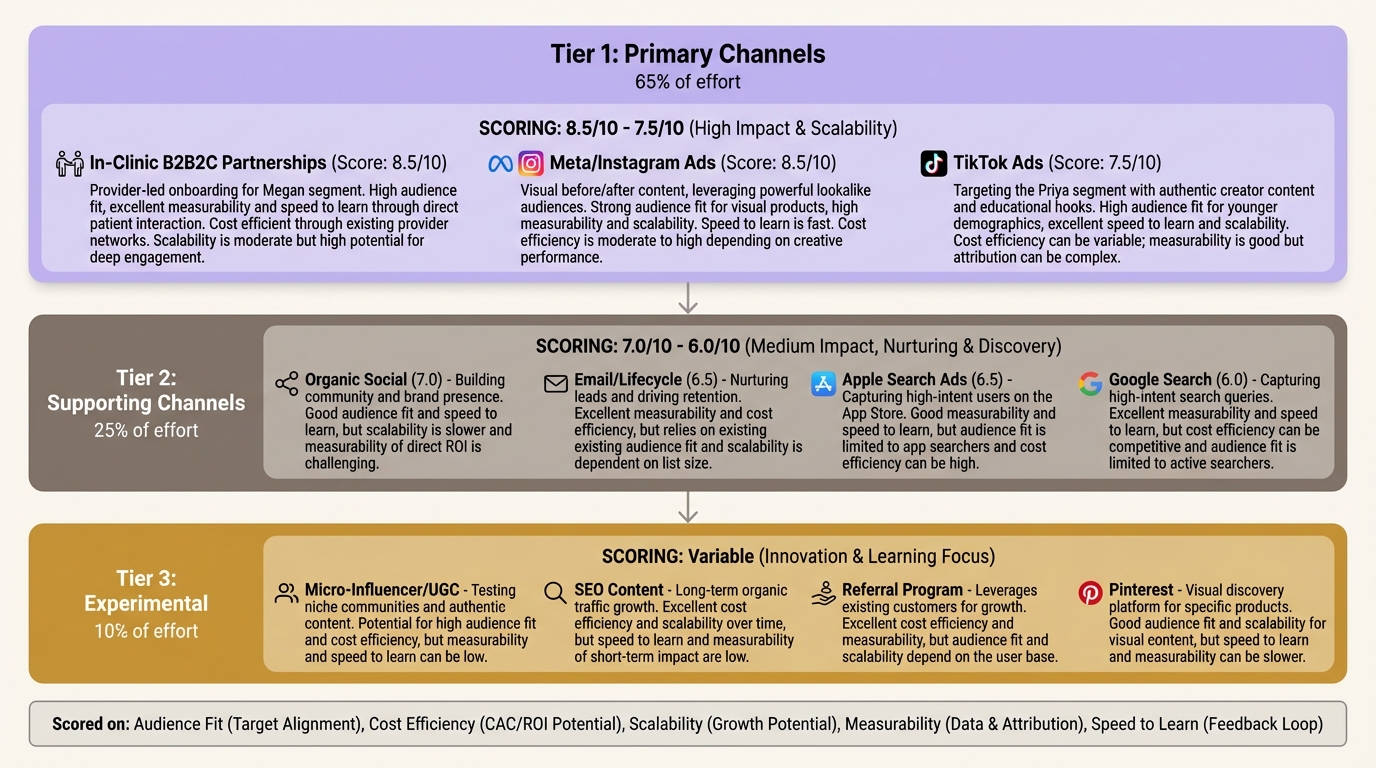
Tier breakdown: T1 (Meta/TikTok/In-Clinic), T2 (Organic/Founder/Email/Search), T3 (Influencer/SEO/Referral), T4 (Future)
Channel Scoring Matrix
Each viable channel is scored on four dimensions (1-10 scale). Composite = weighted average: GlowGuide Fit (30%) + Targeting Precision (25%) + Cost Efficiency (25%) + Audience Reach (20%). Weights reflect GlowGuide's stage: fit and targeting matter more than raw reach right now.
| Channel | DC Category | Audience Reach | Cost Efficiency | Targeting Precision | GlowGuide Fit | Composite Score | Tier |
|---|---|---|---|---|---|---|---|
| In-Clinic B2B2C | Partnerships | 5 | 9 | 10 | 10 | 8.5 | Tier 1 |
| Meta Ads (FB/IG) | Paid | 9 | 7 | 9 | 9 | 8.5 | Tier 1 |
| TikTok Ads | Paid | 8 | 7 | 7 | 8 | 7.5 | Tier 1 |
| Organic Social (IG/TikTok) | Content | 7 | 8 | 5 | 8 | 7.0 | Tier 2 |
| Founder-Led Content | Content | 4 | 9 | 6 | 9 | 7.0 | Tier 2 |
| Email Nurture/Lifecycle | Sales | 3 | 9 | 8 | 8 | 7.0 | Tier 2 |
| Apple Search Ads | Paid | 4 | 7 | 8 | 7 | 6.5 | Tier 2 |
| Google Search Ads | Paid | 6 | 5 | 7 | 6 | 6.0 | Tier 2 |
| Influencer/UGC | Content/Paid | 7 | 5 | 6 | 8 | 6.5 | Tier 3 |
| Company SEO/Blog | Content | 7 | 8 | 5 | 7 | 6.8 | Tier 3 |
| Programmatic SEO | Content | 6 | 7 | 5 | 5 | 5.8 | Tier 3 |
| Word-of-Mouth/Referral | Virality | 6 | 10 | 3 | 8 | 6.8 | Tier 3 |
| Pinterest Ads | Paid | 5 | 6 | 6 | 7 | 6.0 | Tier 3 |
| UGC Social Media | Content | 5 | 8 | 3 | 7 | 5.8 | Tier 3 |
| LinkedIn Ads | Paid | 3 | 3 | 8 | 4 | 4.5 | Not Recommended |
| PR / Press | Content | 5 | 6 | 2 | 6 | 4.8 | Not Recommended |
| Reddit (organic) | Community | 4 | 8 | 4 | 3 | 4.8 | Not Recommended |
| X Ads (Twitter) | Paid | 3 | 4 | 4 | 3 | 3.5 | Not Recommended |
| Podcast Sponsorships | Content | 4 | 4 | 5 | 6 | 4.8 | Not Recommended |
| Events/Conferences | Sales | 2 | 3 | 7 | 5 | 4.3 | Not Recommended |
Tier 1: Launch Channels (Day 1)
These channels start immediately and receive the majority of spend.
In-Clinic B2B2C
Why Tier 1: Acquires users at the moment of highest intent — they just had a treatment and have something to track NOW. Solves the timing mismatch problem that kills retention from other channels. 4 existing medspa partnerships provide immediate distribution.
Format: QR code table tents, take-home cards, staff scripts, activation days
Key metric: GEM contribution rate of in-clinic cohort vs. other channels
Meta Ads (Facebook / Instagram)
Why Tier 1: Zero competitor paid ads in aesthetic treatment tracking = blue ocean. Target demo (women 30-55, affluent, urban) lives on Instagram. Rich visual creative from treatment footage library. CPIs already dropping daily.
Format: 9:16 Reels, 1:1 feed posts, Carousel. VP1 vs VP2 creative split test. Whitelisted from Tara's personal account.
Key metric: Cost per GEM-contributing user, split by VP1 vs VP2
TikTok Ads
Why Tier 1: Treatment reveal content performs exceptionally well. UGC-native format fits GlowGuide's brand voice. Growing aesthetic audience skews younger (Priya personas entering the research phase).
Format: UGC-style treatment tracking stories, "things I wish I knew" format, app demos
Key metric: Cost per GEM, post-install engagement rate
Tier 2: Supporting Channels (Month 2-3)
These channels build trust, capture demand from other sources, and extend the funnel.
Organic Social (Instagram + TikTok)
Hours of treatment footage available. Before/after content is highest-engagement format. Creates creative assets that fuel paid campaigns.
Cadence: 5-6x/week on IG (Reels, carousels, stories). 3-4x/week on TikTok.
Founder-Led Content (Substack + LinkedIn)
Tara's personal story IS the brand. "Pretty Smart" Substack builds email list. LinkedIn reaches professional Claires. Founder content outperforms brand accounts in wellness/beauty by 2-3x.
Cadence: Substack biweekly. LinkedIn 1-2x/week.
Email Nurture / Lifecycle
Solves the timing mismatch by holding users between treatments. Customer.io infrastructure exists. Lifecycle emails drive re-engagement for dormant users.
Sequences: Incomplete onboarding (3 emails), Feature discovery (4 emails), Treatment reminder triggers, Win-back campaigns.
Apple Search Ads
High-intent users searching for treatment-related apps. Direct app install path. Complements Meta/TikTok by capturing bottom-funnel search demand.
Google Search Ads
Captures high-intent searchers ("is Botox worth it", "how long does filler last"). Web-to-app conversion structurally harder than social-to-app. Keep budget small, measure carefully.
Tier 3: Growth Channels (Month 4+)
These channels require proven product engagement before investment.
Influencer/UGC Partnerships
Treatment tracking stories are compelling. Micro-influencer army is possible. But need proven product value before scaling. Feb 23 in-clinic influencer day is the test case.
SEO / Content Marketing (GlowGuide Magazine)
Massive keyword opportunity ("is Botox worth it" = high volume, low competition). But 6-12 month time-to-value. Seeds must be planted now for Month 6+ harvest. 2-3 SEO-optimized articles/month.
Word-of-Mouth / Referral
Before/after sharing is a natural viral mechanic. GEMs ARE shareable content. But need users creating GEMs first before viral loops can activate.
Pinterest Ads
Aesthetic-oriented platform. Women use Pinterest for beauty inspiration. Visual format suits before/after content. Lower purchase intent than Meta/TikTok for app installs.
Not Recommended (Current Stage)
| Channel | Why Not Now |
|---|---|
| LinkedIn Ads | High CPM ($8-12 per click), B2B-oriented platform. Tara's organic LinkedIn is better. |
| Reddit Ads/Organic | Anti-marketing culture. Better as research source than acquisition channel. |
| X/Twitter Ads | Low-quality traffic for app installs. Platform instability. |
| Podcast Sponsorships | Indirect attribution. Hard to measure. Better as Tier 3 when budget allows. |
| Events/Conferences | Low scale, high cost. Opportunistic only. |
Channel-Persona Mapping
| Channel | Claire | Priya | Megan |
|---|---|---|---|
| In-Clinic B2B2C | Medium | Low | Very High |
| Meta Ads (IG) | High | High | Medium |
| TikTok Ads | Medium | Very High | Low |
| Organic Social | High | High | Low-Medium |
| Founder Content | High | High | Low |
| Email Nurture | High | High | Medium |
| Google Search | High | Very High | Low |
| Influencer/UGC | Medium | High | Low |
| SEO/Blog | High | Very High | Low |
| Referral | Very High | Medium | Medium |
Key Takeaway: No Single Channel Reaches All Three
Megan is almost exclusively reachable via in-clinic B2B2C. Priya is reachable via paid social (TikTok + Meta) and content. Claire is reachable via Meta (VP2), Google Search, and referral. The channel mix must be multi-pronged.
Paid digital budget targets Priya + Claire only. Megan is 35% of SAM but ~10% of digitally addressable users. She is invisible in social data and does not respond to paid ads. Every dollar spent targeting Megan on Meta/TikTok/Google is wasted — acquire her through her provider.
Per-Persona Channel Recommendations
| Persona | Primary Channel | Secondary Channel | VP Entry | Key Hook Type |
|---|---|---|---|---|
| Priya (40% of TAM) | Meta Ads (VP1), TikTok | Organic social, Founder content | VP1 | Curiosity gap, Persona callout |
| Claire (25% of TAM) | Meta Ads (VP2), Google Search | Organic social, Substack | VP2 | PAS, Cost/ROI |
| Megan (35% of TAM) | In-Clinic B2B2C (exclusive) | Email nurture (via provider) | Provider referral | Speed/ease, Provider endorsement |
Phased Channel Rollout
| Channel | Month 1 | Month 2 | Month 3 | Month 4 | Month 5-6 |
|---|---|---|---|---|---|
| Meta Ads | Launch | Optimize | Scale winner | Geo expand | Scale |
| TikTok Ads | Launch | Optimize | Scale if CPI works | Scale | Scale |
| In-Clinic B2B2C | 4 locations | Activation days | Expand | +3-5 locations | Scale |
| Google Search | Test | Optimize | Scale or cut | Maintain | Maintain |
| Apple Search Ads | Launch | Maintain | Maintain | Maintain | Maintain |
| Email Nurture | — | Launch | Optimize | Scale | Scale |
| Organic Social | — | Launch | Build | Optimize | Scale |
| Founder Content | — | Launch | Build | Optimize | Scale |
| Retargeting | — | — | Launch | Optimize | Scale |
| Influencer/UGC | — | — | — | Launch | Scale |
| SEO/Blog | — | — | — | Plant seeds | Build |
| Referral/Viral | — | — | — | — | Test |
Channel Synergies & Dependencies
| Synergy | How It Works |
|---|---|
| In-Clinic → Paid Social | In-clinic users create GEMs → GEMs become UGC for paid social creative → more authentic ads |
| Paid Social → Email Nurture | Users who install but don't activate → lifecycle emails bridge the timing gap → re-engagement |
| Founder Content → Paid Social | Tara's Substack/LinkedIn posts → whitelisted as paid ads → founder credibility + paid reach |
| Organic Social → Paid Creative | Organic post performance signals → top performers become paid creative → lower CPA |
| SEO/Blog → Email List | Blog visitors → lead magnet capture → email nurture → app download |
| Influencer → Social Proof | Influencer tracking stories → social proof for paid ads and organic → credibility |
| GEMs → Referral | Users share before/after comparisons → friends ask "what app is that?" → organic installs |
Critical Dependency
In-clinic acquisition quality determines the entire strategy. If in-clinic users have significantly higher GEM contribution rates than paid social users, it confirms the timing mismatch hypothesis and makes provider partnership expansion the #1 priority. If in-clinic users also don't engage, it signals a product problem that no channel optimization can fix.
This diagnostic (in-clinic vs. paid social cohort comparison) should be the Day 40 deliverable that shapes all subsequent allocation.
The Creative
Answering: "What hooks and creative approaches do we use?"
The Hook Library
27 hooks organized by type — each sourced from verbatim consumer language (1,530 Reddit posts, 515 comments, 144 tweets)
All hooks use verbatim consumer language from social listening data. Hook frameworks: PAS (Problem-Agitate-Solve), Persona Callout, Contrarian, Curiosity Gap, Social Proof, Cost/ROI, Fear/Relief. Brand guardrails from the Story System applied throughout.
PAS Hooks (Problem-Agitate-Solve)
"Directly call out a pain point, twist the knife, and frame your product as the solution."
Hook 1: "You spent $8,000 on treatments this year. Can you name the one that actually made a difference?"
Source: "I've spent so much money and I honestly can't tell you what actually made a difference" (Claire persona, Story System)
Hook 2: "Your treatment history lives in a Notes doc you started and abandoned, 23,000 photos in your Camera Roll, and a text thread with your friend from 6 months ago."
Source: "I took so many notes and tried different products until the point I am today" (Reddit, r/SkincareAddiction)
Hook 3: "Your injector said 3-4 months. Your body says 6 weeks. And you have no idea which one to believe."
Source: "I stopped Botox because it was only lasting a month. Dysport seems to last a little longer" (Reddit comment)
Hook 4: "You've been researching Botox for 6 months. You have 14 open tabs, 47 bullet points in Notes, and you're MORE confused than when you started."
Source: "Every Reddit thread says something different" (Priya persona, Story System)
Hook 5: "You've seen 3 different providers for 3 different treatments. None of them know what the others did. And neither do you."
Source: "I'm between injectors, I go to one medspa for my filler and another one for Botox" (Reddit comment)
Hook 6: "You're about to spend $600 on filler and your 'before photo' is a dimly lit bathroom selfie from 4 months ago."
Source: "I took a before photo somewhere but it was in totally different lighting" (Claire persona, Story System)
Persona Callout Hooks
"Call out who it's for directly in the ad."
Hook 7: "If you've read 200 Reddit posts about first-time Botox and STILL haven't booked, this is for you."
Source: 902 Reddit posts matching "first time botox" (social listening data)
Hook 8: "For women who spend $400+ a month on treatments but track their results in... their memory."
Source: "She spent 30k+ on lasers/skincare" (Reddit, 1,692 upvotes)
Hook 9: "You forgot to rebook your Botox. Again. And now your elevens are back."
Source: "I know I'm overdue but I keep putting it off" (Megan persona)
Hook 10: "You've asked 3 friends, watched 50 TikToks, and saved 14 Instagram posts. You're not still researching. You're stalling."
Source: "I've been thinking about Botox for months but I keep going back and forth" (Priya persona, Story System)
Hook 11: "Botox at one medspa. Filler at another. Laser at your derm. Zero idea what your total treatment story looks like."
Source: "I've been getting Botox/dysport for about 2.5 years. This past November I switched medspas" (Reddit)
Contrarian Hooks
"Something that goes against common beliefs."
Hook 12: "Stop Googling 'first time Botox.' You'll never feel ready from a Reddit thread."
Source: "I've always been a little intimidated about seeing a dermatologist" (Reddit, r/SkincareAddiction)
Hook 13: "Your injector can only recommend what they offer. That doesn't make it what's best for you."
Source: "My provider recommended this but I'm not sure it's the best option — just the one they offer" (Claire persona, Story System)
Hook 14: "You don't need another skincare routine. You need a system that remembers what you did and whether it worked."
Source: "Just tell me what to buy and where to go" (Megan persona, Story System)
Curiosity Gap Hooks
"Leave out key details to create intrigue."
Hook 15: "The one thing every woman tracking her treatments discovers after 3 months."
Source: Treatment duration variability is a MAJOR pain point (social listening)
Hook 16: "She tracked every treatment for 6 months. What she found out about her Botox changed everything."
Source: "Spent 30k+ on lasers/skincare — here are my hacks and takeaways" (Reddit, 1,692 upvotes)
Hook 17: "Why your Botox lasts 4 months and hers lasts 6 weeks. (It's not what your injector told you.)"
Source: "Working out daily and using a sauna multiple times per week is increasing your metabolism and causing your body to metabolize the Botox faster" (Reddit, 38 upvotes)
Social Proof Hooks
Hook 18: "902 women posted about first-time Botox on Reddit this year. They all had the same 3 questions. We built an app that answers them."
Source: 902 Reddit posts matching "first time botox" (social listening data)
Hook 19: "She's the friend in the group chat who always knows which treatment to get, when to rebook, and whether it was worth it. Now there's an app that does what she does."
Source: Brand archetype: "The knowledgeable friend in the group chat who actually did the research" (Story System)
Hook 20: "This before/after got 1,232 upvotes on Reddit. Imagine having your own — with actual data behind it."
Source: Before/after posts are the highest-engagement content type across all subreddits (social listening)
Cost/ROI Hooks
Hook 21: "She spent $30,000 on treatments over 5 years. Her only tracking system? 'I think I look... better?'"
Source: "Spent 30k+ on lasers/skincare" (Reddit, 1,692 upvotes) + "I think I look... better?" (core problem)
Hook 22: "You know your Botox costs $14/unit. You don't know your cost per month of visible improvement. Big difference."
Source: "My actual cost per month of visible improvement. Like, ROI by treatment type" (Claire persona)
Hook 23: "Forgetting to rebook Botox on time costs you an extra 10-20 units next visit. That's $140-$280 you didn't need to spend."
Source: "Forgot to rebook Botox twice last year, resulting in deeper lines that took more units to treat" (Claire persona)
Fear/Relief Hooks
These follow the "forward, not anti" guardrail. They name a real concern and immediately offer relief — not shame.
Hook 24: "What if your treatments have been changing your face so slowly you can't see it? (There's a way to check.)"
Source: "That I've been overdoing it gradually and can't see it because the change is so slow. Like frog in boiling water." (Claire persona)
Hook 25: "1,481 women upvoted a post about filler regret. The common thread? No baseline photo, no treatment record, no way to show a new provider what went wrong."
Source: "I went against recommendations and got under eye filler, could use some support" (Reddit, 1,481 upvotes)
Hook 26: "Getting your first treatment? Future you will wish you captured a proper before photo. It takes 30 seconds."
Source: "Don't wait to wish you had a before photo" (Story System, VP2 Priya hook)
Bonus: GLP-1 Crossover Hook
Hook 27: "First time considering aesthetic treatments after your weight loss journey? Start with confidence, not confusion."
Source: 40% of GLP-1 patients at aesthetic practices are entirely new to aesthetics (Market Research)
Ad Concepts & Messaging
16 ad concepts with full creative briefs, the persona x funnel x channel messaging matrix, and complete ad funnel copy from the Story System
Creative Testing Cadence
| Week | Action |
|---|---|
| 1-2 | Launch Concepts 1-5 (including "Your Botox Timer" — duration prediction is the #1 pain point). Monitor CTR, hook rate, CPI. |
| 3 | Kill anything with CTR below 1.5%. Launch Concepts 6-8 as replacements. |
| 4-5 | Measure VP1→VP2 bridge conversion and per-VP creative performance. Identify winning format. |
| 6-8 | Scale winners. Launch Concepts 9-12 to test new angles. Add retargeting with Concepts 11, 15, 16. |
| 9-12 | Iterate on winning creative DNA. Launch 6-8 new concepts based on learnings. |
All 16 Ad Concepts
Concept 1: "The Camera Roll Scroll"
Hook (0-3s): Close-up of a hand scrolling through a chaotic Camera Roll — random selfies, food photos, blurry treatment pics. Text: "Trying to find your 'before' photo be like..."
Body (3-12s): Cut to the same woman opening GlowGuide. Clean treatment timeline: dated photos, treatment labels, comparison sliders. She smiles. Text: "Or you could just use this."
Visual: Split feel: first half is messy, relatable, iPhone-shot. Second half is clean, premium app UI. Warm lighting throughout.
CTA: "See what's working. Download free."
Rationale: Phone-ception format is native to social feeds. Opens with universally relatable frustration. Contrast between chaos and order demonstrates value without explaining features.
Concept 2: "Tara's $2K Confession"
Hook (0-3s): Tara, casual setting (couch, natural light), looks at camera: "I spent $2,000 on laser treatments last year and I couldn't tell you if they worked."
Body (3-25s): "I had photos in different lighting. Notes I never looked at again. And my only metric was 'I think I look... better?' So I built an app that actually answers the question."
Visual: Natural, iPhone-quality. Tara in casual clothes, warm background. No studio lighting. Must feel like a real person talking.
CTA: "Stop guessing. Start tracking."
Rationale: Founder-led content outperforms brand accounts 2-3x in wellness. Tara's "confession" format creates trust through vulnerability. Authority/credibility hook.
Concept 3: "14 Open Tabs"
Hook (0-3s): Screen recording of a phone with 14+ browser tabs open: "first time botox reddit," "best filler for cheeks," etc. Text: "When your Botox research has its own research."
Body (3-12s): Tabs close one by one. GlowGuide opens. Clean personalized recommendation: treatment, timeline, cost range, "what to expect." Text: "Or let GlowGuide do the research for you."
CTA: "Your personalized plan in 5 minutes."
Rationale: Pattern interrupt — chaotic browser tabs are a scroll-stopper. Mirrors Priya's daily reality: "saving screenshots and posts across 5 different apps."
Concept 4: "The 3-Month Text"
Hook (0-3s): iPhone text notification: "Hi! It's been 4 months since your last Botox. Time to schedule!" Woman rolls eyes. Text: "When your medspa remembers better than you do."
Body (3-10s): Opens GlowGuide: "Your Botox typically lasts 3.5 months for you. Next appointment window: this week." Taps "Book reminder." Text: "GlowGuide remembers so you don't have to."
CTA: "Never forget to rebook. Download free."
Rationale: Persona callout for Megan. Speed/ease hook. Humor of medspa text is universally relatable.
Concept 5: "Your Botox Timer"
Hook (0-3s): Close-up of phone showing personalized countdown: "Based on your last 4 sessions, your Botox typically wears off at week 11. You're at week 9." Text: "Your Botox has its own clock. Do you know yours?"
Body (3-12s): Pull back. Cut to GlowGuide showing duration history: Session 1: 10 weeks, Session 2: 12 weeks, Session 3: 11 weeks. Average: 11 weeks. Text: "GlowGuide learns YOUR personal pattern."
CTA: "Know your personal timing."
Rationale: Duration prediction is the #1 pain point in social listening data. "Why doesn't mine last as long?" appears in 50+ posts. This is GlowGuide's most defensible feature angle. Should be in first creative rotation.
Concept 6: "Before/After: The Right Way"
Slide 1: Two photos side by side. Left: blurry, dark bathroom selfie labeled "Your 'before' photo." Right: well-lit, structured GlowGuide capture labeled "Your before photo."
Slide 2: "Same treatment. Same face. The difference is the evidence."
Slide 3: GlowGuide timeline showing Day 0, Day 7, Day 14, Day 30 progression.
Slide 4: "In 30 days, you'll have actual proof it worked. Or proof it didn't — which is just as valuable."
Slide 5: App Store download CTA: "Start your visual timeline today."
Rationale: Before/after posts are highest-engagement content type. Carousel educates on problem and solution in swipeable format.
Concept 7: "The Group Chat Friend"
Hook (0-3s): "Every friend group has that ONE friend who knows exactly what treatment you need, when to rebook, and whether it was worth it."
Body (3-18s): Quick cuts of women asking: "When should I get my Botox redone?" / "Is $400 too much for filler?" / "Should I try laser?" / "Was your Botox worth it?" Each cuts to GlowGuide answering. Final: "GlowGuide is that friend. For everyone."
CTA: "Your knowledgeable friend. Download free."
Rationale: Mirrors brand archetype directly. Multi-persona appeal catches all three simultaneously.
Concept 8: "POV: Your Botox Journal"
Hook (0-3s): "POV: You've been tracking your Botox for 6 months and finally know your personal wear-off pattern."
Body (3-13s): First-person view of opening GlowGuide. Treatment timeline: appointments logged, duration tracked, personal notes. Shows Botox lasts 3.5 months in forehead, 2.5 months in crow's feet. "Your treatments are personal. Your tracking should be too."
CTA: "Start your treatment journal."
Rationale: POV hook — "Make the reader feel like they're part of the experience." Addresses #1 pain point: duration unpredictability.
Concept 9: "The Treatment Portfolio"
Hook: Clean, Oura Ring-style data visualization. "Your treatment portfolio, visualized." Stylized app screenshot: treatment timeline, spend summary, progress comparison.
Body: "You manage your investments with a dashboard. Why not your aesthetic routine? GlowGuide tracks every treatment, shows what's working, and tells you when to rebook."
CTA: "See your results. For real."
Rationale: Metaphor/analogy hook ("like a financial advisor for your face"). Claire trusts premium design. The static format works because the image IS the value prop.
Concept 10: "First Time? Start Here."
Hook (0-3s): "Getting Botox for the first time? Here's exactly what to expect."
Body (3-18s): "Day 0: Small pinches, 10 minutes. Day 1-3: Maybe some redness. Day 7: You start to see it. Day 14: Full effect. And GlowGuide tracks it all for you."
CTA: "Track your first treatment from Day 1."
Rationale: Priya wants "a preview of the experience." Education creates trust, tracking CTA is a soft VP1→VP2 bridge. 902 posts matching "first time botox."
Concept 11: "What $30K Taught Her"
Slide 1: "She spent $30K on treatments over 5 years."
Slide 2: "What she tracked: Nothing. What she proved: Nothing. What she'd do differently: Everything."
Slide 3: "After 6 months of tracking: her Botox lasts 3.5 months (not 4). Her best ROI: laser (not filler). She was overpaying by $200/visit."
Slide 4: "Your treatments deserve this kind of clarity." + download CTA
Rationale: References highest-engagement Reddit post (1,692 upvotes). Carousel unfolds micro-belief shifts at each swipe.
Concept 12: "The Injector Switch"
Hook (0-3s): "I switched injectors last month and the new one asked for my treatment history."
Body (3-13s): "I stared at her like..." (confused face). "So I downloaded GlowGuide. Now everything's in one place. My new injector was impressed."
CTA: "One place for every treatment."
Rationale: Provider switching is a real pain point. "Impressed injector" is social proof through trusted authority.
Concept 13: "Normalize Knowing"
Hook (0-3s): "Normalize..." Quick flash of different women.
Body (3-10s): "Normalize knowing how many units you get." / "Normalize tracking your results." / "Normalize comparing your own before and after." / "Normalize being smart about your face."
CTA: "Track with confidence."
Rationale: "Normalize" format is native to TikTok. Aligns with cultural transparency movement. Contrarian: challenges the norm of guessing.
Concept 14: "The Zinc Tip"
Hook (0-3s): "3 things that make your Botox last longer (backed by actual data)."
Body (3-18s): "1. Zinc supplements (can extend up to 30%). 2. Avoid heavy exercise for 24 hours. 3. Track your personal wear-off pattern so you know YOUR ideal rebooking window." #3 shows GlowGuide.
CTA: "Track your personal pattern."
Rationale: Listicle hook. Leads with genuinely useful info (zinc tip got high Reddit engagement). GlowGuide plug is tip #3, not the whole ad — education builds trust before the ask.
Concept 15: "Your Doctor Doesn't Track This"
Hook: Split image. Left: "What your provider tracks: What they did." Right: "What you should track: Whether it worked." Center: GlowGuide logo.
Body: "Your medspa tracks their side. GlowGuide tracks yours."
CTA: "Track your side."
Rationale: This vs. That is one of the highest-performing ad structures. Names a real gap: provider EMR systems track their side, patients have nothing.
Concept 16: "90 Days of Proof"
Hook (0-3s): "What 90 days of tracking looks like." Photo: Day 0 face.
Body (3-22s): Smooth transition through Day 7, 14, 30, 60, 90. Each milestone shows GlowGuide screenshot alongside progress photo. Subtle improvements, not dramatic — realistic. End: "This is a GEM. Your Glow Evidence Moment."
CTA: "Create your first GEM. Download free."
Rationale: Before/after content is #1 engagement driver. This ad IS a GEM — shows the product's output as the marketing. Outcome-first: shows the result of tracking, not the act.
The Messaging Matrix
Persona (rows) x Funnel Stage (columns) x Channel (layers). VP variants included where both VP1 and VP2 apply.
Claire — Curated Connoisseur (25% of TAM)
Meta Ads (Instagram/Facebook)
| Element | TOF (Awareness) | MOF (Consideration) | BOF (Conversion) |
|---|---|---|---|
| Primary Message | "You spent $8K this year on treatments. Can you prove any of them worked?" | "One timeline. Every provider. Every treatment. Every result." | "Your treatment portfolio is waiting." |
| Supporting Proof | "Zero apps exist for tracking treatment results across providers." | App screenshot: unified timeline, 3 providers, spend summary, comparison photos. | "Join women who stopped guessing and started tracking." |
| CTA | "Find out what's working" | "See your results" | "Download free" |
| VP1 Variant | "You've tried everything. But do you know what actually worked?" | "GlowGuide's recommendations are based on your goals and history — not your provider's inventory." | "Your personalized plan is ready." |
| VP2 Variant | "Six months and $2K later, you THINK you look better?" | "Track every treatment. Compare over time. Know for sure." | "Start your visual timeline today." |
TikTok
| Element | TOF | MOF | BOF |
|---|---|---|---|
| Primary Message | "POV: You're scrolling your Camera Roll looking for that 'before' photo from 4 months ago." | "She tracked her treatments for 6 months. Here's what she discovered about her Botox." | "Track your next treatment from Day 1." |
| CTA | "Stop scrolling. Start tracking." | "Know your personal pattern." | "Download free" |
Google Search
| Element | TOF | MOF | BOF |
|---|---|---|---|
| Primary Message | "Is Botox worth it? Track your results and find out." | "How long does YOUR Botox last? Track your personal pattern." | "Treatment tracking app — free download." |
| CTA | "Track your results" | "See your timeline" | "Download now" |
Priya — Thoughtful Explorer (40% of TAM)
Meta Ads (Instagram/Facebook)
| Element | TOF (Awareness) | MOF (Consideration) | BOF (Conversion) |
|---|---|---|---|
| Primary Message | "You've been researching Botox for 6 months. Every thread says something different. What if you had a system that helped you decide?" | "GlowGuide walks you through your goals, concerns, and budget — then recommends what actually fits. No sales pitch." | "Thousands of women used GlowGuide to confidently book their first treatment. Your plan takes 5 minutes." |
| Supporting Proof | "902 women posted about first-time Botox on Reddit this year." | App onboarding flow: simple questions > personalized recommendation with cost range, timeline. | "Personalized. Private. Free to start." |
| CTA | "Take the quiz" | "See your options" | "Get your plan free" |
| VP1 Variant | "Stop researching. Start deciding." | "Your first treatment, planned. Expert-backed guidance for beginners." | "Confidence starts here." |
| VP2 Variant | "Booking your first treatment? Future you will wish you'd captured a proper before photo." | "Log your treatment, snap structured photos, get check-in reminders." | "Start your glow story today." |
TikTok
| Element | TOF | MOF | BOF |
|---|---|---|---|
| Primary Message | "If you've read 200 Reddit posts about first-time Botox and STILL haven't booked, this is for you." | "Here's exactly what happens at a Botox appointment. Day 0 through Day 30." | "Your personalized treatment plan. 5 minutes. No Reddit required." |
| CTA | "Stop stalling. Start planning." | "Know what to expect." | "Get your free plan" |
Megan — Guided Minimalist (35% of TAM)
Channel Note
Megan's messages below are for in-clinic materials and lifecycle emails only, NOT paid digital ads. Social listening data confirms Megan is digitally invisible (~10% of digitally addressable users despite 35% of SAM). All paid ad budget targets Priya and Claire. Megan is acquired exclusively through in-clinic provider referral.
In-Clinic (Primary Channel)
| Element | At Reception | During Treatment | At Checkout |
|---|---|---|---|
| Primary Message | "Get the most from today's treatment. Scan to track your results." | "This treatment works best when you rebook on time. GlowGuide reminds you." | "Scan to keep track of what you got today. We'll remind you when it's time to come back." |
| Supporting Proof | "Your provider recommends GlowGuide." | "Personalized reminders based on YOUR treatment timing." | QR code + "Takes 2 minutes to set up." |
Email / Lifecycle (Post-Clinic)
| Element | Immediate (Post-Visit) | Day 3 | Treatment Cycle |
|---|---|---|---|
| Primary Message | "You just had [treatment]. Here's how to capture your baseline (30 seconds)." | "Your recovery is on track. Here's what to look for at Day 7." | "Your [treatment] typically lasts [X months]. Your next window is coming up." |
| CTA | "Open GlowGuide" | "Check in" | "Set a reminder" |
Cross-Persona Micro-Beliefs Sequential Funnel
"People don't buy in one leap. They buy in micro-beliefs." Each message in the matrix earns exactly one of these beliefs. No single asset tries to earn all six.
| Belief # | Micro-Belief | Stage | Asset That Earns It |
|---|---|---|---|
| 1 | "This sounds like my problem." | TOF | Hook (PAS, Persona callout) |
| 2 | "This is built for women like me." | TOF | Persona-specific creative, founder story |
| 3 | "They seem credible and trustworthy." | MOF | Founder content, social proof, premium design |
| 4 | "This is different from what I've tried." | MOF | Product demo, This vs. That comparison |
| 5 | "This is easy enough to try." | BOF | "Free," "5 minutes," "No account required" |
| 6 | "This was worth it." | Post-Install | First value moment, GEM celebration |
Story System — Ad Funnel Copy
Complete ad component copy by persona and VP, from the GlowGuide Story System.
Claire VP1 — "What's Right for Me?"
| Component | TOF (Awareness) | MOF (Consideration) | BOF (Conversion) |
|---|---|---|---|
| Headline (25 char) | "Done guessing with your face?" | "Smarter choices, better skin." | "Your plan is ready." |
| Description (30 char) | "You've tried everything. Now try knowing." | "Recommendations backed by data, not hype." | "Personalized treatment + product plan." |
| Primary Text (125 char) | "You've spent thousands on treatments. Can you name the one that made the biggest difference? Neither could we. That's the problem." | "GlowGuide's Aesthetic Intelligence matches treatments and products to your goals, skin type, and budget. Not your provider's inventory." | "Join women who stopped guessing and started glowing with evidence. Get your personalized plan in 5 minutes." |
| CTA | "See what's right for you" | "Get your plan" | "Download free" |
Claire VP2 — "Is It Worth It?"
| Component | TOF (Awareness) | MOF (Consideration) | BOF (Conversion) |
|---|---|---|---|
| Headline (25 char) | "Was that treatment worth it?" | "See your results. For real." | "Your proof is waiting." |
| Description (30 char) | "Your skin changes slowly. Track it." | "Private photo tracking + smart reminders." | "Track treatments, products, and progress." |
| Primary Text (125 char) | "Six months and $2K later, you think you look better? You think? GlowGuide turns 'I think' into 'I know' with real progress tracking." | "Snap progress photos, log treatments, compare over time. GlowGuide remembers so you don't have to. Private, simple, actually useful." | "Women tracking with GlowGuide see their Glow Evidence Moments clearly. Start your visual timeline today." |
| CTA | "Find out what's working" | "Start tracking" | "Download free" |
Priya VP1 — "What's Right for Me?"
| Component | TOF (Awareness) | MOF (Consideration) | BOF (Conversion) |
|---|---|---|---|
| Headline (25 char) | "Stop researching. Start deciding." | "Your first treatment, planned." | "Confidence starts here." |
| Description (30 char) | "Reddit can't give you a skincare plan." | "Expert-backed guidance for beginners." | "Personalized. Private. Free to start." |
| Primary Text (125 char) | "You've been thinking about Botox for 6 months. Every thread says something different. What if you had a system that actually helped you decide?" | "GlowGuide walks you through your goals, budget, and concerns — then recommends treatments and products that actually fit. No sales pitch." | "Thousands of women used GlowGuide to confidently book their first treatment. Your personalized plan takes 5 minutes." |
| CTA | "Take the quiz" | "See your options" | "Get your plan free" |
Priya VP2 — "Is It Worth It?"
| Component | TOF (Awareness) | MOF (Consideration) | BOF (Conversion) |
|---|---|---|---|
| Headline (25 char) | "Your first treatment deserves a record." | "Track it from day one." | "Capture your baseline now." |
| Description (30 char) | "Don't wait to wish you had a before photo." | "Photos, check-ins, reminders. One app." | "Start your glow story today." |
| Primary Text (125 char) | "Booking your first treatment? Future you will wish you'd captured a proper before photo. GlowGuide makes it effortless from day one." | "Log your treatment, snap structured photos, get check-in reminders at the right intervals. See exactly how your skin responds over time." | "Start your treatment journey with a visual baseline. Track progress, learn what works, and build your Glow Evidence from the start." |
| CTA | "Start your story" | "Try the tracker" | "Download free" |
Megan VP1 — "What's Right for Me?"
| Component | TOF (Awareness) | MOF (Consideration) | BOF (Conversion) |
|---|---|---|---|
| Headline (25 char) | "Just tell me what to do." | "Your plan. No homework." | "5 minutes to your plan." |
| Description (30 char) | "Expert skincare guidance on autopilot." | "Treatments + products matched to you." | "Download. Answer 5 questions. Glow." |
| Primary Text (125 char) | "You don't have time to become a skincare expert. You just want to know what works for your face. GlowGuide is the easy button." | "Answer a few questions about your goals and GlowGuide builds your plan — treatments, products, timeline. Like a financial advisor for your face." | "Your friends asked what you did. You told them GlowGuide did the thinking. Get your personalized plan in minutes." |
| CTA | "Get the easy button" | "Build my plan" | "Download free" |
Megan VP2 — "Is It Worth It?"
| Component | TOF (Awareness) | MOF (Consideration) | BOF (Conversion) |
|---|---|---|---|
| Headline (25 char) | "Is your routine working?" | "30-second check-ins. Real results." | "Track without the effort." |
| Description (30 char) | "$300/month and no idea if it works." | "Reminders, photos, progress. Done." | "Your skin's ROI, visualized." |
| Primary Text (125 char) | "You spend $300/month on skincare and treatments. You have no idea what's working. You're not alone. But you could be informed." | "GlowGuide sends you a reminder, you snap a photo, answer two questions. Done. In 3 months, you'll have actual proof of what's working." | "Stop spending blind. Women using GlowGuide see exactly what's delivering results. Takes 30 seconds. Zero effort." |
| CTA | "Find out what works" | "Try the tracker" | "Download free" |
UGC & Influencer Program
Creator program structure, persona-aligned recruitment, 10 content prompts, compensation tiers, and measurement framework
Program Philosophy
GlowGuide's UGC program recruits micro-creators who authentically document their aesthetic treatment journey using the app. This is not traditional influencer marketing. It is a creative production pipeline that generates authentic ad assets and organic content simultaneously.
Primary goal: Produce 10-15 pieces of authentic treatment-tracking content per month usable as paid creative on Meta and TikTok.
Key distinction: These creators ARE GlowGuide users. They're not "sponsored by" — they're "tracking with." The distinction matters for trust.
Launch: Month 3-4 (after Feb 23 influencer test and early product validation).
Creator Profile: Who to Recruit
Persona-Aligned Creator Types
| Creator Type | Maps to Persona | Content Value |
|---|---|---|
| The Tracking Convert | Claire | "I never tracked before. Now I can't stop." Long-term journey content. |
| The Nervous First-Timer | Priya | "I'm finally doing it." First treatment documentation. Highest emotional resonance. |
| The Busy Mom | Megan | "I barely have time but this app makes it easy." Effortless tracking content. |
Content Types
Treatment Tracking Stories (Primary)
Creator documents their actual treatment journey using GlowGuide over 30-90 days. Content arc: Day 0 ("I'm logging my treatment today"), Day 1-3 ("Here's what recovery actually looks like"), Day 7 ("First check-in"), Day 30 ("One month later — was it worth it?"). Deliverable: 4-6 short videos per creator per treatment cycle, plus raw footage for paid ads.
Before/After Reveals
Creator shares their GlowGuide comparison (structured before/after with metadata) as the centerpiece of a post. This is the "GEM content" — it demonstrates the product's core value. Format: Carousel (swipe to reveal) or video (dramatic pause). Always show the app.
App Demo / Day-in-the-Life
Quick, casual content showing GlowGuide integrated into the creator's routine. Not a tutorial — a glimpse. Examples: "Before my appointment, I always pull up GlowGuide to check when I last went." Opening the app, logging a treatment in real-time.
"Things I Wish I Knew" Educational
Treatment education content that naturally features GlowGuide as a tool, not the hero. Examples: "3 things I wish I knew before my first filler." "Why your Botox might not last as long as hers." The GlowGuide plug is one tip, not the whole video.
Founder Collab (Special)
Co-created content with Tara. Creator interviews Tara about building GlowGuide, or Tara walks a creator through their first tracking session. Blends authority + authenticity.
Creative Guidelines
Do
Talk about treatments naturally, like you'd tell a friend
Share honest reactions, including uncertainty
Show the app as a tool in your routine
Be specific: mention units, cost, provider, brand name
Use your natural voice and filming style
Don't
Use marketing language ("revolutionary," "game-changing")
Guarantee specific results or timelines
Make GlowGuide the ONLY thing you talk about
Be vague ("I got something done and it was great")
Try to match GlowGuide's brand aesthetic (we want YOUR aesthetic)
Brand Guardrails (Non-Negotiable)
Forward, not anti
Never use "anti-aging." Frame treatments as self-investment and curiosity, not fighting aging.
Undetectable is the goal
Appeal to subtle, natural results. Don't celebrate dramatic transformations.
No fear-based messaging
Don't create urgency through insecurity. "I wanted to" not "I needed to."
Evidence over hype
Share what actually happened. If results were underwhelming, that's valuable content too.
No medical claims
Don't say "Botox prevents wrinkles." Say "I noticed a difference in my forehead lines."
No provider bashing
Don't compare providers negatively. Positive recommendations only.
Compensation Model
| Tier | Followers | Compensation | Requirements |
|---|---|---|---|
| Tier 1: Product Exchange | 1K-5K | Free premium features, featured on GlowGuide channels, early access to new features | 2-3 content pieces/month, raw footage rights |
| Tier 2: Flat Fee + Product | 5K-25K | $200-400 per content piece + free premium + featured placement | 3-4 pieces/month, raw footage rights, 30-day exclusivity on paid use |
| Tier 3: Performance-Based | 25K-50K | $300-500 base per piece + $50-100 bonus per 1,000 tracked installs (UTM) | 4-6 pieces/month, raw footage rights, 60-day paid use rights |
Whitelisting Agreement
All creators must agree to whitelisted ads run from their account. This is critical — whitelisted UGC ads outperform brand-account ads significantly. The ad appears to come from the creator, not GlowGuide, which builds trust.
10 Specific Content Prompts
"My Treatment Day"
Film yourself before, during (waiting room), and after your treatment. Show logging it in GlowGuide. Caption: "Tracking from Day 0 this time."
"The Before Photo I Actually Kept"
Show your Camera Roll chaos vs. your GlowGuide structured photo. Caption: "This is why I track now."
"Was It Worth It? — 30 Day Check-In"
Open GlowGuide, show your before/after comparison at 30 days. Be honest. Caption: "The data doesn't lie."
"3 Things My Injector Never Told Me"
Educational content about treatment maintenance (zinc tip, rebooking timing, personal wear-off patterns). Mention GlowGuide tracking as one of the three.
"Switching Providers? Here's What I Bring"
Show opening GlowGuide and showing your treatment history to a new provider. Caption: "Finally walked into a new medspa and actually knew my history."
"The $[X] Question"
Reveal how much you've spent this year. Show GlowGuide tracking. Ask: "Can I prove any of it worked?" Then show your GEMs. Caption: "Now I can."
"First Time [Treatment] — Tracking the Whole Thing"
Document your first experience with a new treatment type, start to finish. Caption: "If I'm doing this, I'm tracking it properly."
"The Notification That Actually Helps"
Screen record receiving a GlowGuide reminder notification. Show how it prompted you to rebook. Caption: "The only notification I don't swipe away."
"What 6 Months of Tracking Taught Me"
Longer-form content summarizing your journey. Share surprises (one treatment wasn't worth it, personal Botox duration is shorter). Caption: "Evidence > opinions."
"My Treatment Plan for [Season/Year]"
Show your GlowGuide timeline and plan for next quarter. What you're rebooking, skipping, trying new. Caption: "Data-driven beauty decisions."
Content Calendar & Seasonal Themes
Monthly Cadence per Creator
| Week | Content Theme | Format | VP Alignment |
|---|---|---|---|
| 1 | Treatment appointment documentation | Video (day-of story) | VP2 |
| 2 | Recovery/check-in update | Video or carousel (Day 3-7) | VP2 |
| 3 | Education or "things I learned" | Video or carousel | VP1 |
| 4 | Before/after reveal or app demo | Video (GEM reveal) or Reel | VP2 |
Seasonal Themes
| Month | Theme | Content Direction |
|---|---|---|
| March | Spring renewal | "Starting fresh this spring. Here's my plan." |
| April | Pre-summer prep | "Getting summer-ready. Tracking from Day 1." |
| May | Mother's Day | "Treating myself for Mother's Day. Finally tracking it." |
| June | Wedding season | "Wedding prep treatments — tracking every step." |
| Sep-Oct | Fall skin repair | "Post-summer skin repair. Here's what I'm trying." |
| Nov-Dec | Holiday + New Year | "My treatment plan for next year. Here's what worked." |
Distribution & Measurement
Distribution
Organic: Creator posts to own channels, tags @glowguide, uses #TrackWithGlow
Paid (Whitelisted): Top organic UGC whitelisted for paid distribution from creator's account
GlowGuide Integration: Best content repurposed for brand Reels and Stories, journey series in Highlights
Attribution
Each creator gets: unique UTM link, unique promo code, unique QR code for events, AppsFlyer deep link
Engagement Benchmarks
Scaling Criteria
| Scale Level | Criteria |
|---|---|
| Creator: Tier 1 → Tier 2 | Engagement rate consistently above 4%. At least 5 attributed installs per content piece. Content quality meets paid ad standards (used in 2+ whitelisted campaigns). Brand guardrail compliance consistent. |
| Program: Overall scale | 3+ creators producing at Tier 2 level. UGC whitelisted ads achieve CPI within 20% of best brand ads. GEM contribution rate from UGC-attributed installs exceeds paid social average. |
The Operations
Answering: "How do we execute? Is this ready?"
Onboarding & Activation Playbook
Diagnosing and fixing the 30% onboarding drop-off, reducing GEM friction, and building milestone-based lifecycle flows
The Problem
30% onboarding drop-off. D1 retention ~10-15%. D7 retention ~3-5%. Re-engagement effectively zero. North Star Metric: GEM Contribution Rate -- users who track progress 1-2 times post-treatment.
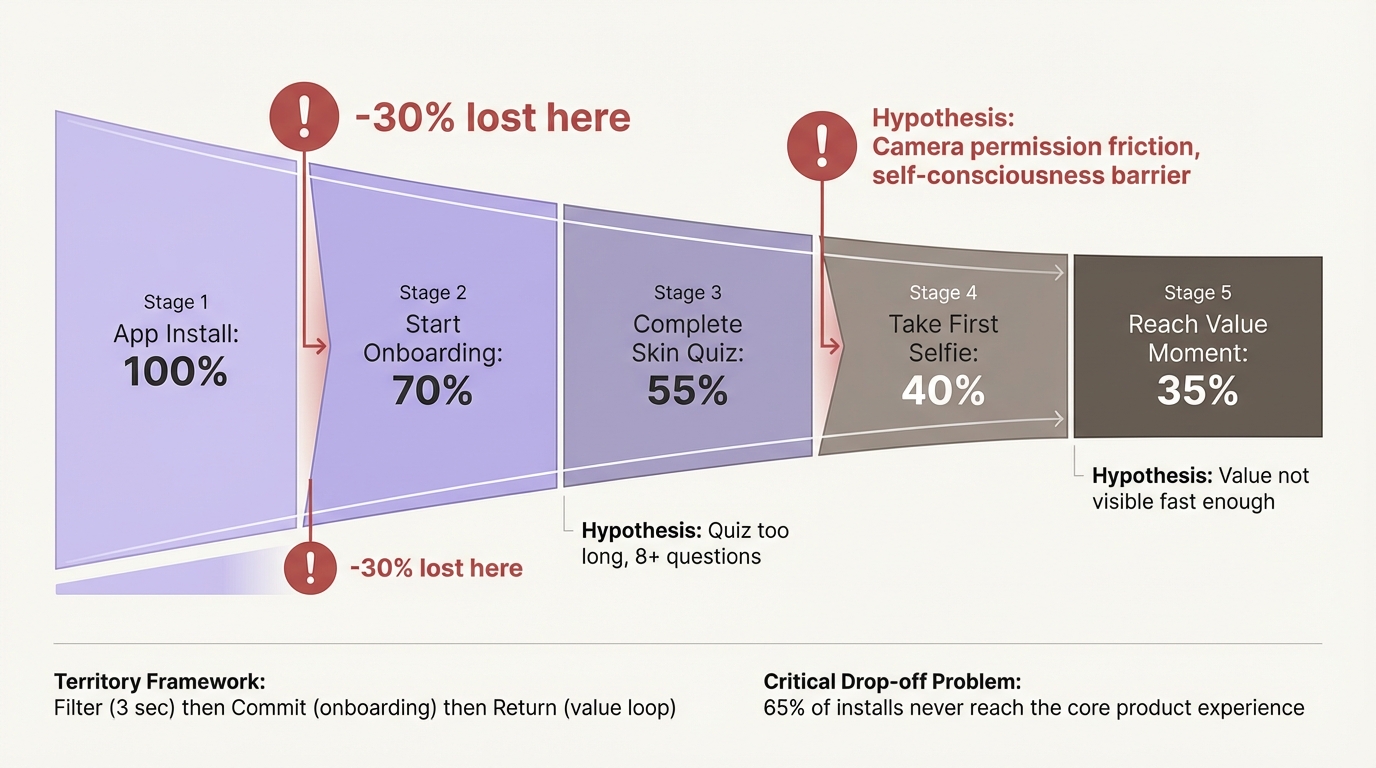
Onboarding drop-off funnel showing where and why 30% of users abandon before completing setup
The 30% Drop-Off: Diagnosis
Based on the funnel audit framework and behavioral patterns from social listening data, four hypotheses explain where and why users abandon onboarding:
Selfie Capture Friction
The onboarding flow asks for a baseline selfie before delivering any value. Megan-type users ("If this requires a lot of input from me, I'm out") and Priya-type users (anxious about committing their face to an app they don't trust yet) both have strong reasons to bail here. The selfie is a high-commitment ask before any value demonstration.
Quiz Length
If onboarding asks more than 5-6 questions before showing a recommendation, cognitive load exceeds the user's patience. Social listening confirms: women in this demo want "just tell me what to do" (Megan) or "walk me through everything" (Priya) -- not a form to fill out.
Account Creation Wall
Requiring email, password, or social sign-in before showing value violates the Territory Framework's Filter stage. Users need to pass a gut-check ("is this worth my effort right now?") before committing identity.
Value Not Visible Fast Enough
The app's first screen may explain features rather than demonstrate value. "Your biggest growth opportunity isn't getting more users, it's activating the ones you already have. A 10% improvement in activation often has more impact than a 50% improvement in signups."
Territory Framework: Filter, Commit, Return
Stage 1: FILTER (First 3 Seconds)
User's brain asks: "What is this? Is this for me?"
Current risk: If the first screen shows a generic beauty app layout, the user's brain files it as "another skincare app" and bounces. GlowGuide must immediately break this pattern.
Recommendations:
- First screen should state the outcome, not the product: "Finally know if your treatments are actually working" (VP2) or "Your personalized treatment plan in 5 minutes" (VP1)
- Show the category anchor immediately: "Like a Fitbit for your skin treatments" or "The beauty app your injector wishes existed"
- Use social proof on the first screen: "Joined by 500+ women tracking their aesthetic journey" (even small numbers with specificity beat no numbers)
- Keep Layer 1 (nav, layout, buttons) boringly conventional. Premium design signals quality. Innovation should be in the message, not the UI structure.
Stage 2: COMMIT (Onboarding Flow)
User's brain asks: "Is this worth my effort right now?"
Current risk: The onboarding flow asks for too many inputs before demonstrating value. Every question, every toggle, every photo request is a "should I keep going?" decision point.
Recommendations:
- Deliver first value within 3 minutes of opening the app ("Target 3-15 minutes" for immediate-value products)
- Make the selfie optional -- surface it as "capture your baseline now or later" instead of gating progress on it
- Use valid defaults: pre-select the most common treatment type (Botox), pre-populate likely concerns
- Show a personalized recommendation or treatment timeline BEFORE asking for account creation
- Split the commitment: ask 3 questions, show value, then ask 3 more. Never front-load 8 questions before any payoff.
Stage 3: RETURN (Post-Onboarding)
User's brain asks: "Will I come back?"
Current risk: After onboarding, there's no clear next action. Users see a dashboard with nothing in it. The empty state is a dead end.
Recommendations:
- End onboarding with a specific CTA tied to their treatment status: "Got a treatment coming up? Set a reminder" or "Just had Botox? Capture your baseline in 30 seconds"
- Show what their populated dashboard WILL look like (sample data, preview of a timeline with GEMs) -- "fill in your dashboards with sample data"
- Send the first lifecycle email (Flow 2, E1) immediately after install. The first follow-up email should arrive while the user still remembers downloading the app.
- Create a "peak" moment at the end of onboarding: "You're all set. We'll remind you when it's time for your next treatment" -- resolution, not more work.
The 3-Tap Test
Can a new user reach their first moment of value in 3 taps or fewer?
VP1 path: Open app > Answer 3 questions > See personalized recommendation (PASS: 3 taps)
VP2 path: Open app > Tap "Just had a treatment?" > Take photo (PASS: 3 taps if we surface this prompt)
Current path: Open app > Create account > Answer quiz > Upload selfie > See dashboard (FAIL: 5+ steps before value)
Zero-Education Onboarding Design
Principle: No Tours, No Explainers. Onboarding should be about achieving value, not learning features. "When most founders hear 'onboarding,' they think: Welcome emails, Product tours, Setup wizards, Feature walkthroughs. There's more to it than that."
For GlowGuide, this means:
- No "tap here to learn about GEMs" tooltips. Users don't care what a GEM is until they've created one.
- No feature walkthrough on first open. Show the app doing something useful instead.
- No terminology education. Don't teach "Aesthetic Intelligence" -- just show a recommendation. Don't explain "Glow Evidence Moments" -- just prompt "Take a quick photo to start tracking."
- Labels should be action verbs, not feature names: "Track a treatment" not "Treatment Log." "Compare your progress" not "GEM Dashboard."
VP1 vs VP2 Onboarding Paths
VP1 Path: "What's Right for Me?" (Priya + Megan)
These users downloaded because they want guidance. They may not have had a treatment yet.
Flow:
- "What's your top skin concern?" (single select, 4 options max)
- "Have you had aesthetic treatments before?" (Yes/No -- determines depth)
- "What's your comfort level?" (Conservative / Open to trying new things)
- VALUE: Show personalized recommendation with treatment name, expected timeline, cost range, "what to expect"
- Optional: "Want to save this plan? Create a free account"
- Bridge to VP2: "When you book your first treatment, we'll help you track how it goes"
Time to first value: ~2 minutes
Account creation: After value, not before
VP2 Path: "Is It Worth It?" (Claire + post-treatment Priya)
These users downloaded because they want to track results. They likely just had or are about to have a treatment.
Flow:
- "What treatment did you just have?" (pre-populated list: Botox, Filler, Laser, Other)
- "When was your appointment?" (date picker, defaulted to today)
- VALUE: Show personalized treatment timeline -- "Here's what to expect at Day 1, Day 7, Day 14, Day 30"
- "Want to capture your baseline? Snap a quick photo" (optional, not required)
- "We'll check in at Day 7 to see how you're feeling"
Time to first value: ~90 seconds
Photo capture: Optional prompt, not a gate
GEM Creation Friction Reduction
Current Friction Points (Estimated)
- User must navigate to the tracking section (requires knowing it exists)
- User must select the treatment type
- User must take a photo with specific framing
- User must add metadata (date, provider, units, cost)
- User must wait days/weeks to take a comparison photo
- User must return to the app and find the comparison feature
Target: Reduce GEM creation from 6 steps to 2
Step 1: Get push notification > Tap to open camera (before photo pre-loaded)
Step 2: Take photo > See instant comparison (GEM created)
Friction Reduction Recommendations
Make the first step invisible: After a treatment is logged, surface a "Take a quick photo" prompt with one tap. Pre-fill treatment type, date, and provider from the log. Use structured photo capture with on-screen guides (face outline, lighting indicator) but make them optional -- a quick selfie with no metadata is better than no photo at all.
Make the return automatic: At the treatment-appropriate interval (Day 7 for Botox, Day 14 for filler), send a push notification: "Time to check in. Quick photo?" One tap opens the camera with the comparison overlay already loaded. Show the before photo side-by-side with the live camera view so the user can see progress in real-time during capture.
Make the celebration immediate: The moment a comparison is captured, show the before/after with a "Your first Glow Evidence Moment" message. Make it shareable in one tap.
Milestone-Based Triggers (Not Time-Based)
Replace time-based lifecycle emails with milestone-based triggers. Users don't progress on a clock -- they progress on actions.
| Milestone | Trigger | Action |
|---|---|---|
| M1: First value seen | VP1: recommendation displayed / VP2: timeline shown | In-app: "Your plan is ready" confirmation |
| M2: Baseline captured | User takes first photo | Push: "Great start. We'll remind you to compare at Day 7" |
| M3: Treatment logged | User logs a treatment | Email: "Your treatment timeline is live. Here's what to watch for" |
| M4: First check-in | User opens app 3-7 days post-treatment | In-app: "How's your recovery going? Quick 2-question check-in" |
| M5: First GEM | User captures comparison photo or logs progress | Email: GEM Celebration (Lifecycle v1, Trigger T3) |
Why Milestone > Time-Based
A "Day 3" email makes no sense if the user hasn't logged a treatment yet. A "Day 7" email about checking results is meaningless if there are no results to check. Milestone triggers fire when the user is ready for the next step -- not when an arbitrary timer expires.
Exception: Stall recovery. If a user reaches M1 but not M2 within 48 hours, fire the stall recovery trigger. This is the one time-based trigger that's warranted.
D1 and D7 Retention Tactics
| D1 Retention (Target: 25%) | ||
|---|---|---|
| Tactic | Channel | Description |
| Immediate value delivery | In-app | Show recommendation (VP1) or timeline (VP2) before session ends |
| First-day nudge | Push (4h) | "Your personalized plan is ready -- see what we recommended" |
| Treatment reminder setup | In-app | "When's your next treatment? We'll remind you" (creates a reason to return) |
| Welcome email | Email (immediate) | Lifecycle v1 Flow 2 E1: warm welcome + single CTA to complete one action |
| D7 Retention (Target: 15%) | ||
|---|---|---|
| Tactic | Channel | Description |
| Check-in prompt | Push | "It's been a week. How are your results looking?" (VP2 users) |
| New recommendation | Push | "We found a treatment that matches your goals" (VP1 users) |
| Feature discovery email | Lifecycle v1 Flow 2 E3: show one feature they haven't used | |
| Content nudge | Push | Link to a relevant Substack post or treatment guide |
Stall Recovery Playbook
| Stall Point | Detection | Recovery Action | Channel |
|---|---|---|---|
| Installed, never onboarded | app_installed + 48h, no onboarding_completed |
"Finish setup in 2 minutes. Your plan is waiting." | Push + Email |
| Onboarded, no baseline | onboarding_completed + 72h, no baseline_photo_uploaded |
"You don't need a perfect photo. A quick selfie works." | Push |
| Baseline captured, no treatment logged | baseline_photo_uploaded + 7d, no treatment_logged |
"Treatment coming up? We'll help you track results." | |
| Treatment logged, no return | treatment_logged + 14d, no app_opened |
"Your [treatment] results should be settling in. Time to check in?" | Push + Email |
| Churned 30+ days | Last app_opened > 30d |
"Spring treatment season is here. Your tracking is waiting for you." | Email only |
Stall Recovery Principles
- One recovery attempt per stall point. Do not spam dormant users.
- Each message focuses on removing the specific friction at that stage, not re-pitching the whole app.
- Tone: helpful friend, not nagging app. "Just a reminder" not "You haven't logged in!"
- Max 2 push notifications per week across all triggers.
- If a user doesn't respond to recovery within 7 days, move to a 30-day quiet period. Respect the "no."
Lifecycle v1 Integration
| This Playbook | Lifecycle v1 |
|---|---|
| Reduces onboarding drop-off (from 30% to <15%) | Flow 2 catches users who installed but haven't activated |
| Creates VP-specific onboarding paths | Flow 2 emails can be segmented by VP cohort |
| Establishes milestone triggers | Support Triggers T1-T3 fire on milestone events |
| Reduces GEM friction | Trigger T3 (GEM Celebration) fires more often |
Key Dependency
Lifecycle v1's identity stitching (web signup > app install) must work reliably. If the email from Flow 1 prompts a download, and the app fires app_installed with the user's email, Customer.io merges the profiles. Without this, the entire lifecycle sequence breaks.
Onboarding Metrics to Track
| Metric | Current (est.) | Day 30 Target | Day 90 Target |
|---|---|---|---|
| Onboarding completion rate | ~70% | 85% | 90% |
| Time to first value | Unknown | <3 minutes | <2 minutes |
| D1 retention | ~10-15% | 25% | 30% |
| D7 retention | ~3-5% | 15% | 20% |
| GEM contribution rate | Near 0% | 5% | 10-15% |
| Stall recovery success rate | N/A | 15% | 25% |
| VP1-to-VP2 bridge rate | Unknown | Establish baseline | 20%+ |
A/B Tests to Run
| Test | Variants | Success Metric | Timeline |
|---|---|---|---|
| Welcome screen framing | VP1 ("Find what's right") vs VP2 ("Start tracking") | Onboarding completion rate | Days 7-21 |
| Selfie requirement | Required vs Optional vs Skip | Onboarding completion + D7 retention | Days 7-21 |
| Value-first onboarding | Show recommendation before account creation vs after | Onboarding completion + D1 retention | Days 14-28 |
| Empty state design | Blank dashboard vs Sample data preview | D1 retention | Days 14-28 |
30/60/90 Day Execution Plan
70 action items across 7 workstreams with owners, timelines, checkpoints, and go/no-go decisions
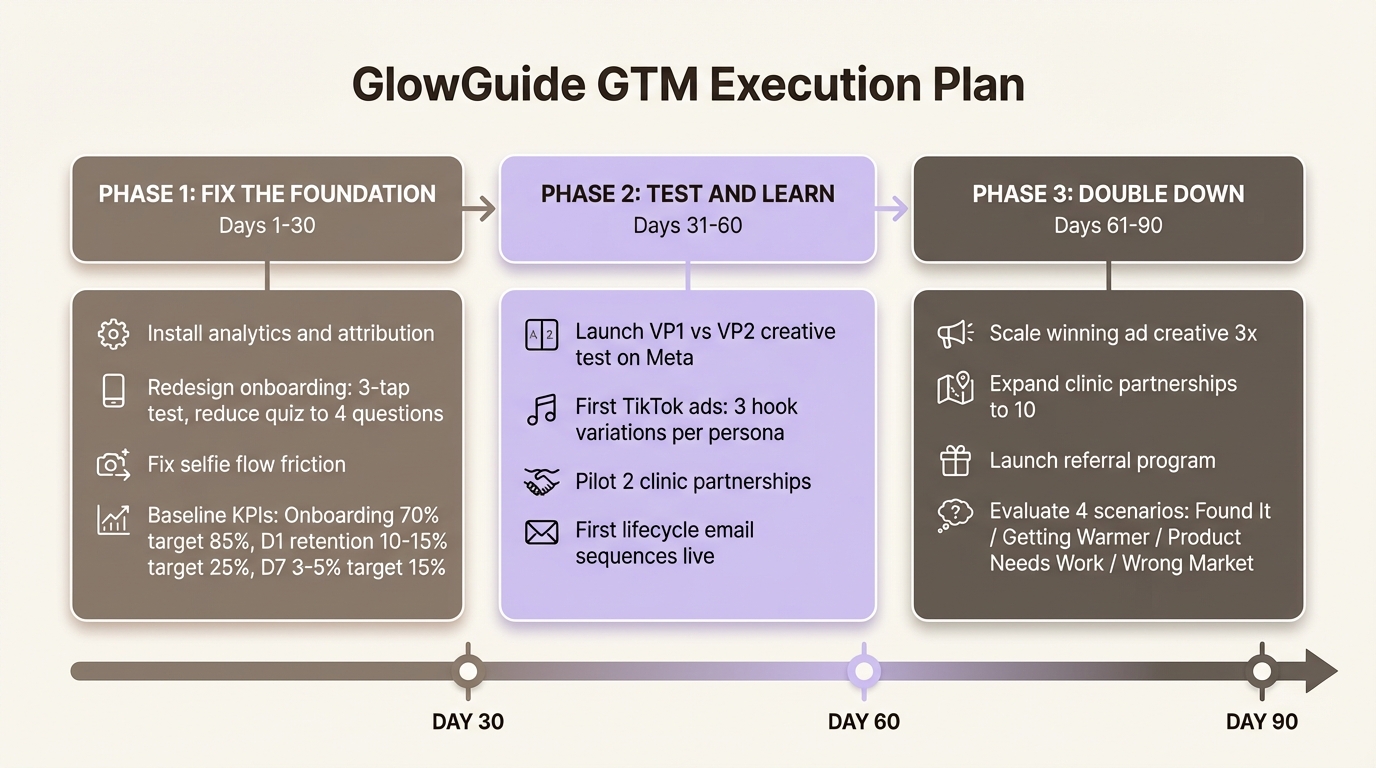
Three-phase execution roadmap: Fix the Foundation (Days 1-30), Test & Learn (Days 31-60), Double Down (Days 61-90)
Phase 1: Days 1-30 -- "Fix the Foundation"
Theme
Stop the leaky bucket before pouring more water in. Fix onboarding, establish baseline metrics, set up lifecycle infrastructure, and prepare creative assets. No scaling spend until the funnel works.
1.1 Audit & Instrumentation (Days 1-7)
Goal: Understand exactly where and why users drop off. Establish measurement infrastructure.
Full funnel audit
Map every step from ad impression > install > onboarding start > onboarding complete > first action > first GEM. Identify exact drop-off percentages at each step using Amplitude data.
Cohort analysis of January users
Segment the 400-500 users by: acquisition source (paid VP1 vs VP2 vs organic), onboarding completion status, first action taken, treatment status (active vs between treatments), geographic location. Find patterns in who engaged vs. who bounced.
Define GEM tracking events
Ensure Amplitude is tracking every step toward a GEM: baseline photo captured, treatment logged, check-in started, check-in completed, before/after comparison viewed. If any events are missing, work with engineering to add.
Establish baseline KPIs
Document current state for all metrics we'll track going forward: onboarding completion rate, D1/D7 retention, product/treatment/photo actions, GEM contribution, re-engagement rate, CPI, cost per completed onboarding.
1.2 Onboarding Optimization (Days 3-14)
Goal: Reduce 30% onboarding drop-off to <15%. Every user who doesn't complete onboarding is invisible to us.
Onboarding drop-off analysis
Identify exactly which screen(s) in onboarding have the highest abandonment. Is it the selfie capture? The quiz length? Account creation friction? Use Amplitude session replays if available.
Launch incomplete onboarding email sequence
Set up in Customer.io: Email 1 at 1 hour ("You're almost there -- finish your profile in 2 minutes"), Email 2 at 24 hours ("Your personalized plan is waiting"), Email 3 at 72 hours (re-pitch value prop that drove their install).
Onboarding push notifications
For users who have notifications enabled, send a push at 4 hours and 24 hours post-install if onboarding is incomplete. Warm, helpful tone -- not nagging.
Recommend onboarding simplification to product team
Based on drop-off analysis, recommend specific changes: reduce steps, make selfie optional, show value (first recommendation) faster. Goal: deliver first personalized recommendation within 3 minutes of opening app.
A/B test onboarding welcome screen
Test VP1-framed onboarding ("Let's find what's right for you") vs VP2-framed ("Start tracking your results"). See which framing leads to higher completion AND downstream engagement.
1.3 Lifecycle & Re-engagement Infrastructure (Days 5-21)
Goal: Break the zero re-engagement rate. Build the email/push system that brings users back at the right moments.
Map lifecycle email journey
Design the full post-onboarding email sequence by user state. Not one-size-fits-all -- different paths for users who completed onboarding but took no action, users who added a product but didn't track, users who logged a treatment but didn't do a check-in.
Build "Feature Discovery" email series
Many users may not know what the app does. 4-email series over 14 days post-onboarding: (1) "Here's your personalized plan" (VP1), (2) "How to track your first treatment" (VP2), (3) "Set a reminder so you never forget to rebook" (utility), (4) "See how GlowGuide works for [persona-relevant use case]".
"Treatment coming up?" re-engagement trigger
If user logged a treatment type during onboarding that has a known rebooking cycle (Botox = 3-4 months, filler = 6-12 months), calculate approximate next treatment date and send a re-engagement email/push 1 week before: "Your next [treatment] might be coming up -- open GlowGuide to track it."
Win-back campaign for January churned users
The 400-500 January users who never came back. Test two win-back emails: (a) VP1 angle: "We've improved your recommendations -- come see what's new," (b) VP2 angle: "Have a treatment coming up? Capture your baseline now." Measure which brings more users back and which VP those returning users engage with.
Push notification strategy
Define cadence rules: max 2 pushes per week, never at night, only when triggered by a meaningful event (treatment reminder, check-in due, new recommendation). No "we miss you" pushes -- only useful, timely nudges.
1.4 Paid Media -- Restructure & Learn (Days 1-30)
Goal: Restructure campaigns for clean VP1 vs VP2 testing with hyperlocal targeting. Generate learnings, not volume.
Audit January campaigns
Review all January creative, targeting, and results. Which ads drove installs? Which drove onboarding completions? Any signal on which VP or creative type led to users who actually engaged beyond onboarding?
Restructure Meta campaigns
Clean VP1 vs VP2 split: separate campaigns, separate ad sets, separate creative. Each VP gets its own budget. Within each VP, test 2-3 creative concepts. Hyperlocal targeting: Bay Area, LA/Orange County, San Diego.
Creative production: Round 1
Cut 4-6 creative assets from existing Frame.io footage (in-clinic treatment videos with photo consent). 2-3 for VP1 (decision-making angle), 2-3 for VP2 (tracking/results angle). Formats: 9:16 Reels, 1:1 feed. Use brand voice -- warm, evidence-based, not clinical.
Whitelisting test: Tara's personal account
Run 1-2 ads from Tara's personal Instagram/Facebook account (founder-led creative). Test: (a) Tara talking to camera about why she built GlowGuide, (b) Tara showing the app / demonstrating tracking. Founder content typically outperforms brand accounts in wellness.
Google Ads pilot
~20% of budget. Test VP1 keywords ("best treatment for [concern]", "what aesthetic treatment should I get") vs VP2 keywords ("track aesthetic treatment results", "is Botox worth it"). Expect lower volume but potentially higher intent.
Weekly performance reporting
Establish weekly report cadence: spend, CPI, installs, onboarding completions, cost per completed onboarding, D1/D7 retention by cohort. Share every Monday in Slack.
1.5 In-Clinic B2B2C Setup (Days 1-30)
Goal: Prepare the in-clinic acquisition channel. This is the highest-potential channel because it acquires users at the moment of treatment (solves timing mismatch).
Finalize in-clinic materials
Review and refine QR code table tents, take-home cards, and staff scripts. Test both versions: Version A ("GlowGuide helps you track and get the most out of this plan") vs Version B ("GlowGuide helps us follow and extend your plan based on your results").
Staff training one-pager
Create a simple script for front desk / aestheticians at partner medspas. When to mention GlowGuide, what to say, how to handle questions. 30 seconds max -- they're busy.
Feb 23 activation day plan
Detailed plan for Illuminate Skin (San Jose) in-clinic day. Influencer appointment + new user acquisition. Who's there, what materials, how we track attribution (unique QR code / UTM), what data we capture, follow-up plan for users acquired that day.
In-clinic tracking setup
Create unique UTM-tagged links or separate QR codes per location so we can attribute in-clinic installs in AppsFlyer/Amplitude. Even if SKAN limits user-level data, we can see aggregate installs from each clinic QR code.
Deploy materials to 4 partner locations
Deliver materials to existing partner medspas in Bay Area, LA, San Diego. Confirm placement (front desk, treatment rooms, checkout area).
1.6 Organic Social & Founder Content (Days 1-30)
Goal: Establish consistent social presence. Begin building the email list via Substack. Create content bank for paid creative testing.
Instagram audit & content calendar
Audit current Instagram feed. Define posting cadence (3-4x/week minimum). Create 30-day content calendar mixing: treatment education (VP1), tracking stories (VP2), founder voice (Tara), user tips, and behind-the-scenes.
First 12 Instagram posts
Produce and schedule first two weeks of content. Use Frame.io footage, app screenshots, treatment education carousels, and quote graphics. Every post should subtly reinforce either VP1 or VP2.
Tara Substack post #3
Publish third "Pretty Smart" Substack post. Topic suggestion: the "timing problem" in aesthetics (why you forget to rebook, why progress is invisible, why GlowGuide exists). Include CTA to download app.
Tara LinkedIn post cadence
Begin posting 1-2x/week on LinkedIn. Founder thought leadership: building in beauty tech, evidence-based beauty, the data gap in aesthetics. Target: professional women ICP who are on LinkedIn.
TikTok exploration
Film 3-4 short TikTok-style videos using in-clinic footage. Treatment education, "things I wish I knew before my first [treatment]", "how I track my treatments." Test organic reach before investing in paid TikTok.
Day 30 Checkpoint
Questions to answer:
- What is the actual onboarding completion rate now vs. baseline? Did our changes help?
- What does the re-engagement rate look like with the new lifecycle emails?
- Which VP (1 or 2) is driving more installs AND more downstream engagement? Are they different?
- Do we have ANY GEMs from January or February users? If so, what do those users have in common?
- What is the cost per completed onboarding by channel/VP?
- Are in-clinic materials deployed and generating any installs?
Go/No-Go Decisions:
- If onboarding completion is improving --> continue optimizing, prepare to increase spend in Phase 2
- If onboarding completion is NOT improving --> escalate to product team, do NOT increase spend
- If one VP is clearly outperforming --> shift creative weight toward winning VP
- If in-clinic installs are happening --> plan more activation days in Phase 2
Phase 2: Days 31-60 -- "Test & Learn"
Theme
Now that the funnel basics work, run structured experiments. Test VP1 vs VP2 at scale. Execute the Feb 23 in-clinic activation. Launch email lead magnet. Begin answering the critical question: is low engagement a GTM problem or a product problem?
2.1 The Critical Diagnostic (Days 31-45)
Goal: Answer the single most important question -- are we acquiring the wrong users, or is the product not delivering enough value?
In-clinic vs Paid Social cohort comparison
Compare the two cohorts on: onboarding completion, first action, D7 retention, GEM contribution. If in-clinic users engage significantly more --> it's a GTM/targeting problem (paid is bringing wrong users). If neither cohort engages --> it's likely a product problem.
VP1 vs VP2 cohort comparison
Compare users acquired via VP1 creative vs VP2 creative on the same downstream metrics. Which value prop attracts users who actually do things in the app? This tells us which messaging to double down on.
Qualitative user interviews (5-8 users)
Recruit from recent installs. Talk to: (a) 2-3 users who completed onboarding but didn't engage further (why?), (b) 2-3 users who are actively using the app (what's working?), (c) 1-2 users who started tracking (what motivated them?). Record with consent.
Product feedback synthesis
Combine quantitative cohort data with qualitative interview insights. Present a clear recommendation: here's what we think is happening and here's what should change (product, messaging, or both).
2.2 In-Clinic Activation (Days 31-50)
Goal: Execute Feb 23 activation day. Plan and execute 2-3 more activation days at other partner locations. Prove the in-clinic flywheel.
Execute Feb 23 Illuminate Skin activation
Full activation day: influencer appointment, QR codes, staff engagement, content capture. Track every install from that day. Follow up with every user acquired within 48 hours via email.
Feb 23 post-mortem
How many installs? How many completed onboarding? Any GEMs? What worked about staff engagement? What didn't? What would we change? Influencer content quality assessment.
Schedule 2-3 more activation days
Based on Feb 23 learnings, plan activation days at LA and San Diego partner locations. Refine the playbook: what materials, what staff training, what follow-up sequence.
In-clinic user follow-up sequence
Special Customer.io segment for users acquired in-clinic. Different from paid social users because they just had a treatment and have something to track RIGHT NOW. Email 1 (same day): "You just had [treatment] -- here's how to capture your baseline." Email 2 (Day 3): "Your recovery timeline and what to look for." Email 3 (Day 7): "Time for your first check-in." Email 4 (Day 30): "Compare your before/after -- your first GEM."
2.3 Paid Media -- Optimize & Expand (Days 31-60)
Goal: Double down on winning creative/VP/audience combinations. Kill what's not working. Begin testing new formats.
Creative refresh: Round 2
Based on Month 1 learnings, produce 4-6 new creatives. Test: (a) UGC-style "day in my treatment" content, (b) Problem-agitation hooks, (c) App demo walkthroughs, (d) Founder story (Tara to camera). Kill any Month 1 creatives with CTR below benchmark.
Audience expansion testing
Beyond core targeting, test: (a) Lookalike audiences based on onboarding completers (via Customer.io > Meta), (b) Interest-based: Sephora, medical aesthetics, skincare routine, (c) Behavioral: health app users, beauty app users. Small budgets to find new pockets.
Retargeting campaigns
Set up retargeting for: (a) Users who visited glowguide.com but didn't download, (b) Users who installed but didn't complete onboarding (if possible via SKAN limitations), (c) Instagram/TikTok engagers who haven't installed.
Influencer content integration
If Feb 23 influencer content is compelling, use it as paid creative (with permission). Whitelisting from influencer account. Also test as organic post on GlowGuide channels.
Budget reallocation based on learnings
If one VP is clearly winning, shift budget 70/30 (from 50/50). If one geo is outperforming, increase spend there. If Google is underperforming vs Meta, reallocate.
2.4 Email Lead Magnet Launch (Days 35-55)
Goal: Begin capturing emails from people who aren't ready to download but are in the GlowGuide target market. Solves the timing mismatch by maintaining the relationship until they have a treatment to track.
Design lead magnet content
Create a high-value downloadable: "The Smart Woman's Guide to [Treatment Category]" (e.g., injectables, lasers, or skincare). Evidence-based, beautifully designed, GlowGuide-branded. 8-10 pages. Include a soft CTA to download the app.
Build landing page
Simple landing page on glowguide.com for the lead magnet. Email capture form. Clean, on-brand. Mobile-optimized (most traffic will be mobile).
Meta lead gen campaign
Run lead gen ads targeting the same audiences as app install campaigns. Lower commitment ask (email vs download). Test: does this attract a broader audience that eventually converts to downloads?
Email nurture sequence for leads
6-email sequence over 30 days. (1) Deliver the guide, (2) "What questions do you have?" invite reply, (3) Treatment education content, (4) "Tara's story" founder angle, (5) "Tracking your first treatment" VP2 angle + app CTA, (6) "Your personalized plan is waiting" VP1 angle + app CTA.
2.5 Organic Social -- Scale & Systematize (Days 31-60)
Goal: Increase posting frequency, begin building UGC pipeline, systematize content production.
Increase IG cadence to 5-6x/week
Add Reels (2-3x/week) alongside feed posts. Reels from in-clinic footage, app demos, treatment education. Instagram algorithm favors Reels -- this is the growth lever.
UGC content collection
Reach out to 5-10 engaged users (if any) and ask if they'd create short testimonial videos or treatment tracking stories. Offer free premium features (when available) or gift cards. Even 2-3 pieces of authentic UGC is gold.
Tara Substack post #4
Continue biweekly cadence. Topic: a deep-dive on a specific treatment with personal experience (follows "The Appeal of the Peel" format). Build the "Pretty Smart" brand.
Cross-promote Substack <> Instagram <> App
Each Substack post gets teased on IG Stories. Each IG Reel gets mentioned in Substack. Both drive to app. Create a connected ecosystem, not isolated channels.
Day 60 Checkpoint -- The Critical Decision Point
The Diagnostic Question (must answer): Is the low engagement a GTM problem (we're acquiring the wrong users with the wrong expectations) or a product problem (the experience doesn't deliver enough value fast enough)?
| Signal | Interpretation |
|---|---|
| In-clinic users engage significantly more than paid social users | GTM problem -- paid ads are bringing wrong people. Fix targeting/messaging. |
| In-clinic users also don't engage | Product problem -- even highest-intent users aren't finding value. Escalate to product. |
| VP2 users engage more than VP1 users | Tracking resonates more than recommendations. Shift messaging. |
| VP1 users engage more than VP2 users | Recommendations drive engagement. Consider making VP1 the primary pitch. |
| Users who received lifecycle emails retain better | Lifecycle working -- invest more in email/push. |
| No difference between any cohorts | Deeper product investigation needed. Possibly too early/too few users for signal. |
Go/No-Go Decisions for Phase 3
- Increase paid spend? Only if cost per GEM-contributing user is trending in a fundable direction
- Scale in-clinic? If in-clinic cohort outperforms paid, aggressively expand clinic partnerships
- Product escalation? If product problem identified, pause paid growth and redirect budget to product improvements
- Email lead magnet working? If lead-to-download conversion is promising, scale lead gen budget
Phase 3: Days 61-90 -- "Double Down"
Theme
We should now know what works. Phase 3 is about doubling down on the winning motions, cutting what doesn't work, and building toward the investor narrative of "1-2 repeatable, measurable GTM motions that produce GEM-contributing users."
3.1 Scale Winning Acquisition Channel (Days 61-75)
Scale the winner
Whichever channel/VP/audience combination produced the best cost-per-GEM, increase budget by 50-100%. If in-clinic is winning, add 3-5 new partner locations. If paid VP2 is winning, increase VP2 budget with proven creative.
Kill the losers
Any channel, VP, audience, or creative that isn't contributing to GEMs after 60 days of data gets cut. Reallocate budget to winners. No sentimentality.
Creative production: Round 3
Iterate on winning creative concepts. If founder-led content won, produce more Tara content. If UGC won, recruit more creators. If treatment education won, build a content series. 6-8 new creatives this round.
Expand geographic targeting (if warranted)
If hyperlocal is working, expand to: Scottsdale/Phoenix, Dallas, Miami -- top medspa-density metros. Only if CPI and downstream metrics hold.
3.2 Provider Partnership Expansion (Days 61-90)
Goal: If in-clinic acquisition is working, this is the highest-leverage activity. Build the flywheel.
Develop provider pitch deck
Using data from Phase 1-2 activation days: "X users downloaded GlowGuide at [clinic name]. Y% came back for their next appointment on time. Z% tracked their treatment. Here's what this means for your retention." Even small numbers tell a powerful story.
Approach 5-10 new medspas
Target Bay Area, LA, San Diego, plus 1-2 new metros if data supports it. Use the pitch deck. Offer free partnership (no cost to provider). Ask for: QR code placement, staff script, one activation day.
Develop provider retention dashboard (v0)
Even a simple Looker Studio report showing "patients from your clinic who use GlowGuide" metrics. Rebook rates, tracking engagement, satisfaction scores. This becomes the proof for sponsored listings later.
Monthly provider update email
Send partner medspas a monthly summary: how many of their patients use GlowGuide, engagement metrics, testimonials. Keep them engaged and invested in the partnership.
3.3 Lifecycle Optimization (Days 61-90)
Goal: Refine the lifecycle system based on 60 days of data. Build the automated journey that turns installs into GEM contributors.
Lifecycle performance review
Which emails have the highest open rates? Which drive the most app opens? Which trigger the most GEM-related actions? Optimize: rewrite low performers, A/B test subject lines, adjust send times.
Build "GEM celebration" email
When a user completes their first GEM (tracks progress post-treatment), send a celebration email: "You just created your first Glow Evidence Moment!" Include their before/after comparison, encourage sharing, and prompt to invite a friend. This is the viral moment.
Seasonal re-engagement campaign
Spring treatment season (March-May). Email + push to churned users: "Spring is the perfect time to start a new treatment. Track your results from day one." Timely, relevant, not spammy.
SMS pilot (if appetite exists)
Test SMS for treatment reminders and check-in nudges. SMS has 98% open rates vs 20-30% for email. Start with a small opt-in segment. Only useful, timely messages.
3.4 Content & Community (Days 61-90)
Substack > email list growth assessment
How many email subscribers from Substack? What's the open rate? Are any converting to app downloads? If promising, increase Substack cadence to weekly and invest in cross-promotion.
Blog/Magazine SEO foundation
Identify top 10 keywords GlowGuide should own long-term ("is Botox worth it", "how long does filler last", "treatment tracking app"). Publish 2-3 SEO-optimized articles on GlowGuide Magazine. Not expecting traffic yet -- planting seeds for Month 4+.
Influencer/creator micro-program
If Feb 23 influencer content worked, recruit 3-5 micro-influencers (5K-50K followers) in the aesthetic/skincare space. Not paid sponsorship -- offer free premium features and early access in exchange for authentic tracking journey content.
Community signal assessment
Are users sharing GEMs? Are there any organic mentions of GlowGuide on social? Is anyone asking about the app in Reddit skincare communities? If yes, nurture. If no, understand why not (product value not strong enough? sharing not easy enough?).
3.5 Phase 3 Final Deliverables
90-day marketing performance report
Full analysis: what we tested, what we learned, what's working, what's not. Include all KPIs, cohort analyses, creative performance, channel comparison, lifecycle metrics.
GTM playbook v1
Document the 1-2 repeatable acquisition motions with unit economics. "Here's how we get a GEM-contributing user, here's what it costs, here's why we believe it scales."
Investor data package
Prepare the metrics for investor conversations. GEM contribution rates, retention curves, GTM unit economics, market opportunity context. Not a pitch deck -- a data appendix.
Day 90 Checkpoint -- The Investor Readiness Assessment
The question: Do we have the data to support the investment thesis?
| Dimension | Target for "Fundable" |
|---|---|
| Total engaged users (completed onboarding + at least one action) | 500-1,000 |
| GEM contribution rate (% of onboarders who create a GEM) | 10-15% |
| D30 retention | 15-20% |
| Cost per GEM-contributing user | <$50 |
| At least one repeatable GTM motion identified | Yes |
| In-clinic flywheel showing early signs | Yes |
| Brand awareness signals (social following, Substack, organic mentions) | Trending up |
| Clear diagnosis: GTM vs product problem | Answered |
Weekly Meeting Cadence
| Meeting | Frequency | Attendees | Purpose |
|---|---|---|---|
| MH-1 Internal Standup | 2x/week (Mon, Thu) | Elise, Chris Ahn, Chris Johnson | Tactical: what's running, what needs attention, blockers |
| MH-1 <> GlowGuide Sync | Weekly (Wed) | Elise, Tara, Wes | Strategic: results, learnings, decisions, product feedback |
| Performance Review | Weekly (Mon) | Chris Ahn | Data: send weekly KPI report to full team via Slack |
| Monthly Deep Dive | Monthly | Full team | Strategic: cohort analyses, diagnostic progress, budget decisions |
Creative Testing Framework
Always be testing
At any given time, we should have at least 3-4 active creative concepts per VP. Kill losers weekly, replace with new concepts.
Format priority: Reels/9:16 video > carousel > static image. Video outperforms 2-3x in beauty/wellness.
| Concept Type | VP1 Example | VP2 Example |
|---|---|---|
| Pain spotlight | "You've tried everything. But do you know what actually worked?" | "You spent $1,200 on that laser. Can you prove it worked?" |
| Social proof / aspirational | "Join women who stopped guessing" | "Finally have the receipts when friends ask 'what did you do?'" |
| Founder story | Tara: "I built this because I was tired of guessing" | Tara: "I spent $2K and couldn't tell you what worked" |
| App demo | Screen recording: onboarding > first recommendation in 3 min | Screen recording: snap photo > compare > see progress |
| UGC / testimonial | "GlowGuide told me to skip the treatment I was about to book" | "I can actually see the difference now" |
| Treatment education | "3 things to know before your first filler" (VP1 CTA) | "How to know if your Botox is working" (VP2 CTA) |
Key Risks & Mitigations
| Risk | Likelihood | Impact | Mitigation |
|---|---|---|---|
| Onboarding doesn't improve despite changes | Medium | Critical | Escalate to product team by Day 14. Consider radical simplification (skip selfie, 3-tap onboarding). |
| In-clinic acquisition doesn't produce engaged users either | Low-Medium | Critical | This would confirm a product problem. Pause paid growth. Redirect all resources to product iteration. |
| Tara can't maintain content cadence | Medium | Moderate | Pre-batch content. Ghostwrite drafts. Record 5-6 videos in one session, distribute over weeks. |
| SKAN attribution limitations prevent clean cohort analysis | High | Moderate | Use proxy metrics: unique QR codes per clinic, UTM parameters, Customer.io event matching, self-reported "how did you hear about us?" in onboarding. |
| Budget runs out before we have signal | Low | High | Strict weekly budget monitoring. Kill underperformers fast. Focus spend on highest-signal experiments. |
| Provider partners lose interest | Medium | Moderate | Monthly update emails. Show them data. Invite to activation days. Make them feel like partners, not distribution channels. |
Measurement & Success Framework
North star metric, per-stage KPIs, risk matrix, and four success scenarios for Day 90
Per-Stage KPI Thresholds
In-Clinic Channel KPIs
Lifecycle KPIs
Diagnostic Framework: GTM Problem or Product Problem?
This is the single most important analytical question. Run this diagnostic at Day 40 (in-clinic vs. paid cohort comparison) and Day 60 (full diagnostic with VP, persona, and lifecycle dimensions).
| Signal | Diagnosis | Action |
|---|---|---|
| In-clinic users have 3-5x higher GEM rates than paid social | GTM problem: paid ads bring wrong people or set wrong expectations | Fix targeting, creative, VP messaging. Scale in-clinic. |
| In-clinic users AND paid social users both have near-zero GEMs | Product problem: even highest-intent users don't find value | Pause paid. Redirect all resources to product (reduce GEM friction, improve TTFV). |
| VP2 cohort has higher GEMs than VP1 cohort (at 90 days) | Sequential funnel working: VP2 captures high-intent users directly | Maintain both. Optimize VP1>VP2 bridge. Measure VP1 users again at 6 months. |
| VP1-bridged users create GEMs at rates comparable to native VP2 | Full funnel validated: VP1 successfully feeds VP2 | Scale VP1 acquisition (larger addressable audience). Invest in bridge optimization. |
| Lifecycle email recipients retain better than non-recipients | Lifecycle working: invest more in email/push | Scale lifecycle: add treatment-specific nurture, seasonal campaigns, SMS pilot. |
| Users who received lifecycle emails also don't retain | Deeper product issue: lifecycle can't compensate for missing product value | Investigate: is the value gap in tracking, recommendations, or timing? |
Risk Matrix
| # | Risk | Likelihood | Impact | Early Warning Indicator | Mitigation |
|---|---|---|---|---|---|
| 1 | Product delivers insufficient value for GEMs -- even high-intent in-clinic users don't track after Day 14 | Medium | Critical | In-clinic GEM rate <10% at Day 40. Qualitative interviews reveal "I forgot" or "didn't seem worth it." | Reduce GEM to 2 steps (tap notification, take photo). Show instant before/after comparison as reward. If still failing, consider: is the value in recommendations (VP1) rather than tracking (VP2)? Possibly shift product emphasis entirely. |
| 2 | Timing mismatch persists despite VP1 bridge -- paid social users download, get a recommendation, and never return | High | High | VP1-to-VP2 bridge rate <5% after 60 days. Email nurture open rates decline over sequence. | Strengthen VP1 standalone value: make the recommendation engine worth returning to even without a treatment. Consider: is VP1 the product, not just the bridge? |
| 3 | In-clinic channel doesn't scale -- 4 partner medspas produce good results but expanding proves operationally difficult | Medium | High | Activation day results vary 3x+ across locations. Staff compliance drops after Week 1. New medspa outreach yields <20% interest rate. | Standardize the activation playbook. Create provider retention dashboard showing patient engagement data. Build the provider pitch on THEIR benefit: "patients who use GlowGuide rebook on time more often." |
| 4 | Allergan (Alle) adds treatment tracking -- with 6M members and 19K provider relationships, could add tracking within 12-18 months | Low-Medium | Very High | Allergan press releases mentioning "treatment tracking" or "patient outcomes." Alle app updates adding photo features or treatment timelines. | Move fast on category definition. Own "aesthetic treatment tracking" in consumer and press consciousness. Build data switching costs. Lock in provider partnerships. Cross-provider tracking is GlowGuide's structural advantage -- Alle will always be Allergan-biased. |
| 5 | Budget exhausted before signal -- spend runs for 3 months without conclusive data on GEM contribution | Low | High | Cost per GEM-contributing user >$100 at Day 60. Sample sizes too small for cohort-level conclusions. | Strict weekly budget monitoring. Kill underperformers fast. Focus 65% of budget on the two highest-signal experiments. Accept that 90-day learnings are worth the investment even if GEM rates are modest -- the data itself is fundable if the trend is right. |
Day 90 Success Scenarios
Scenario A: "We Found It" (Best Case)
- One VP clearly wins on downstream engagement
- In-clinic users have 3-5x higher GEM rates than paid social
- We have a repeatable in-clinic playbook and 8-10 partner locations
- GEM contribution rate is 10-15% and improving
- Tara has compelling data for investor conversations
Next step: Raise on data. Scale in-clinic aggressively. Launch subscription tier.
Scenario B: "Getting Warmer" (Good Case)
- One VP is trending better but not conclusive
- In-clinic shows promise but sample size is small
- GEM contribution rate is 5-10%
- Lifecycle emails are clearly helping retention
Next step: Continue for another 60 days. Increase in-clinic investment. Begin subscription tier design.
Scenario C: "Product Needs Work" (Tough Case)
- Neither in-clinic nor paid social users are contributing GEMs at meaningful rates
- Users complete onboarding but don't track
- Qualitative interviews reveal product friction or value gap
Next step: Pause paid growth. Redirect all budget to product improvements. Focus on: reducing friction to first GEM, improving TTFV for VP2, possibly pivoting product emphasis toward VP1 (recommendations) as the primary hook.
Scenario D: "Wrong Market" (Worst Case)
- Even high-intent users (in-clinic, with something to track) don't engage
- Qualitative interviews reveal users don't want to track (too much effort, don't care enough)
- The problem exists but the solution isn't valued
Next step: Fundamental product/market reassessment. Explore: is the value in provider-facing analytics instead of consumer tracking? Is the value in the recommendation engine (VP1) rather than tracking (VP2)? Consider pivoting GTM entirely.
Cohort Analysis Framework
Every user is tagged at acquisition with three dimensions. All downstream metrics are analyzed at the cohort level, not as averages ("Think in cohorts, not averages").
| Dimension | Values | Why It Matters |
|---|---|---|
| Acquisition source | Paid Meta VP1, Paid Meta VP2, Paid TikTok VP1, Paid TikTok VP2, Google VP1, Google VP2, In-Clinic (by location), Organic, Referral, Substack/Email | Answers: which channel produces GEM-contributing users? |
| VP entry | VP1 (recommendation path), VP2 (tracking path), Provider referral (no VP) | Answers: which value prop attracts users who actually engage? |
| Persona proxy | Claire (multi-treatment, multi-provider signals), Priya (first-timer signals, VP1 entry), Megan (in-clinic acquisition, single-treatment) | Answers: which persona converts to GEMs at the highest rate? |
Attribution Stack
| Tool | Role | Limitation |
|---|---|---|
| AppsFlyer SKAN | Aggregated install attribution | 24-48h lag, no user-level data, limited conversion values |
| Amplitude | In-app behavior, cohort analysis, GEM tracking, session replays | Requires proper event instrumentation |
| Customer.io | Lifecycle email attribution, segment tracking, identity stitching | Depends on web-to-app identity merge working |
| UTM parameters | Web-to-app flow, clinic QR codes, campaign tagging | Manual, requires discipline |
| BigQuery + Looker Studio | Cross-channel reporting, cohort comparisons, weekly dashboard | Aggregation layer, not real-time |
SKAN Workarounds
Apple's SKAN framework limits user-level attribution. Five practical workarounds:
Unique QR codes per clinic
Aggregate installs from each clinic QR code measured directly, no SKAN needed.
UTM parameters on all links
Customer.io captures UTM data at signup, persists through install.
Self-reported "How did you hear about us?"
Simple dropdown in onboarding, low-friction.
Customer.io identity stitching
Web signup email matched to app install email. Flow 1 effectiveness is directly measurable.
Cohort-level inference
If VP2 Meta campaign drives 100 installs and 15 create GEMs, that cohort's GEM rate is 15% -- no user-level attribution needed.